

As the climate changes the health burden from extreme heat will increase, with heat stroke and other diseases becoming more common. Air conditioning (AC) is rarely thought of as a health intervention. However, it is becoming clear that it has important protective health effects. At the same time, it is a direct cause of urban heat islands, creating a dichotomy where the technology improves the health of the rich and worsens the health of the poor. There is limited research on access to AC in low and middle income countries (LMICs), and many gaps in our knowledge of how it affects health differently in urban and rural areas.
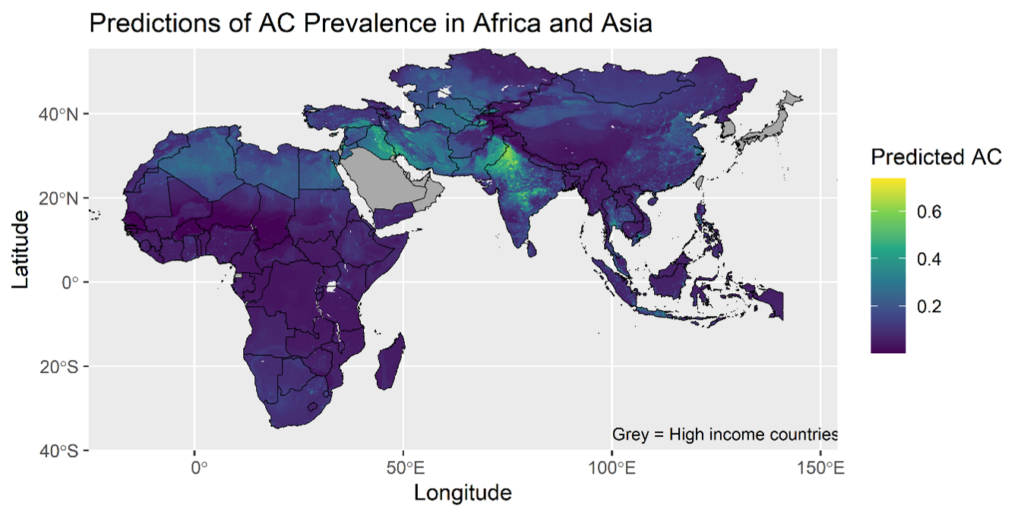
Recent work at Leicester has created the first high-resolution maps of AC ownership in LMICs (Figure 1). The aim of this project is to understand the importance of AC in India. We will research its role as a protective technology against heat stroke in rural, agricultural areas. We will also model its role in urban areas as both a protective technology and a cause of urban heat islands.
In rural areas, which are often poor, with limited access to healthcare, and with exposure to heat being partially driven by outdoor work, understanding the epidemiology of heat stress is complex. Humidity at surface level is a complex process with plants and canopies retaining moisture. And daytime and nighttime temperatures may have very different effects. Therefore, we aim to estimate the causal effects of AC on reducing mortality due to heat stress and on reducing poor maternal health outcomes.
In urban areas, AC is both a driver of urban heat islands, and a protective technology. Therefore, we aim to estimate the expected urban heating of Indian cities, due to AC, through to 2050. We then aim to assess the costs benefits of these changes, accounting for the protective effects on the haves versus the exposure to increased heat for the have nots.
Figure 1: Predictions of air conditioning ownership in Africa and Asia (Vayani et al. in prep). Almost 1 billion people a year are exposed to temperatures over 40° C without air conditioning. India has strong inequalities in access.
This project does not offer a CASE studentship
Each host has a slightly different application process.
Find out how to apply for this studentship.
All applications must include the CENTA application form.
Choose your application route
This study will combine data on AC and health from demographic health surveys with earth observation data and climate projections. We will use modern causal inference methods and models to estimate the effect of AC on health outcomes in rural areas. Land surface temperature (~ 100 m) from the European Space Agency’s Climate Change Initiative (ESA-CCI) will be used to map urban and rural temperature anomalies and extreme heatwave events. Land cover, vegetation classification and precipitation datasets will be used to characterise environmental conditions over daily and seasonal timescales.
To estimate the role of AC on driving urban islands we will take high-resolution estimates of AC ownership (Vayani et al. in prep.) and project them into the future under various SSPs. We will then use temperature from global circulation models, current estimates of urban heating from AC and local dispersion models to predict urban heat island effects of AC in 2050.
DRs will be awarded CENTA Training Credits (CTCs) for participation in CENTA-provided and ‘free choice’ external training. One CTC can be earned per 3 hours training, and DRs must accrue 100 CTCs across the three and a half years of their PhD.
The student will be encouraged to attend the week long module “Epidemiology” which is part of the MSc in Medical Statistics. This includes background in causal inference and an intro to spatial epidemiology. They will also be encouraged to attend the week long module in Machine Learning provided by the MSc in Medical Statistics. Within the lab group of Tim Lucas they will be encouraged to attend lab meetings and epistats seminars to be exposed to a range of research and to present and discuss their own work. Training in git and pair programming will be provided for robust, reproducible research.
Dr Nidhi Shukla is based at the World Bank, Delhi. However, for this project she is contributing in an individual capacity, not as a representative of the World Bank.
She brings expertise on the local Indian context and an understanding of the policy pathways that can be accessed via the World Bank. Having worked in Indian Government industries and now at the World Bank, she has a clear understanding of the policy environment in India.
Additionally, she brings expertise in environmental monitoring and environmental health. She has extensive expertise in environmental monitoring in India and the datasets that are available.
Year 1:
Training. Access and exploration of SSP and climate forecast datasets, current earth observation temperature datasets, predicted AC surfaces and DHS health and AC data.
Undertake statistical analysis of the causal effect of AC on health in rural areas.
Year 2: Develop models of urban heat islands due to AC. Publish year 1 project.
Year 3: Calculate estimates of mortality and morbidity due to urban heat islands. Publish urban heat island work. Present first and second projects at conference. Write up thesis.
Journal:
van Oldenborgh, G. J., Philip, S., Kew, S., van Weele, M., Uhe, P., Otto, F., Singh, R., Pai, I., Cullen, H., and AchutaRao, K.: Extreme heat in India and anthropogenic climate change, Nat. Hazards Earth Syst. Sci., 18, 365–381, https://doi.org/10.5194/nhess-18-365-2018, 2018.
Merchat, Michèle. “How much can air conditioning increase air temperatures for a city like Paris, France?.” International Journal of Climatology (2012).
Davis, L., Gertler, P., Jarvis, S. and Wolfram, C., 2021. Air conditioning and global inequality. Global Environmental Change, 69, p.102299.
Taraz, V., 2018. Can farmers adapt to higher temperatures? Evidence from India. World Development, 112, pp.205-219.
For any enquiries related to this project please contact Tim Lucas, [email protected].
To apply to this project:
Applications must be submitted by 23:59 GMT on Wednesday 6th January 2027.