

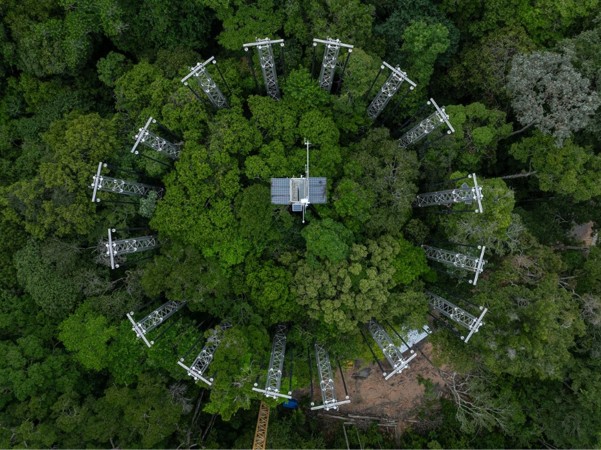
How tropical forests will respond to rising atmospheric CO2 is one of the biggest uncertainties in climate projections. Models disagree on the strength of CO2 fertilisation in the Amazon, partly because nutrient availability may limit the response and partly because until recently there has been no direct experimental evidence from a mature tropical forest. Amazon-FACE, near Manaus in Brazil, is the first Free-Air CO2 Enrichment experiment in old-growth rainforest, exposing forest plots to the CO2 concentrations expected by mid-century.
Solar-induced fluorescence (SIF) is a faint glow given off by chlorophyll during photosynthesis. It can be measured from tower-mounted sensors and aircraft, and mapped from space, making it the most direct measure of photosynthesis we have at large scales. SIF is particularly valuable over tropical forests, but persistent cloud cover and a lack of ground measurements make the satellite data difficult to interpret there. Amazon-FACE is now one of the best instrumented sites in the tropics, with continuous SIF measurements running in the forest itself. The experiment also poses an interesting question. The direct effect of elevated CO2 on fluorescence yield is expected to be small, but slower responses through leaf area, water use efficiency and leaf structure could change the SIF signal over time, and these have never been measured in a tropical forest.
The student will use the Amazon-FACE site to improve our understanding of SIF in tropical forests. They will characterise the tower record and what drives it, working with Met Office and NCEO scientists on the interpretation. They will run the JULES-SIF land surface model for the site to link the signal to the underlying physiology and evaluate satellite SIF from TROPOMI and ESA’s new FLEX mission against the ground data. They will then use the model to predict what changes elevated CO2 should produce in SIF, and whether satellites could detect them. This work will improve our ability to monitor tropical forest photosynthesis from space as new fluorescence missions become available.
Figure 1: Aerial photograph of the Amazon-FACE rings. Picture: AmazonFACE/João Rosa.
This project is a CENTA Flagship Project.
This project does not offer a CASE studentship
Each host has a slightly different application process.
Find out how to apply for this studentship.
All applications must include the CENTA application form.
Choose your application route
The project has four strands. (1) Analysis of the continuous tower SIF record at the Amazon-FACE rings, characterising the diurnal and seasonal behaviour, its environmental drivers, and any differences between the elevated and ambient plots. (2) Airborne IBIS imaging spectroscopy to scale from the rings to the wider canopy and to constrain how much of the emitted fluorescence escapes. (3) Site-scale simulations with the JULES-SIF land surface model, set up and run by the student, to attribute the observed variability and to simulate how elevated CO2 should alter SIF through leaf area, water use efficiency and leaf structure. (4) Evaluation of TROPOMI and new FLEX observations over tropical forest against the site data, and a model-based assessment of whether the expected CO2-driven changes could be seen from space.
DRs will be awarded CENTA Training Credits (CTCs) for participation in CENTA-provided and ‘free choice’ external training. One CTC can be earned per 3 hours training, and DRs must accrue 100 CTCs across the three and a half years of their PhD.
NCEO will provide access to its Researcher Forum, staff conferences/workshops and national-level training.
The student will receive training in SIF retrieval and analysis at Leicester, and in land surface modelling with JULES-SIF and data assimilation through NCEO-Reading and the UK Met Office.
The student will be trained in processing on the ALICE (University of Leicester) and JASMIN (NERC) supercomputer facilities.
The project is based within NCEO at Leicester, with co-supervision from Heiko Balzter (forest remote sensing) and Tristan Quaife (NCEO-Reading, SIF modelling and data assimilation). The UK Met Office (Eddy Robertson) leads the interpretation of SIF measurements at Amazon-FACE and will co-supervise, with visits to Exeter and an informal placement possible. We will also explore working closely with our Brazilian partners. Data access is through the existing collaboration with the Amazon-FACE consortium, and commitment emails referencing a 2027 start are attached. We are involved in ESA activities on satellite fluorescence, giving the student links to the wider SIF community.
Year 1: CENTA induction and core training, literature review and refinement of research questions. Quality control and processing of the tower SIF time series from the FACE rings. JULES set up and evaluated for the site, with a first characterisation of diurnal and seasonal SIF under ambient conditions.
Year 2: Analysis of the environmental drivers of tower SIF, with comparison of elevated and ambient rings. Analysis of IBIS overflight data for canopy scaling. JULES-SIF simulations of the site. Journal publication aimed at the tower SIF record and its drivers.
Year 3: Evaluation of TROPOMI and early FLEX observations over the site. Model-based assessment of whether elevated CO2 effects on SIF are detectable from space. Second journal publication and thesis writing.
The final six months of the 3.5 year programme are reserved for thesis completion. The IBIS and FLEX elements are written as opportunities rather than dependencies, and the core analysis and modelling are achievable with data already flowing from the site.
Drusch, M. et al., The FLuorescence EXplorer Mission Concept – ESA’s Earth Explorer 8, IEEE Transactions on Geoscience and Remote Sensing, 55(3), 1273-1284, https://doi.org/10.1109/TGRS.2016.2621820, 2017
Fleischer, K. et al., Amazon forest response to CO2 fertilization dependent on plant phosphorus acquisition, Nature Geoscience, 12, 736-741, https://doi.org/10.1038/s41561-019-0404-9, 2019
Mohammed, G.H. et al., Remote sensing of solar-induced chlorophyll fluorescence (SIF) in vegetation: 50 years of progress, Remote Sensing of Environment, 231, 111177, https://doi.org/10.1016/j.rse.2019.04.030, 2019
Norby, R.J. et al., Model-data synthesis for the next generation of forest free-air CO2 enrichment (FACE) experiments, New Phytologist, 209(1), 17-28, https://doi.org/10.1111/nph.13593, 2016
We would very strongly encourage anyone considering an application to get in touch with us in advance for an informal chat about the project at an early stage of any application.
Please contact us at: Dr Robert Parker – University of Leicester – [email protected].
To apply to this project:
Applications must be submitted by 23:59 GMT on Wednesday 6th January 2027.