

Current levels of climate change directly threaten global human security, placing 3.3 to 3.6 billion people in highly vulnerable conditions. As the climate warms, we can expect more heatwaves, flooding, droughts, crop failures, wildfires, and tropical cyclones. Millions across Africa, Asia, Central and South America, and small island states are already facing acute food and water insecurity. This vulnerability, when combined with escalating extreme weather events, is likely to trigger new humanitarian crises and drive population displacement. Furthermore, a recent study has shown that 3-16% of people born between 2003 and 2020 will experience unprecedented lifetime exposure to such events—exposures that could be avoided if global warming were limited to 1.5 °C. Looking ahead, intensifying climate pressures will increasingly undermine agricultural production and nutrition, while significantly accelerating rates of illness and premature death. The long-term outlook remains severe: compounding environmental stressors may expose 50% to 75% of the global population to life-threatening climatic conditions driven by extreme heat and humidity by 2100.
While scientists agree climate impacts will worsen, exact timelines remain uncertain due to system complexity. Accurately mapping future climate models is essential to predict extreme events and guide adaptation plans. AI-powered next-generation NWP emulators, such as AIFS, ACE, and HiRO-ACE, offer fast and efficient solutions. However, early tests from the AI Model Intercomparison Project (AIMIP) show that while these models do well by standard measures, they struggle to generalise beyond their training data and often underestimate rare and extreme events.
This PhD project will develop new ways to use open-access AI forecast tools to model multiple climate disasters in vulnerable regions. By applying these emulators to past events in a reanalysis approach, you will:
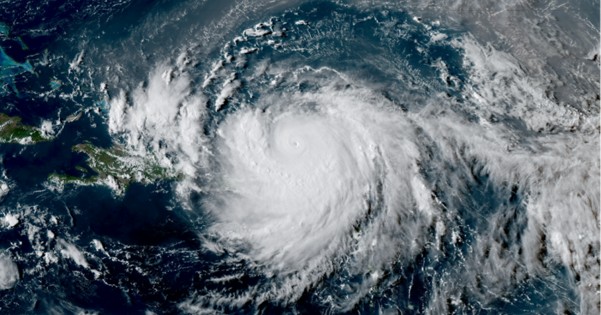
Figure 1: A satellite image of Category 5 Hurricane Erin, the first hurricane of the 2025 Atlantic season. While overall storm counts fell near historical averages, extreme ocean heat fuelled three Category 5 hurricanes—Erin, Humberto, and Melissa. Hurricane Melissa severely impacted Jamaica, making it the strongest landfall in its history.
This project is a CENTA Flagship Project.
This project offers a CASE studentship
Each host has a slightly different application process.
Find out how to apply for this studentship.
All applications must include the CENTA application form.
Choose your application route
In this project, the student will learn to work with the new generation of NWP emulators (NWPE) and initially investigate:
The student will begin by developing new data-driven methods for predicting extremes, starting with simpler conceptual models and then progressing to more robust frameworks. The project will also use new observational datasets that have not yet been included in this kind of study. Lastly, the project will either focus on i) testing policy options and relating the results to policy outcomes, or ii) extending the model to examine climate futures at different spatial and temporal scales.
DRs will be awarded CENTA Training Credits (CTCs) for participation in CENTA-provided and ‘free choice’ external training. One CTC can be earned per 3 hours training, and DRs must accrue 100 CTCs across the three and a half years of their PhD.
Established in 1990, the Met Office Hadley Centre is one of the UK’s foremost climate change research centres. Dr Robert Dunn leads and been involved in the development of several underpinning in situ datasets for detecting climate change and climate extremes. In addition to hosting student placements, MOHC will also provide access to and support with flagship datasets. Through, this project the student will also be introduced to a broader network through the MOHC Climate Monitoring group and AI4Climate.
Throughout the entirety of this project the student will spend some time at MOHC each project year, the duration of each visit to be discussed and decided upon once the project is underway to ensure appropriate support.
Year 1: Review of existing literature, refinement of research plan & objectives, and training. Initial training will focus on computing skills needed for the project, including (but not restricted to) coding, HPC usage, executing model runs, and attendance at 1-2 suitable meetings/workshops. Analysis of NWPE output from freely existing models with climate quality in situ and satellite products will allow the student to refine the research plan and objectives. The final objective for the year would be for the student to feedback findings to UKMO through AI4Climate and present their work at an appropriate national/international conference.
Year 2: Design, run and analyse current ML experiment(s) for predicting extreme cases outside traditional training datasets with the objective to publish the results in a peer-reviewed journal. The student would also look to present at one international meeting/conference and one national conference during this year.
Year 3: Based off your preference, you would pursue either research that would bring look at how future hazard would shape policy either here in the UK or internationally or focus on novel approaches to enhance your results from year 2. The exact nature of this work would be reviewed before starting the third year of the project. The student would also look to present at one international meeting/conference and one national conference during this year and publish the study in a peer reviewed journal.
Camps-Valls, G., Carrassi, A., de Melo Viríssimo, F., Debeire, K., Fernández-Torres, M.Á., Hess, P., Heuer, H., Mankovich, N., Montero, D., Rodrigo-Bonet, E. and Serva, F., 2026. Bridging the weather and climate divide with artificial intelligence. Nature Communications, 17(1), p.8578. https://doi.org/10.1038/s41467-026-75787-y
Cheung, K. H., Wong, M. N., Li, R. K. K., Tam, F., Scaife, A. A., & Dunstone, N. (2025). The risk and dynamics of unprecedented summer monsoon rainfall over Southeast China under the current climate. Environmental Research Letters, 20(11), 114033. https://iopscience.iop.org/article/10.1088/1748-9326/ae0ae7
Dunn, R.J., Donat, M.G. and Alexander, L.V., 2022. Comparing extremes indices in recent observational and reanalysis products. Frontiers in Climate, 4, p.989505. https://doi.org/10.3389/fclim.2022.989505
Perkins, W.A., Kwa, A., McGibbon, J., Arcomano, T., Clark, S.K., Watt-Meyer, O., Bretherton, C.S. and Harris, L.M., 2025. HiRO-ACE: Fast and skillful AI emulation and downscaling trained on a 3 km global storm-resolving model. arXiv preprint arXiv:2512.18224. https://arxiv.org/abs/2512.18224
Thompson, V., Dunstone, N. J., Scaife, A. A., Smith, D. M., Slingo, J. M., Brown, S., & Belcher, S. E. (2017). High risk of unprecedented UK rainfall in the current climate. Nature Communications, 8(1), Article 107. https://www.nature.com/articles/s41467-017-00275-3
Thompson, V., Dunstone, N. J., Scaife, A. A., Smith, D. M., Hardiman, S. C., Ren, H.-L., Lu, B., & Belcher, S. E. (2019). Risk and dynamics of unprecedented hot months in South East China. Climate Dynamics, 52(5–6), 2585–2596. https://doi.org/10.1007/s00382-018-4281-5
We strongly encourage anyone considering an application to contact us in advance for an informal chat about the project at an early stage of any application. Please get in touch with Dr Tim Trent (University of Leicester) at [email protected] with any questions regarding this project. For further details on the Water and Climate Research Lab please visit www.wcrl.co.uk.
To apply to this project:
Applications must be submitted by 23:59 GMT on Wednesday 6th January 2027.