

Artificial lighting at night (ALAN) is a major contributor to the “insect apocalypse”. Loss of insects has profound implications on the sustainability of ecosystems and food security [1]. However, ALAN’s impact on insect fitness beyond increasing predation for nocturnal insects is less clear. Night light causes sleep loss in diurnal insects [2,3] and can lead to defects in reproductive and visual performance [3,4]. We recently showed that insect sleep is dynamically modulated by light and vision [5], but it is unclear what colour wavelength and intensity of the lighting are the most sleep-depriving at night. Guidelines to limit obtrusive night light are available from Institution of Lighting Professionals (ILP) (GN01) to avoid their impacts on environment for defined environmental zone. Whether the same guideline is suitable for insects is unclear. Moreover, our understanding of the impact of ALAN on sleep in key pollinators like bees and hoverflies are limited.
This PhD project therefore aims to collaborate with ILP to implement real-life lighting conditions to investigate the effect of duration, intensity, and colour spectrum of artificial lighting on insect sleep. The experiment will be performed on the established insect sleep model, Drosophila species, taking advantage of their diverse niches[6], and on a key pollinator, hoverfly Episyrphus balteatus[7].
Working with ILP, the student will conduct three research objectives:
Together, the project studies how ALAN affects insect sleep with a focus on a key pollinator species by combining high-throughput insect behaviour and electrophysiology assays and knowledge from insect biologists and lighting industry experts. The outcome is likely to lead to easily implemented recommendations to add to the ILP guidance for outdoor lighting.
This project does not offer a CASE studentship
Each host has a slightly different application process.
Find out how to apply for this studentship.
All applications must include the CENTA application form.
Choose your application route
Drosophila and Episyrphus balteatus culture: the student will use established breeding conditions for Drosophila species and Episyrphus balteatus from Chen, Heslop-Harrison, and Wotton labs.
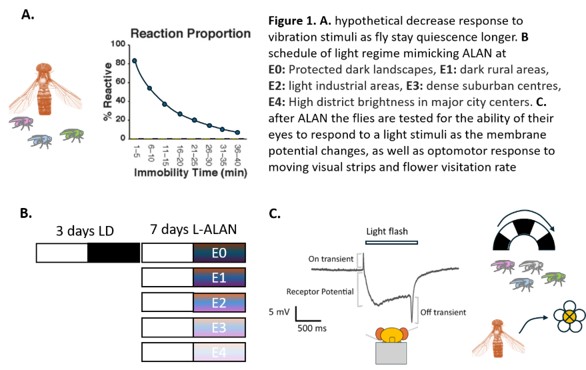
High throughput sleep and arousal measurement: insect sleep is first defined by using vibrational stimuli to probe locomotor response across a range of sleep-like immobile episodes (Figure 1A) using the DART system. Once this is established the sleep recording will be done via automated DAM system or Ethoscope.[5,8]
Visual performance: the visual performance will be measured using electroretinogram to assess any electrophysiological changes due to sleep loss derived from ALAN exposure [5]. The visual-related behaviour including optomotor response (Figure 1C, Chen lab) as well as flower visitation rates (Wotton Lab) will be also verified when applicable.
Lighting design and measurement: Lighting conditions will be designed to mimic ALAN intensity, scatter, spectrum and temperature at each environmental zone (Figure 1Bm supported by Prof. Peter Raynham, ILP).
DRs will be awarded CENTA Training Credits (CTCs) for participation in CENTA-provided and ‘free choice’ external training. One CTC can be earned per 3 hours training, and DRs must accrue 100 CTCs across the three and a half years of their PhD.
Dr Ko-Fan Chen, has expertise in insect sleep and visual neuroscience. He will provide in-house training for required behavioural and electrophysiology experiments. The non-melanogaster Drosophila culture will be obtained via Prof. Pat Heslop-Harrison. The hoverfly culture and behaviour assays will be trained via collaboration with Dr Karl Wotton, an expert in Episyrphus balteatus ecology and behaviour. The lighting design will be advised and supported by ILP’s Prof. Peter Raynham. The student will be part of the Institute of Environmental Futures and the Division of Genetics and Genome Biology, and Bioclocks UK, providing a positive research environment for cross-disciplinary collaboration.
Institution of Lighting Professionals is a professional body that assembles expertise from academics to industry experts. They have long term interaction with the government in shaping legislation and regulations that affect the built environment. Specifically with ALAN, The ILP provided evidence at the House of Lords Science & Technology Committee inquiry and are keen to establish the balance between benefit of night lighting and its damage to ecology. The PhD project will be working directly with one the author, Prof Peter Raynham, of the ALAN-linked ILP Guideline GN01 to design and implement ALAN in the lab.
Year 1: Establish no-melanogaster fruitfly and hoverfly cultures, and define their sleep. Attend UK sleep and entomology conferences.
Year 2: Design lighting intensity and spectrum and implement ALAN affected sleep recording. Identify the most sleep-depriving lighting setting.
Year 3: Verify visual performance for electroretinogram and potentially optomotor and flower visitation behaviour assay before and after ALAN-mediated sleep deprivation. Potential genetic dissection of ALAN sensing pathway using D.melanogaster mutant lines.
Project contact details: [email protected].
To apply to this project:
Applications must be submitted by 23:59 GMT on Wednesday 6th January 2027.