

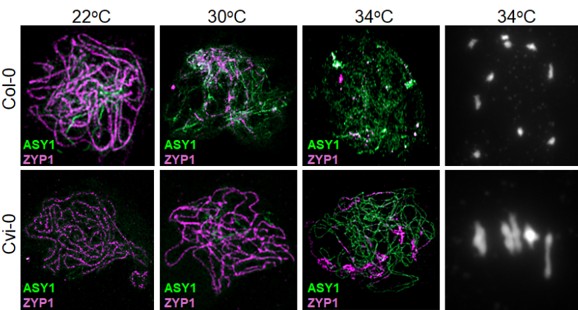
Thale cress (Arabidopsis thaliana) is a small, temperate plant in the Brassicaceae family that has spread throughout the northern hemisphere and thrives in both cold and warm environments. Even though A. thaliana is generally considered to be an inbreeding species it is capable of cross-pollination and adapting to new conditions via mutation and gene flow. The genetic history of A. thaliana in the Cape Verde Islands suggests that it arrived from Morrocco (~5000-7000 years ago) with very few individuals that were geographically isolated until the Portuguese settled (~1460). The Cape Verde Arabidopsis populations are generally limited to high-altitude volcanic mountain slopes that are ~5oC cooler than the coastal regions. They flower during the cooler spring months (February to April), where they produce seeds that germinate in the rainy season (August – October). Their restricted habitat range would imply that Arabidopsis has not adapted to average high temperatures on these islands. However, our preliminary data suggests that meiosis, the reproductive cell division stage, is far more stable in the Cape Verde flowers grown at 34oC when compared to the standard lab ecotype Col-0 from USA (see Figure 1). This indicates that the Cape Verde Arabidopsis plants have adapted to higher temperatures which might enable them to broaden their ecological niche and succeed in a warming climate. The aim of this project will be to investigate the Cape Verde Island A. thaliana population history through phylogenetic analysis of ~100 meiosis genes to determine their origin. This will be achieved by comparing Cape Verde Arabidopsis to populations that have already been sequenced in the 1001 genomes project, as well as identifying de novo mutations that may confer useful adaptations. Therefore, this project will provide novel insight into island adaptation from a small bottleneck of genetic diversity to thriving populations in challenging conditions.
Figure 1. Comparing key meiotic stages at 22oC, 30oC and 34oC between Col-0 (USA) and Cvi-0 (Cape Verde Islands) Arabidopsis thaliana. Super-resolution microscopy of ASY1 and ZYP1 meiotic protein fluorescent markers show that they fail at 30oC in Col-0 but are normal in CVI. At 34oC Col-0 has complete meiotic failure leading to ten non-recombined chromosome pairs, whereas CVI is relatively normal (far right panel) forming five chromosome pairs, indicating adaptation to high temperatures.
This project does not offer a CASE studentship
Each host has a slightly different application process.
Find out how to apply for this studentship.
All applications must include the CENTA application form.
Choose your application route
As Arabidopsis is a model organism, there are many tools available for analysis and genomic data available to be mined. A bioinformatic approach will be employed to analyse the genomic and protein sequences of ~100 meiosis genes, with the aim to identify polymorphisms including single nucleotide polymorphisms and insertions/deletions. This will be complemented by wet lab experiments to determine meiotic thermotolerance. A Quantitative Trait Loci (QTL) analysis will be performed with Cape Verde and Col-0 plants to associate the fertile phenotype at high temperatures and the underpinning genotype. This will be achieved by crossing plants and utilising our Oxford Nanopore PromethION 2 Solo to sequence multiple genomes and map adaptive genes with rQTL. Plants will be phenotyped by fertility (seed counts/silique lengths) as well as chromosome configurations during meiosis by fluorescence microscopy.
DRs will be awarded CENTA Training Credits (CTCs) for participation in CENTA-provided and ‘free choice’ external training. One CTC can be earned per 3 hours training, and DRs must accrue 100 CTCs across the three and a half years of their PhD.
We will provide Oxford Nanopore genomic DNA sequencing and fluorescence microscopy of meiotic chromosomes.
Year 1: Retrieve and analyse sequence information (genomic DNA and protein sequences) of ~100 meiosis genes from the 1,001 Arabidopsis genomes. Determine which genes have mutated and which have remained the same and identify if there is a pattern. Grow Arabidopsis ecotypes Col-0 and Cape Verde Islands (CVI) at a range of temperatures and measure fertility and flowering time. Cross Col-0 and CVI to produce F1 seeds.
Year 2: Using bioinformatics compare meiosis genes from Cape Verde Islands to other ecotypes to develop phylogenetic trees. Sow F1 seeds: Measure fertility & flowering time (phenotype) of F2 plants. Extract and sequence genomic DNA from 100 plants (genotype) with Oxford Nanopore PromethION for QTL analysis.
Year 3: Validate QTL analysis with bioinformatic analysis of polymorphisms and determine if they are de novo or already existing in another ecotype. Perform population analysis of genes to determine if the expected origin of Cape Verde plants originated from Morrocco or other African countries. Perform Fst and Tajima’s D analysis to identify genomic regions under selection.
Bomblies K, Higgins JD, Yant L. (2015) Meiosis evolves: adaptation to external and internal environments. New Phytologist 208(2):306-23. doi: 10.1111/nph.13499
Fulgione A, Neto C, Elfarargi AF, Tergemina E, Ansari S, Göktay M, Dinis H, Döring N, Flood PJ, Rodriguez-Pacheco S, Walden N, Koch MA, Roux F, Hermisson J, Hancock AM. (2022) Parallel reduction in flowering time from de novo mutations enable evolutionary rescue in colonizing lineages. Nat Commun.;13(1):1461. doi: 10.1038/s41467-022-28800-z.
For enquiries please see: https://le.ac.uk/people/james-higgins
To apply to this project:
Applications must be submitted by 23:59 GMT on Wednesday 6th January 2027.