

Soil microbial communities are structured by a complex network of chemical interactions that influence competition, coexistence, and ecosystem function. While many natural products are studied for their antimicrobial activity, microorganisms in natural environments are often exposed to sub- minimal inhibitory concentration. Under these conditions, natural products may instead alter the behaviour of neighbouring organisms in ways that remain largely unexplored.
Can a molecule produced by one soil bacterium reprogramme gene expression in another, changing how it behaves and competes?
This project investigates whether DNA-binding molecules represent a previously unrecognised mechanism of microbial interaction. We will use netropsin, a naturally occurring DNA-binding molecule produced by soil-dwelling Streptomycetes, as a model compound. Netropsin binds specific AT-rich DNA motifs and has the potential to influence transcription without impairing growth. We hypothesise that environmentally relevant, sub-inhibitory concentrations of netropsin alter gene expression in neighbouring soil bacteria, leading to changes in metabolite production and microbial traits that influence ecological interactions.
This is supported by our preliminary data, which show that genes with predicted netropsin-binding motifs in their promoter regions are differentially expressed following exposure of the soil bacterium Pseudomonas capeferrum to sub-MIC concentrations of netropsin.
You will investigate two connected questions:
You will characterise how sub-MIC netropsin exposure reshapes gene expression and metabolite production in soil bacteria.
You will identify relationships between netropsin-binding motif distributions and transcriptional responses.
Assess how transcriptional rewiring influences bacterial behaviour, resource utilisation, and fitness.
Examine whether netropsin-mediated responses alter microbial interactions, competition fitness and community assembly.
By linking molecular mechanisms to ecological outcomes, this project will establish whether DNA-binding metabolites function as hidden regulators of microbial communities. The findings will advance our understanding of chemical communication in soil ecosystems and may reveal an overlooked process shaping microbial diversity, community stability, and ecosystem function.
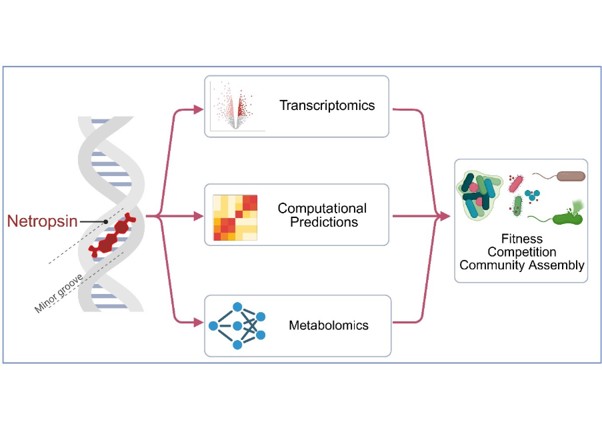
Figure 1: Project overview. Molecular consequences of netropsin binding to DNA will be investigated using transcriptomics, metabolomics and computational analyses to identify molecular responses in soil bacteria. The ecological consequences of these responses will then be explored through studies of bacterial fitness, competition and assembly of polymicrobial communities.
This project does not offer a CASE studentship
Each host has a slightly different application process.
Find out how to apply for this studentship.
All applications must include the CENTA application form.
Choose your application route
The ecological and molecular effects of DNA-binding molecules will be investigated using a combination of transcriptomic, metabolomic, and phenotypic approaches. RNA sequencing and tandem mass spectrometry will be used to identify changes in bacterial gene expression and metabolite production in response to sub-MIC netropsin exposure, while computational analyses will examine associations between transcriptional and metabolic responses and predicted netropsin-binding motifs. Selected DNA-target interactions will be validated experimentally using fluorescently labelled oligonucleotides. The functional consequences of netropsin-induced transcriptional changes will then be assessed through phenotypic assays focusing on traits relevant to bacterial competition and cooperation. Finally, co-culture experiments will determine how these responses influence community composition and interspecies interactions.
DRs will be awarded CENTA Training Credits (CTCs) for participation in CENTA-provided and ‘free choice’ external training. One CTC can be earned per 3 hours training, and DRs must accrue 100 CTCs across the three and a half years of their PhD.
The CENTA DR will be trained in microbial and molecular biology skills and receive hands-on training in transcriptomics and metabolomics. This will include DNA binding assays with DNA-binding molecules, RNA-sequencing and downstream validation via qRT-PCR. Training will also include the isolation of natural products, sample preparation for mass spectrometry and mass spec analysis, including metabolite quantification and annotation via molecular networking. Training will also extend to microbial culturing and phenotypic experiments. Scholarly development will be supported through regular journal clubs within my research group and collaborative network, alongside opportunities to present at divisional seminars and attend School-wide seminar series.
Year 1
Establish experimental systems and define transcriptional and metabolic responses to sub-MIC netropsin using RNA sequencing and tandem mass spectrometry.
Identify relationship between netropsin-binding motifs and gene expression changes.
Year 2
Validate key netropsin-DNA interactions and develop predictive models linking DNA sequence features to regulatory outcomes.
Characterise phenotypic consequences of netropsin-induced transcriptional rewiring.
Year 3
Determine how netropsin-driven changes affect bacterial competition, cooperation, and resource utilisation.
Assess impacts on microbial community composition and assembly in co-culture models.
Year 4
Finalizing data analysis and writing period for thesis and publications.
FINLAY, A. C., HOCHSTEIN, F. A., SOBIN, B. A. & MURPHY, F. X. (1951). Netropsin, a New Antibiotic Produced by a Streptomyces. Journal of the American Chemical Society, 73, 341-343.
GIURINI, E. F., GODLA, A. & GUPTA, K. H. (2024). Redefining bioactive small molecules from microbial metabolites as revolutionary anticancer agents. Cancer Gene Ther, 31, 187-206.
VINGADASSALON, A., LORIEUX, F., JUGUET, M., NOEL, A., SANTOS, L. D. F., MARIN FERNANDEZ, L., PERNODET, J. L., BURY-MONE, S. & LAUTRU, S. (2021). Transcriptional Regulation of Congocidine (Netropsin) Biosynthesis and Resistance. Appl Environ Microbiol, 87, e0138021.
For any enquiries related to this project please contact Christian Jenul, [email protected].
To apply to this project:
Applications must be submitted by 23:59 GMT on Wednesday 6th January 2027.