

Insects underpin the ecosystems we depend on, yet as the climate warms we still cannot predict how heat reshapes their biology of ageing. This project uses the ‘epigenetic clock’, chemical marks on DNA that track biological rather than calendar age, to ask how thermal stress speeds up ageing in the parasitoid wasp Nasonia vitripennis, and whether that stress echoes into the next generation. Nasonia is the first insect with a validated, published epigenetic clock, and our lab has already shown that environmental conditions can slow it: larval diapause extends lifespan and decelerates ageing (Foley et al., 2025, PNAS). This project turns that logic around, asking whether heat does the opposite. You will expose adult wasps to a gradient of temperatures from benign to strongly warmed, track survival and activity using automated ethoscope monitoring, and use Oxford Nanopore sequencing to follow DNA methylation across the lifespan at single-base resolution. A second strand tests whether brief heat exposure in mothers accelerates the epigenetic clock of their unexposed offspring, a first test of whether climate stress can leave a heritable imprint on ageing.
For a strong applicant, this is a rare opportunity to lead a project from day one in an active, well-funded lab with the infrastructure, published preliminary data and technical pipelines already in place. You will build genuinely cross-disciplinary expertise, spanning invertebrate husbandry, long-read genomics, bioinformatics and experimental design, while contributing to one of the most pressing open questions in environmental biology: how will climate change reshape the pace of life?
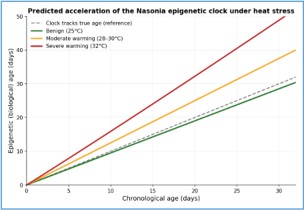
Figure 1: Predicted acceleration of the Nasonia epigenetic clock with warming. Higher temperatures are expected to push epigenetic (biological) age ahead of chronological age, indicating faster biological ageing under climate stress.
This project does not offer a CASE studentship
Each host has a slightly different application process.
Find out how to apply for this studentship.
All applications must include the CENTA application form.
Choose your application route
The project combines experimental ecology with molecular and bioinformatic approaches. Adult male Nasonia will be reared under different temperature regimes spanning benign (25°C) to strongly warmed (32°C) conditions, with survival and activity continuously tracked using high-throughput ethoscope monitoring. At multiple timepoints across the adult lifespan, individuals will be sampled for Oxford Nanopore methylome sequencing to measure DNA methylation dynamics at single-base resolution. A maternal exposure experiment will test whether brief thermal stress in mothers accelerates epigenetic ageing in their offspring, reared under standard conditions. Bioinformatic pipelines already established in the lab will identify clock CpGs, quantify methylation change over time, and model how temperature reshapes the pace of the epigenetic clock.
DRs will be awarded CENTA Training Credits (CTCs) for participation in CENTA-provided and ‘free choice’ external training. One CTC can be earned per 3 hours training, and DRs must accrue 100 CTCs across the three and a half years of their PhD.
You will receive comprehensive training spanning wet-lab and computational methods: Nasonia husbandry, experimental design and high-throughput behavioural tracking; DNA extraction, library preparation and Oxford Nanopore long-read sequencing; and bioinformatics in R and Python for methylation analysis and epigenetic clock construction. Further training is available in statistical modelling, data visualisation and reproducible research workflows. You will be embedded in an active, well-funded lab with established protocols and a genuine track record of rapid publication, giving you both broad technical grounding and the specific quantitative skills needed for a career in genomics, ecology or environmental data science.
This project is jointly supervised by Professor Mallon and Dr Marshall, whose complementary expertise ensures strong interdisciplinary support. Mallon is an international leader in insect epigenetics and ageing, with a particular focus on Nasonia vitripennis and the development of epigenetic clocks. Marshall is a leading expert in environmental epigenomics and next-generation sequencing, with extensive experience applying genomic approaches to ecological questions. Their collaboration gives the student access to a unique combination of molecular, ecological and computational expertise, reinforced through joint weekly lab meetings and established co-supervision practice.
Year 1: Establish Nasonia colonies under the full temperature gradient, optimise husbandry, and complete lifespan and activity assays using ethoscope monitoring. Begin library preparation from time-series samples of control and heat-stressed adults.
Year 2: Complete Oxford Nanopore sequencing across all treatments and timepoints. Carry out bioinformatic analyses to identify clock CpGs and quantify temperature-associated changes in methylation.
Year 3: Conduct the maternal exposure experiment to test transgenerational effects of thermal stress. Analyse offspring methylation data, integrate across datasets, and write up how climate warming reshapes the pace of the epigenetic clock.
Foley, E. E. B., Thomas, C. L., Kyriacou, C. P. and Mallon, E. B. (2025) ‘Larval diapause slows adult epigenetic aging in an insect model, Nasonia vitripennis’, Proceedings of the National Academy of Sciences of the United States of America, 122(31), e2513020122. doi: 10.1073/pnas.2513020122.
Podcast about the above paper: https://www.newstalk.com/podcasts/futureproof-with-jonathan-mccrea/extra-is-slowing-down-ageing-possible
Choi, E. Y. and Ailshire, J. A. (2025) ‘Ambient outdoor heat and accelerated epigenetic aging among older adults in the US’, Science Advances, 11, eadr0616. doi: 10.1126/sciadv.adr0616.
Please contact Eamonn Mallon, University of Leicester, School of Biological and Biomedical Sciences, Division of Genetics and Genome Biology, [email protected] for further details. https://le.ac.uk/people/eamonn-mallon
To apply to this project:
Applications must be submitted by 23:59 GMT on Wednesday 6th January 2027.