

Heavy metal contamination of freshwater systems is a major environmental challenge, posing significant risks to ecosystem health, biodiversity, and human well-being. Toxic metals ions, such as mercury, lead, cadmium and nickel are persistent, non-degradable pollutants that are capable of bioaccumulation through food chains, creating long-term environmental and public health consequences. Consequently, there is an urgent need for technologies that can both detect and remove these contaminants from complex environmental matrices.
The need for innovative heavy-metal remediation technologies has recently been highlighted by several high-profile investigations into the legacy of industrial contamination in the UK. The BBC Wales investigation ‘Britain’s Toxic Secret’ reported that thousands of potentially contaminated sites remain uninspected, with concerns over elevated levels of lead and arsenic in former industrial areas and documented cases of high blood-lead levels in residents. Additionally, the BBC documentary ‘Buried with Michael Sheen’ has brought renewed attention to historic chemical contamination in Wales, including concerns surrounding persistent pollutants and contaminated land associated with former industrial and quarry sites. Recent parliamentary and scientific discussions have also highlighted the continuing environmental impacts of abandoned Welsh metal mines, which release lead, cadmium, zinc and other toxic metals into rivers, agricultural land and food chains.
Current remediation approaches include carbon-based adsorbents (activated carbon, carbon nanotubes and graphene), mineral adsorbents (zeolite, silica and clay), ion-exchange resins, photocatalysis, and chemical based separation. However, many of these technologies show reduced selectivity in natural waters containing competing ions such as calcium and magnesium, while others generate significant volumes of secondary waste sludge requiring further treatment. Furthermore, electrochemical approaches offer rapid treatment but are often limited by expensive electrode materials and high energy demands.
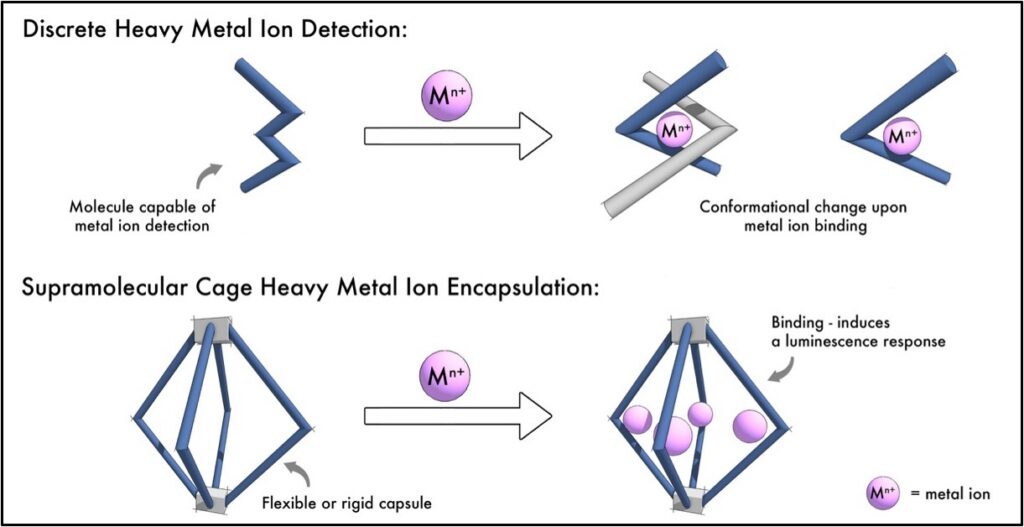
Supramolecular chemistry offers a promising alternative, through the design of discrete and self-assembled cage-like architectures capable of highly selective host-guest recognition. This PhD project will investigate the design, synthesis, and characterisation of supramolecular discrete and structures capable of selectively encapsulating heavy metal ions from environmentally relevant water samples, providing a platform for next-generation sensing and remediation technologies.
Figure 1: The design of discrete and supramolecular cages for heavy metal ion detection in water samples.
This project does not offer a CASE studentship
Each host has a slightly different application process.
Find out how to apply for this studentship.
All applications must include the CENTA application form.
Choose your application route
The project will be delivered through four work packages (WPs).
WP1 (Months 1-12) will focus on the design, synthesis and characterisation of novel luminescent supramolecular receptors for environmentally relevant heavy metal ions. A library of compounds will be prepared and optimised to enhance solubility, binding affinity and photophysical properties.
WP2 (Months 9-18) will evaluate metal-ion binding, selectivity and luminescence response. Structure-property relationships will be investigated and identifying lead candidates for publication.
WP3 (Months 12-30) will assess the performance of the most promising receptors in freshwater samples supplied by external partners. Metal-ion uptake, removal efficiency and selectivity will be quantified under environmentally relevant conditions, including varying pH and competing ions.
WP4 (Months 24-36) will optimise the best-performing systems through recyclability, stability and scalability studies. Findings will be disseminated through peer-reviewed publications and engagement with environmental agencies and other water industry partners.
DRs will be awarded CENTA Training Credits (CTCs) for participation in CENTA-provided and ‘free choice’ external training. One CTC can be earned per 3 hours training, and DRs must accrue 100 CTCs across the three and a half years of their PhD.
The student will benefit from the comprehensive training and development programme provided by the Loughborough Doctoral College, including workshops in research methods, responsible research, scientific communication, leadership, project management and career development. They will receive specialist training in synthetic and supramolecular chemistry, molecular characterisation, fluorescence spectroscopy and environmental analysis. The project will develop expertise in advanced analytical techniques (including ICP-MS), environmental sampling and data analysis. Collaboration with environmental agencies will provide experience of translating fundamental research into practical environmental solutions, while enhancing stakeholder engagement, presentation and publication skills.
Year 1: Design, synthesis and characterisation of luminescent supramolecular receptors at Loughborough University. Preliminary screening will be undertaken to assess metal ion binding affinity, selectivity and sensing performance against a range of environmentally relevant heavy metal ions.
Year 2: Evaluation of metal ion uptake and removal from freshwater samples supplied by external partners. Performance will be assessed under environmentally relevant conditions, including varying pH, ionic strength and competing ion concentrations, to establish practical applicability for water treatment and monitoring.
Year 3: Optimisation of lead supramolecular systems based on the results from Years 1 and 2, with detailed investigation of structure-property relationships governing metal ion recognition, luminescence response and sequestration efficiency. The most promising candidates will undergo validation in complex environmental samples, alongside studies of regeneration, reusability and long-term stability.
Journal
Web page
Further details on how to contact the supervisor for this project and how to apply for this project can be found here:
For any enquiries related to this project please contact Dr Samantha E. Bodman – [email protected]
To apply to this project:
Applications must be submitted by 23:59 GMT on Wednesday 6th January 2027.