

Soil microbial communities are fundamental to ecosystem functioning, supporting nutrient cycling, decomposition, carbon storage, soil fertility and water regulation. Yet these communities are vulnerable to environmental pressures, particularly drought, which is expected to become more frequent and severe under climate change. Understanding how soil biodiversity responds to drought is therefore essential for maintaining healthy, resilient ecosystems and informing climate adaptation.
This interdisciplinary PhD will apply AI, machine learning and deep learning to soil environmental DNA(eDNA) data to identify indicators of soil health, ecosystem functioning and drought resilience. It will use fungal and microbial eDNA data from Defra’s Natural Capital and Ecosystem Assessment (NCEA) programme and Forest Research, alongside soil physical, chemical and biological measurements. These data will be integrated with environmental variables including rainfall, temperature, groundwater, land cover and topography.
Moving beyond traditional analytical methods, machine learning has the potential to uncover previously hidden relationships and generate predictive insights that can support environmental monitoring and decision-making. The student will develop robust, reproducible and interpretable workflows for quality-controlling, integrating and analysing large, high-dimensional eDNA and spatial environmental datasets. They will develop and evaluate machine-learning and deep-learning models to detect ecological patterns, identify informative microbial and fungal features, and predict how soil communities respond to drought-related pressures across habitats, environmental gradients and future climate scenarios.
The research will address important methodological challenges, including integrating data collected at different spatial scales; handling incomplete, variable eDNA observations; feature selection; uncertainty quantification; and assessing model robustness and transferability. Explainable and responsible AI methods will make model outputs transparent and identify potential bias arising from uneven sampling or missing data. The resulting computational tools will be reusable for environmental monitoring beyond this project.
The student will work closely with Defra’s DNA Centre of Excellence and project partners, who will provide domain expertise, guide interpretation and ensure policy relevance. The outputs will strengthen the evidence base for soil-biodiversity monitoring, natural-capital assessment, climate adaptation and nature recovery. By combining advanced AI with nationally significant soil eDNA resources, the project will help Defra and land managers identify vulnerable soils, anticipate ecosystem responses to drought and support sustainable environmental decision-making.
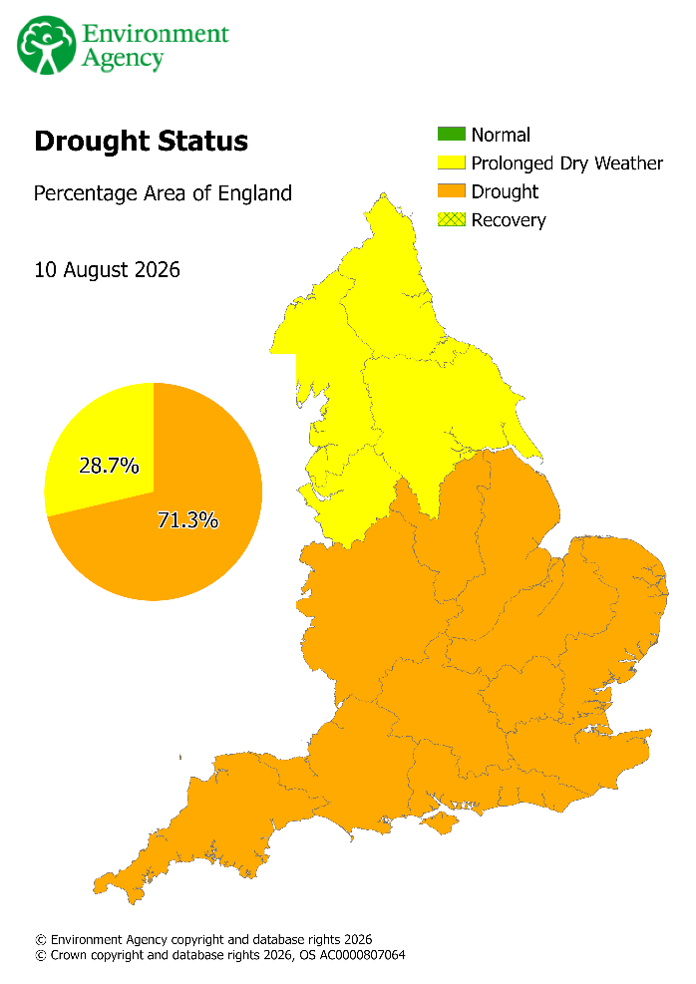
Figure 1: Drought status across England in August 2026, highlighting that 71% of the country is experiencing drought, with the remainder under prolonged dry conditions. Image copyright of Environment Agency.
This project is a CENTA Flagship Project.
This project offers a CASE studentship
Each host has a slightly different application process.
Find out how to apply for this studentship.
All applications must include the CENTA application form.
Choose your application route
This interdisciplinary project will integrate soil environmental DNA (eDNA) data from Defra’s Natural Capital and Ecosystem Assessment (NCEA) programme, focused on fungal communities across England and Wales, with soil chemistry, climate, hydrological and spatial datasets. Reproducible computational pipelines will quality-control, harmonise and analyse these high-dimensional data.
Current soil condition and drought risk will be characterised using microbial community composition, soil moisture, temperature, land cover and other environmental covariates. Predictive machine-learning and deep-learning models will identify ecological patterns, select informative microbial features and forecast soil health and community responses under drought scenarios. Models will be evaluated for accuracy, robustness and generalisability across environmental gradients and locations.
A second focus will be explainable and responsible AI: transparent outputs, uncertainty quantification, robustness testing and detection of bias caused by incomplete or uneven data. Defra experts will guide feature design, interpretation and validation, ensuring credible, policy-relevant indicators.
DRs will be awarded CENTA Training Credits (CTCs) for participation in CENTA-provided and ‘free choice’ external training. One CTC can be earned per 3 hours training, and DRs must accrue 100 CTCs across the three and a half years of their PhD.
Applicants will normally hold, or expect to gain, at least a 2:1 degree (or equivalent) in Computer Science, Engineering or a relevant Master’s degree, with strong programming skills. The student will receive training in Python, data engineering, statistical modelling, machine learning, explainable and responsible AI, GPU/HPC computing, as well as publication and knowledge transfer skills.
Training in soil and microbial ecology will include opportunities for field sampling. Defra’s DNA Centre of Excellence will provide eDNA training, from sampling design to data interpretation. A Defra placement will offer first-hand experience of evidence-to-policy translation, stakeholder engagement and interdisciplinary working at science–policy interface.
DNA Centre of Excellence, Department for Environment, Food and Rural Affairs (Defra)
The project is led by Computer Science at Loughborough University, providing expertise in AI, machine learning and data science. Defra’s DNA Centre of Excellence is the CASE partner, contributing eDNA methods, advising on data and interpretation, ensuring policy expertise and practical relevance. Its Working Group includes Centre for Environment, Fisheries and Aquaculture Science (Cefas), Natural England, Forest Research, the Environment Agency, Joint Nature Conservation Committee, Royal Botanic Gardens Kew, and Animal and Plant Health Agency. A Defra placement will support policy-facing testing and refinement of AI tools.
Year 1: To synthesis soil eDNA datasets, and integrate them with environmental data (e.g. groundwater, temperature)
Year 2: To identify indicators of soil health and ecosystem function using fungal/microbial diversity across habitats and environmental gradients. To develop machine learning approaches to identify and predict soil health and ecosystem functioning
Year 3: To test soil health and ecosystem functioning indicators in policy-relevant applications, to evaluate their potential to support environmental monitoring and decision making
To synthesis soil eDNA datasets, and integrate them with environmental data (e.g. groundwater, temperature)
Year 1: Review literature; undertake training in AI, eDNA methods and responsible research; explore and quality-control soil eDNA datasets, and integrate them with environmental data (e.g. groundwater, temperature); undertake a Defra placement; develop benchmark machine-learning models and evaluate initial results; present findings through academic seminars.
Year 2: in-depth research and identify knowledge gaps and challenges; identify indicators of soil health and ecosystem function using fungal/microbial diversity across habitats and environmental gradients; develop machine learning approaches to identify and predict soil health and ecosystem functioning; present findings at conferences, workshops and relevant industry or policy forums.
Year 3: test soil health and ecosystem functioning indicators in policy-relevant applications, to evaluate their potential to support environmental monitoring and decision making; evaluate model robustness, explainability, uncertainty, generalization and transferability across habitats, environmental gradients and drought scenarios; undertake Case studies and real-world testing; produce demonstrations.
Year 4: Finalise and validate experiments and findings; publish research outputs; disseminate results and develop policy-facing recommendations; complete the thesis and viva.
Arguiano, C., et al. (2026). Soil fungi in Nothofagus forests under reduced rainfall: Implications of climate change for Central Patagonia, Argentina, Forests, 17(4).
Balkrishna, A., et al. (2026). Artificial intelligence in soil microbiome-driven agriculture: from practical limits to a translational roadmap. Frontiers in Microbiomes.
Hu, H. et al. (2023). Supervised machine learning improves general applicability of eDNA metabarcoding for reservoir health monitoring’, Water Research.
Jones, D. (2025) Major milestone: NCEA publishes new datasets on England’s environment. Environment Blog, 15 December. Department for Environment, Food & Rural Affairs (Defra). Available at: https://defraenvironment.blog.gov.uk/2025/12/15/major-milestone-ncea-publishes-new-datasets-on-englands-environment
Natural England (2025) England Ecosystem Survey (EES). https://publications.naturalengland.org.uk/publication/5610689568440320
Pace, R., et al. (2025). Artificial intelligence in soil microbiome analysis: a potential application in predicting and enhancing soil health—a review. Discover Applied Sciences, 7(2).
Ramatsitsi, N. et al. (2026). A systematic review on soil microbial shifts under drought stress: a climate-smart agriculture perspective. FEMS Microbiology Ecology, 102(5).
Saki, E. et al. (2025). Metabarcoding of the Soil Fungal Microbiome and Its Environmental Drivers Across Temporal and Spatial Scales. Environmental DNA, 7(5).
Applicants will normally need to hold, or expect to gain, at least a 2:1 degree (or equivalent) in Computer Science, Engineering, or an appropriate postgraduate degree (MSc or equivalent) with good programming skills.
For enquiries about this project, please contact Professor Baihua Li ([email protected]) (https://www.lboro.ac.uk/departments/compsci/staff/baihua-li) at Loughborough University.
For more information on the DNA Centre of Excellence, DEFRA can be found using the following link: Defra DNA Centre of Excellence – GOV.UK (https://www.gov.uk/government/groups/defra-dna-centre-of-excellence)
To apply to this project:
Applications must be submitted by 23:59 GMT on Wednesday 6th January 2027.