

This project responds to a four-year marine litter monitoring campaign on the Isle of Skye, Scotland, UK. It builds on Loughborough University’s 50 Years of Litter on Skye and associated research projects. Integrating environmental, engineering, and social science methods, this interdisciplinary PhD aims to explore where, when, and how, large pieces of marine litter degrade into the ‘plastic confetti’ that accumulates along and within Scotland’s heavily-littered shorelines.
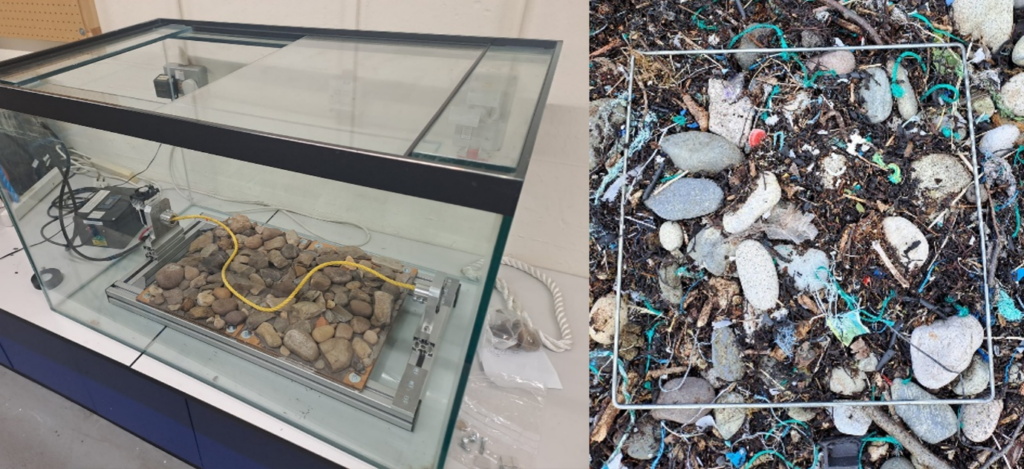
To achieve this aim, this PhD has the following objectives. It will: i) work with community partners across Scotland’s west coast to maximise the granularity of source-attribution for degraded litter, incorporating the lived-experiences of coastal communities who support this team’s work; ii) simulate the degradation of beach litter using tribology techniques using Loughborough’s beach litter degradation test rig and through field experimentation (Figure 1); iii) characterise and, where possible, date, plastic accumulation through the soil profile at the back of beaches; and iv) characterise the chemical diversity of the plastic pieces it collects and generates to evaluate physical and chemical degradation under controlled and environmental conditions.
PhD’s methods will consult community groups working to survey and clear beach litter across Scotland’s west coast. The interdisciplinary nature of this PhD will require the integration of environmental science, engineering, and community science methodologies.
Figure 1: Loughborough University’s marine litter degradation rig (left) and example of degraded litter on a heavily-littered beaches on the Isle of Skye, Scotland (right).
This project does not offer a CASE studentship
Each host has a slightly different application process.
Find out how to apply for this studentship.
All applications must include the CENTA application form.
Choose your application route
This PhD will involve field and lab-based methods. Fieldwork will involve the consultation with community members to identify plastic confetti hotspots, trace confetti sources, and consider the local challenges of this pervasive and bioavailable litter typology. Surveying of surface and subsurface beach litter will be conducted, as well as the collection of soil cores across Scotland’s west coast. Tribology experiments will be undertaken in the laboratory at Loughborough University, simulating field conditions in a controlled environment (Figure 1). Material characterisation (e.g., FTIR, SEM, XPS, EDS) will assess chemical changes at every point in the degradation process to evaluate marine litter degradation processes and its influence on material properties.
Community science methodologies (e.g., interviews, focus groups, surveys) will ensure the outcomes of this PhD are informed by, and appropriately communicated to, the non-professional researchers who support it. This will include consultation with relevant industry representatives should opportunities for industrial marine litter interventions be identified.
DRs will be awarded CENTA Training Credits (CTCs) for participation in CENTA-provided and ‘free choice’ external training. One CTC can be earned per 3 hours training, and DRs must accrue 100 CTCs across the three and a half years of their PhD.
This PhD will provide comprehensive experience of multiple field and analytical skills spanning geography, environmental science, engineering, and social science methodologies. Training in these methods will be provided by the supervisory team and project partners. This includes training in the community science, tribology, and material characterisation techniques. Beyond the research methods, science communication will be core to the dissemination of this PhD. Collectively, this training portfolio will equip the successful applicant with analytical and communication skills that are relevant far beyond the PhD’s focus.
Year 1 will focus on training in core practical skills for this PhD (community science, sampling, sample processing, sample analysis). Training will focus on methods for fieldwork (e.g., interviews and focus groups, marine litter surveying, soil sampling), Tribology techniques (e.g., sliding and impact tribometer testing, wear debris collection methods), and material characterisation (e.g., optical and scanning electron microscopy, FTIR, XPS, EDS). Training will also be provided in community science methodologies. Field season 1 will take place at the end of Year 1.
Year 2 will bring field-collected and unused common macro marine litter samples to the laboratory for tribological testing. Laboratory experiments will simulate degradation and samples analysed throughout the process. Processing and analysis of data collected in field season 1 will take place during year 2, informing the methodological refinement ahead of further fieldwork in year 2. Training in statistical techniques will also be completed in year 2.
Year 3 will see the completion of the field and laboratory analysis and interpretation from years 1 and 2. Science communication training in year 3 will ensure that the findings of this research are appropriately disseminated across relevant audiences (academic, public, industry, government), in addition to thesis writeup.
Journal:
Allison, N.L., Dale, A.C., Turrell, W.R. and Narayanaswamy, B.E., 2023. Modelled and observed plastic pollution on remote Scottish beaches: the importance of local marine sources. Marine Pollution Bulletin, 194, p.115341.
Buckingham, J., Capper, A. and Bell, M., 2020. The missing sink-quantification, categorisation and sourcing of beached macro-debris in the Scottish Orkney Islands. Marine Pollution Bulletin, 157, p.111364.
Henderson, L., Horton, A., A., Bower, C., Courtene-Jones, W., Garrard, S. L., Kulsum, N. M., McKay, D., Manikarachchige, I., Sreekumar. S., Stanton, T. 2025, in press. Towards a ‘theory of change’ for ocean plastics: a socio-oceanography approach to the global challenge of plastic pollution. Microplastics and Nanoplastics
For any enquiries related to this project please contact Dr Thomas Stanton – [email protected]
To apply to this project:
Applications must be submitted by 23:59 GMT on Wednesday 6th January 2027.