

This project addresses a major knowledge gap by examining how volcanic systems influence the breakdown and dispersal of microplastics. Whilst abrasion and transport have been studied in rivers, oceans and deserts, volcanic environments and materials have not previously been investigated.
The studentship will develop and undertake innovative laboratory simulations of microplastic transport in volcanic settings, using pyroclastic materials (ash, pumice and other volcanic particles) sourced from different volcanoes worldwide to understand their effects on plastic degradation-fragmentation.
By determining how volcanic particles alter the physical and chemical properties of microplastics (and vice versa), the project will provide new insights into the environmental fate of plastic [pollution], with implications for human and ecosystem health, biogeochemical cycling, and pollution management in volcanic regions.
Microplastics have been discovered in nearly all global environments, from the deepest oceans to the highest mountains. Microplastics enter water, soil and air through the degradation of discarded plastic products/litter or from shedding of synthetic fabrics. Plastic nurdles can also be accidentally released causing high impact, localised pollution events, such as that seen in the River Tyne and North Sea in Summer, 2026. Microplastic pollution is a pressing global challenge; microplastics are recognised as a pervasive, near-unmanageable pollutant, with consequences for human and animal health, biogeochemical cycling and ecosystem functioning.
Understanding the degradation and mechanical wear of plastics is important to build a picture of the circulation and impact of microplastics in the environment. Whilst transport and abrasion of microplastics have been studied in fluvial, marine and aeolian settings, to date volcanic environments have not been considered.
Pyroclastic materials are solid rock, mineral and glass fragments erupted by volcanoes (e.g., ash and pumice). These particles are typically angular and therefore may be more abrasive than the particles which have been more commonly investigated in microplastic abrasion studies. They also have a large range in chemical composition and may be hot, which may further exacerbate plastic degradation.
This studentship will evaluate how the processes of abrasion by pyroclastic particles affects the physical and chemical properties of microplastics. In comparison with studies on aeolian abrasion, the project will seek to understand the extent to which plastic breakdown and transport is exacerbated in volcanic environments. The student will undertake novel experiments to simulate microplastic transport in volcanic settings, using pyroclastic materials sourced from different volcanoes worldwide. Using state-of-the-art materials characterisation facilities (Loughborough’s Centre for Analytical Science and Materials Characterisation Centre, the student will quantify surface chemical and morphological changes of microplastics in relation to modelled atmospheric abrasion of volcanic materials to assess the extent of abrasion and degradation.
The project will contribute new insights into the environmental fate of plastic [pollution] in a previously unstudied environmental setting. Findings will have implications for human and ecosystem health, biogeochemical cycling, and pollution management in volcanic regions.
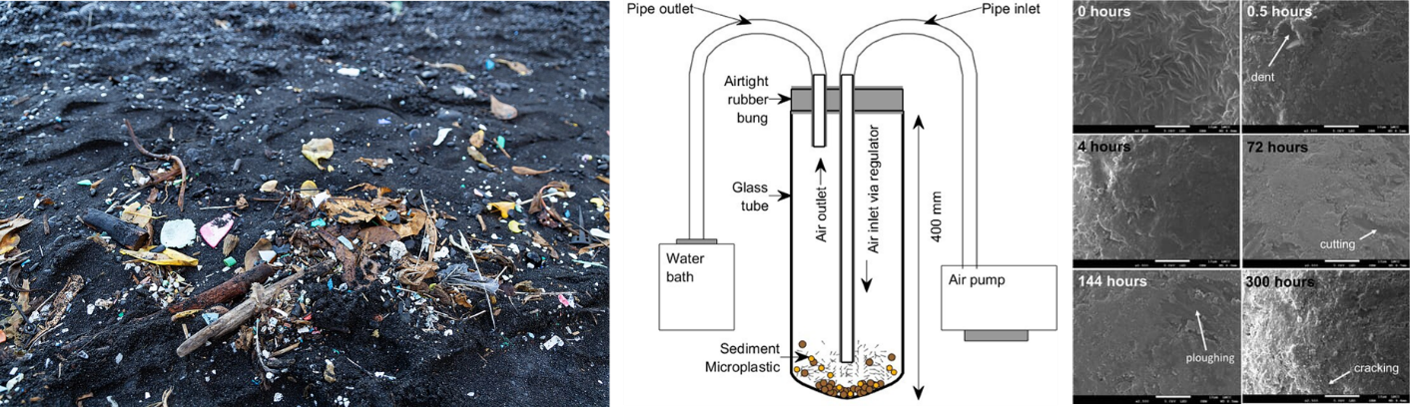
Figure 1: Left: Litter, including plastic, on a volcanic black sand beach, Maui (Photo: dronepicr, Wikimedia Commons). Middle: Abrasian chamber experimental method used in Alvarez-Barrantes et al., 2025. Right: SEM image comparing degradation over different times from Bullard et al., 2023.
This project does not offer a CASE studentship
Each host has a slightly different application process.
Find out how to apply for this studentship.
All applications must include the CENTA application form.
Choose your application route
Pyroclastic materials will be provided by Rebecca Williams. A rotational tumbler and an abrasion chamber are used to agitate pyroclastic materials with plastic particles in order to simulate particle-particle collisions that occur in granular flows and aeolian transport in volcanic settings. Different particle sizes, shapes and chemical composition will be considered. Abraded samples will be characterised through a combination of optical mineralogy, laser diffraction particle size analysers, and high-resolution image analysis by scanning electron microscopy (SEM) and focussed ion beam (FIB). Energy-dispersive spectroscopy (EDS) will be used to analyse the chemical composition and map the elemental distribution at the surface of the microplastics after each abrasion experiment, with mapping FTIR spectroscopy capability used to further assess and quantify chemical composition. Contact angle measurement and x-ray photoelectron spectroscopy (XPS) will further inform surface vs bulk characteristics.
DRs will be awarded CENTA Training Credits (CTCs) for participation in CENTA-provided and ‘free choice’ external training. One CTC can be earned per 3 hours training, and DRs must accrue 100 CTCs across the three and a half years of their PhD.
The student will gain training and expertise in the field of volcanology, chemistry, materials science and aeolian materials transport modelling. Design and use of unique abrasion chambers will be central to the laboratory modelling experiments, with the student being supported to develop a methodology using rotational tumblers. Training will be given on all stages of the experimental design, sample collection, preparation, quantitative and qualitative analysis from materials chemistry and geospatial perspectives, with specific instrumentation training provided. The student will work with Loughborough’s ‘Centre for Analytical Science’ and ‘Materials Characterisation Centre’, two state-of-the-art characterisation facilities supported by a team of specialists.
Year 1: The first year will focus on training on background topics (e.g. pyroclastic materials and microplastic pollution) and core practical skills (sample characterisation, experimental techniques). Year 1 will characterise pyroclastic samples and plastic particles prior to experimentation, conduct prototype experiments and perform initial analysis of first experiments. It will complete with a full methodological protocol developed for abrasion chamber and rotational tumbler experiments.
Year 2: The second year will complete abrasion chamber and rotational tumbler experiments. Training will focus on analytical training and develop a validated workflow for analysis of the resulting experimental sediment-microplastic mixtures. Initial characterisation of sediment-microplastic mixture following experiments will be conducted.
Year 3: The third year will see the completion of characterisation of sediment-microplastic mixture following experiments. The focus will be on analysis and integration of results across experimental suites and samples. Training will focus on science communication and dissemination of findings across varied, relevant audiences (academic, public, industry, government).
Manuscripts will be prepared for publication in consultation with the supervisory team, with the intention that this is conducted at suitable points across the duration of the PhD.
Alvarez-Barrantes, L., Bullard, J., Davis, S., Neuman, C.M., O’Brien, P., Roach, P. and Zhou, Z., (2025). The effects of sediment properties on the aeolian abrasion and surface characteristics of microplastics. Philosophical transactions. Series A, Mathematical, physical, and engineering sciences, 383(2307), p.20240443.
Bullard, J.E., Zhou, Z., Davis, S. and Fowler, S., (2023). Breakdown and modification of microplastic beads by aeolian abrasion. Environmental Science & Technology, 57(1), pp.76-84.
Iroegbu, A.O.C., Ray, S.S., Mbarane, V., Bordado, J.C. and Sardinha, J.P., (2021). Plastic pollution: a perspective on matters arising: challenges and opportunities. ACS omega, 6(30), p.19343.
Rangel-Buitrago, N. and Neal, W.J., (2023). A geological perspective of plastic pollution. Science of the Total Environment, 893, p.164867.
Walding, N., Williams, R., Rowley, P., Dowey, N., Parsons, D. and Bird, A., (2025). Behaviours of pyroclastic and analogue materials, in dry and wet environments, for use in experimental modelling of pyroclastic density currents. Volcanica, 8(1), pp.261-285.
For informal inquiries about this project, please contact the lead supervisor Professor Rebecca Williams ([email protected]) (https://www.lboro.ac.uk/schools/abce/staff/rebecca-williams/).
To apply to this project:
Applications must be submitted by 23:59 GMT on Wednesday 6th January 2027.