

Phosphorus pollution is one of the most persistent threats to lakes and reservoirs worldwide, driving harmful algal blooms and damaging aquatic ecosystems. Many UK lakes have a long history of nutrient enrichment, and effective management requires identifying whether phosphorus originates from sewage, fertiliser and soils within the catchment, or from legacy phosphorus recycled from lake sediments. Conventional water chemistry cannot reliably distinguish between these sources.
Phosphate carries a natural chemical fingerprint in its oxygen isotope composition that can reveal phosphorus sources and indicate whether phosphorus is being recycled or biologically processed. However, the standard analytical approach, Isotope Ratio Mass Spectrometry (IRMS), requires relatively large amounts of phosphorus. This limits its application to key processes that can dominate
phosphorus supply despite producing only small sample volumes, including sediment phosphorus release and microbial cycling of organic phosphorus. These processes are particularly important in managed lakes where external phosphorus inputs have already been reduced, yet the samples needed to investigate them, such as sediment porewaters and organic phosphorus compounds in microbes, are often too small for routine IRMS analysis.
Low-mass Orbitrap mass spectrometry (Orbitrap-MS), a much more sensitive technique, has recently been shown to measure phosphate oxygen isotopes using substantially smaller quantities of material. However, no UK laboratory has yet established this capability, and the preparation methods required for complex environmental samples remain poorly tested.
This project will address this gap by developing and validating a new Orbitrap-MS method for phosphate oxygen isotope analysis for small volumes of complex environmental samples, with real-world application to lake water and sediment samples. The research will determine whether legacy sediment phosphorus release and microbial organic phosphorus cycling contribute to ongoing nutrient problems, providing new evidence to support lake and catchment management. There will also be opportunities to expand the Orbitrap-MS methods developed during the project to undertake other novel analyses, including nitrate and/or carbon isotope measurements and investigations of emerging contaminants such as PFAS, depending on the student’s interests and the direction of the research.
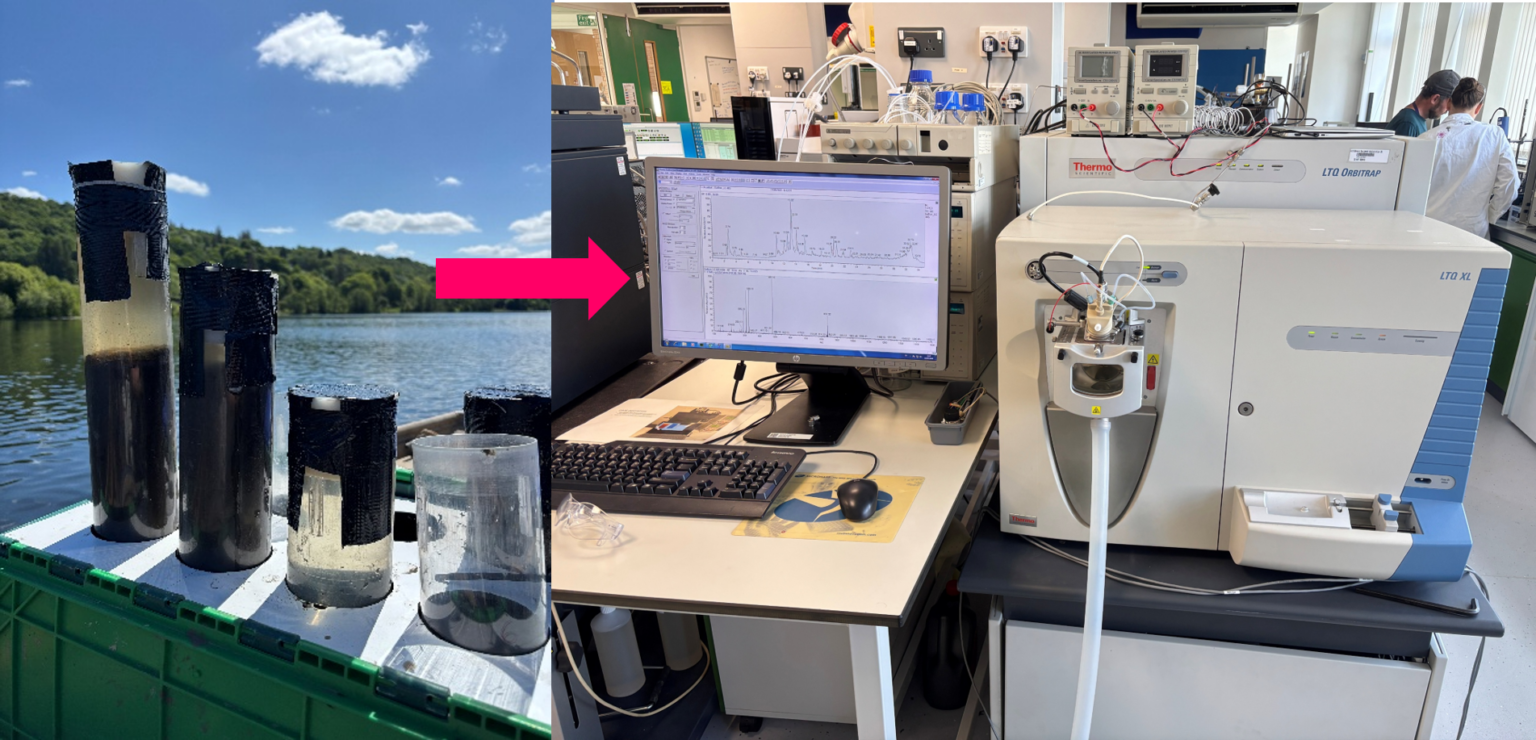
Figure 1: Photos showing lake sediments (left) from which porewaters and organic compounds will be extracted for and purified for analysis using Orbitrap mass spectrometry (right), cross-validated against the established methods at the British Geological Survey, to evaluate legacy phosphorus sources and biogeochemical processes.
This project does not offer a CASE studentship
Each host has a slightly different application process.
Find out how to apply for this studentship.
All applications must include the CENTA application form.
Choose your application route
The project is primarily laboratory-based, developing chemical extraction and purification protocols for phosphate oxygen isotope analysis by Orbitrap mass spectrometry, optimised for low-phosphorus samples including sediment porewaters and organic phosphorus compounds. Sample-mass thresholds will be systematically tested to define where results remain reliable across these challenging matrices. The new method will be validated against the established Ag3PO4 isotope ratio mass spectrometry approach used at the British Geological Survey, benchmarking accuracy and comparability. Fieldwork will be undertaken to collect samples from a UK lake affected by nutrient enrichment across contrasting seasons, capturing temporal variation in phosphorus cycling. Complementary analytical approaches, including nutrient chemistry, sediment characterisation, and other isotope analyses, will provide broader environmental context. The validated method will then be applied to test whether legacy phosphorus release from sediments and microbial cycling of organic phosphorus are contributing to sustained nutrient enrichment, generating evidence directly relevant to lake and catchment management.
DRs will be awarded CENTA Training Credits (CTCs) for participation in CENTA-provided and ‘free choice’ external training. One CTC can be earned per 3 hours training, and DRs must accrue 100 CTCs across the three and a half years of their PhD.
The student will develop skills in analytical chemistry, including Orbitrap mass spectrometry, phosphorus extraction and purification, alongside environmental geochemistry, stable isotope analysis, and biogeochemical cycling. Training will also cover field sampling, risk assessment, COSHH procedures, data analysis, and scientific communication. Additional opportunities include water chemistry (spectrophotometry, ion chromatography), photosynthetic pigment analysis (HPLC), and emerging contaminant analysis (LC-MS). Co-supervision across Geography, Chemistry, and the British Geological Survey will provide experience in both method development and applied environmental science. The student will gain specialist expertise, collaborate with international researchers through established supervisory networks, and disseminate findings through conferences and peer-reviewed publications.
British Geological Survey – British Geological Survey, Keyworth, Nottingham, NG12 5GG – [email protected]
This project is supported by co-supervision from Dr. Andrew Smith at the British Geological Survey (BGS). BGS will provide training in stable isotope methods and the established Ag₃PO₄-IRMS technique, providing baseline skills and underpinning method validation. BGS will host in-person visits for hands-on laboratory training, broadening the student’s professional skillset and networks and wider experience of applied environmental science, supporting long-term career development beyond academia.
Year 1: Gain familiarity with the Orbitrap-MS instrument at Loughborough and identify setup requirements; training visits to the British Geological Survey in stable isotope and Ag₃PO₄-IRMS methods; literature review; begin developing and testing extraction and purification protocols using reference standards.
Year 2: Collect lake water, sediment and porewater samples; develop and refine methods for analysis of real environmental samples, including sediments, porewaters and organic phosphorus compounds. Potential opportunities for visits to established academic networks of supervisory team at Thermo Fisher Scientific (Orbitrap-MS developers) or EAWAG (Switzerland, one of the three international labs where Orbitrap-MS is run for phosphate oxygen isotopes) to support career development opportunities.
Year 3: Finalise the method intercomparison studies on different matrices against established BGS approaches; undertake data interpretation and synthesis for lake management application; begin preparation of peer-reviewed publications. Depending on progress and student interest, scope to expand the method to further sample matrices and/or to nitrate isotopes.
Year 4: Finalise write up of thesis and manuscripts.
Bengt, C., Worne, S., Wynn, P., Prohaska, A., Sexton, T. and Smith, A.C., 2026. Phosphate oxygen isotopes in lake sediments: stability and application for assessing palaeo nutrient dynamics. Biogeochemistry. https://doi.org/10.1007/s10533-026-01324-0
Bernet, N.M., Soldini, C., Felder, T.M.O., Lapčíková, K., Neubauer, C., Queen, W.L., Kaegi, R., Tamburini, F. and Hofstetter, T.B., 2025. Oxygen isotope analyses of phosphate and organophosphorus compounds by electrospray ionization Orbitrap mass spectrometry. Analytical Chemistry, 97(41), pp.22777–22786. https://doi.org/10.1021/acs.analchem.5c04367
Ishida, T., Tayasu, I., Onodera, S., Ban, S. and Okuda, N., 2022. A new sampling method with zirconium-loaded resin for phosphate oxygen isotope analysis in oligotrophic freshwater systems. Rapid Communications in Mass Spectrometry, 36(22), e9393. https://doi.org/10.1002/rcm.9393
Ishida, T., Kamiya, H., Uehara, Y., Kato, T., Sugahara, S., Onodera, S., Ban, S., Paytan, A., Tayasu, I. and Okuda, N., 2022. A new method for phosphate purification for oxygen isotope ratio analysis in freshwater and soil extracts using solid-phase extraction with zirconium-loaded resin. Rapid Communications in Mass Spectrometry, 36(22), e9384. https://doi.org/10.1002/rcm.9384
Wang, Z., Hattori, S., Peng, Y., Zhu, L., Wei, Z. and Bao, H., 2024. Oxygen isotope analysis of nanomole phosphate using PO₃⁻ fragment in ESI-Orbitrap-MS. Analytical Chemistry, 96(11), pp.4369–4376. https://doi.org/10.1021/acs.analchem.3c03070
Wei, Z., Wang, B., Zhu, L., Hong, Y., Wang, Z., Yan, H., Peng, Y., Hattori, S. and Bao, H., 2025. A sub-liter pretreatment method for Orbitrap-based freshwater phosphate oxygen isotope measurement. Applied Geochemistry, 194, 106610. https://doi.org/10.1016/j.apgeochem.2025.106610
For informal inquiries about this project, please contact the lead supervisor Dr Savannah Worne ([email protected]) at Loughborough University.
To apply to this project:
Applications must be submitted by 23:59 GMT on Wednesday 6th January 2027.