

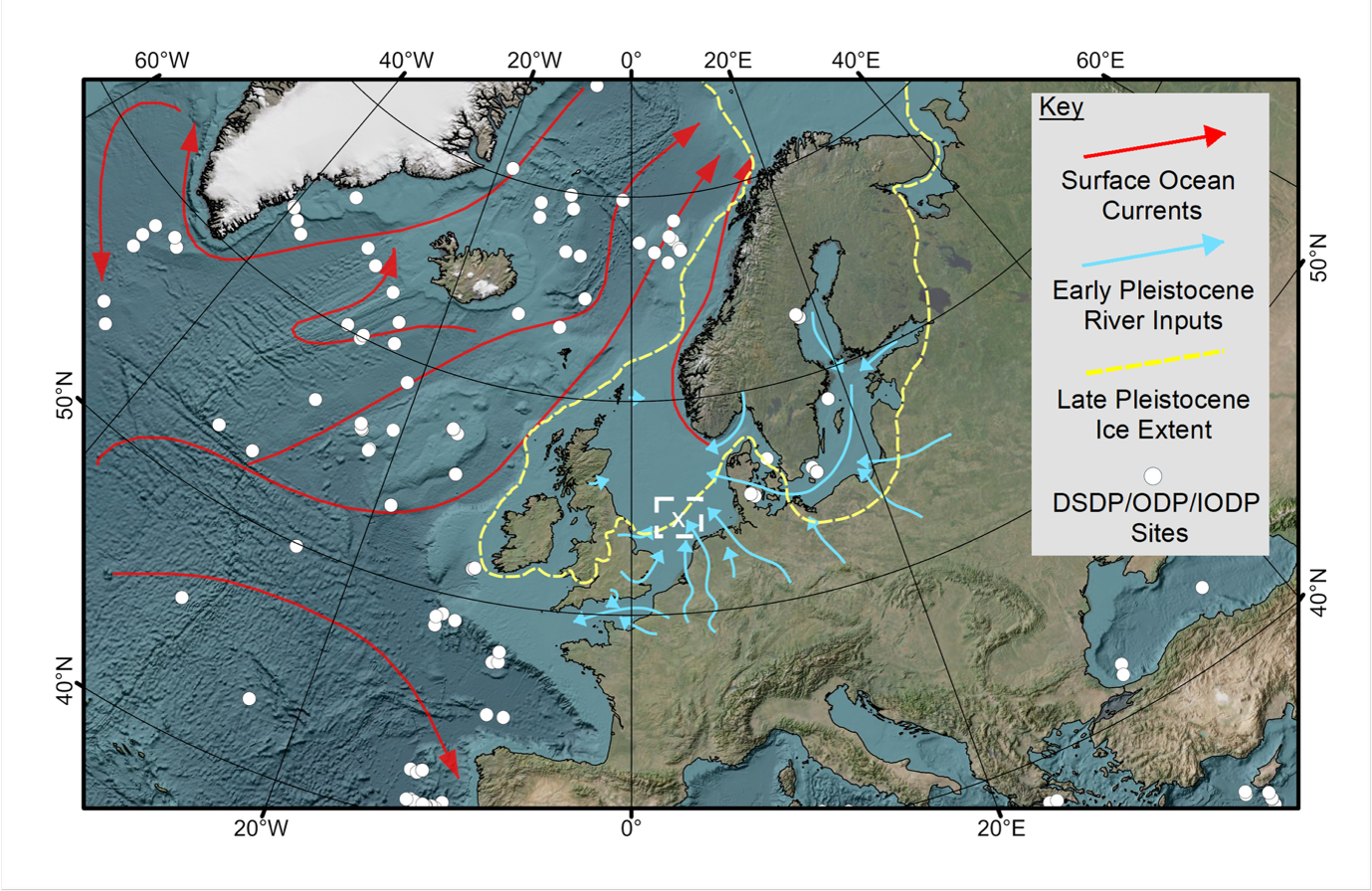
Modern environmental conditions and seasonal availability of food/nutrients drive the marine ecosystem variability1. Mid-latitudes form an important connection between low- and high-latitudes for recording impacts of evolving climatic conditions and its ecological effect. With the onset of major Northern Hemisphere Glaciation (NHG) at ~2.6 million years ago (Ma), the Earth transitioned from warmer late Pliocene conditions to the colder Pleistocene epoch with intensifying glacial-interglacial cycles as the icesheets grew to live longer and become larger. The North Sea Basin (NSB) contains extended sequence (~1.2 km) of palaeoclimate history of the Plio-Pleistocene, but it remains unexplored for palaeoenvironmental change due to absence of scientific drilling in the region2 (Figure 1). The International Ocean Drilling Programme (IODP3) Expedition 507 will recover the first such sedimentary sequence to investigate environmental and ecological changes in the NSB across evolving global climate of the Plio-Pleistocene. The sediments from the mid-latitude study Site (~55°N, 3°E) will generate new multi-proxy palaeoclimate records to assess changes in European hydroclimate as well as linkages between high and low latitude climate and ecosystem.
The project’s team-members are selected to participate in the Expedition 507. You will be part of the extended team to help contribute to age model, continental hydrological change, upper ocean conditions (e.g. temperature, nutrients, stratification) and marine ecosystem (using foraminifera and/or coccolithophore) reconstructions across the cold and warm intervals of the early Pleistocene and late Pliocene (~2.8 to 2.0 Ma). Together these groups capture different upper-ocean habitats allowing changes in community composition and biogeography to be assessed alongside changing ocean conditions. New records will be interpreted in the context of the glacial-interglacial variability as icesheets grew for the establishment of NHG, with an unprecedented wealth of available data3. You will contribute to the Expedition’s preliminary stratigraphic framework and help refine it further for your study interval to generate bulk sediment geochemical record using X-Ray Fluorescence (XRF) and foraminifera (trace elements and oxygen and carbon isotopes) to infer changes in European palaeoclimate and upper ocean conditions respectively, across timescales. New data will help you put NSB records in the context of published high- and low-latitude climate data to assess regional climate-ecosystem change and address – how the shallow marine NSB climate and ecosystem evolved during the cold and warm climate conditions of the late Pliocene and early Pleistocene.
Figure 1: Study Site in the North Sea Basin (IODP3 expedition 507) represented as X (~55° N, 3° E) along with regional context showing surface ocean currents (red arrows), early Pleistocene River inputs (blue arrows), late Pleistocene Ice extent (yellow dashed line) and DSDP/ODP/IODP Sites (white circles). [Figure credit: Andrew Newton]
This project does not offer a CASE studentship
Each host has a slightly different application process.
Find out how to apply for this studentship.
All applications must include the CENTA application form.
Choose your application route
The student will obtain bulk sediment geochemical data using a portable XRF to calibrate XRF core scan elemental composition. Samples will be processed for coccolithophore (<63 µm; Tangunan) and foraminiferal (>150 µm; Woodhouse) assemblage analyses, and geochemical work in the fully equipped laboratories at The Open University. Coarse fraction samples will also be used to generate benthic and planktic foraminifera oxygen and carbon isotopes data to infer changes in stratification, nutrients and/or refine stratigraphy (Anand, Tangunan). Furthermore, targeted glacial (cold) and interglacial (warm) samples will be used to generate multi-species foraminifera geochemical (coupled trace element and oxygen isotope) data to reconstruct water column properties change. Additionally, there will be an opportunity to generate organic proxy data for temperature from the same sediments (Badger). You will gain training and skills to become an independent researcher and generate new records to evaluate NSB palaeoenvironmental and ecosystem change.
DRs will be awarded CENTA Training Credits (CTCs) for participation in CENTA-provided and ‘free choice’ external training. One CTC can be earned per 3 hours training, and DRs must accrue 100 CTCs across the three and a half years of their PhD.
In addition, the student will receive project specific skills training from supervisors and collaborators: foraminifera taxonomy (Woodhouse) and geochemical analyses (Anand), biostratigraphy, coccolithophore taxonomy and age model refinement (Tangunan), oxygen isotope and trace elements (Anand).
Specific skills that will be acquired during this project include:
There is potential to include BGS as a collaborative partner.
Year 1: Generate bulk sediment XRF data and process sediments from the study interval to familiarise with the taxonomy using available training set and atlas. Collaborate with expedition scientists to use/refine stratigraphic framework for interpreting bulk sediment XRF data. Present preliminary data at the UK-IODP and International Conference on Palaeoceanography meetings.
Year 2: Identify samples for evaluating and generating foraminifera, coccolithophore or organic geochemical data after receiving training in interested geochemical techniques. Obtain micropalaeontological and/or geochemical data from targeted orbital cycles of the Plio-Pleistocene interval. Present data at Pal(a)eoPERCS seminar and UK Palaeoclimate Society meeting.
Year 3: Finish remaining analytical work, data analyses, and present results at an international conference and write up thesis and/or prepare manuscript(s).
Journal:
Students should have a background in Earth science, geography, environmental science, chemistry or similar, and an enthusiasm for learning/contributing to palaeoclimate scientific exploration. Experience of labwork and interests in (in)organic geochemistry/micropalaeontology is highly desirable. The student will join a well-established team researching paleoenvironmental change at the Open University. If you would like to apply or require further information, please contact [email protected].
To apply to this project:
You should make your application via The Open University’s applications portal. If you do not already have an account for this portal, you will need to register your interest and will be prompted to create an account. As part of your application, you will need to provide:
Applications must be submitted by 23:59 GMT on Wednesday 6th January 2027.