

The Plio-Pleistocene intensification of global glacial-interglacial cycles starting 3.6 Million years ago had a profound impact on global and regional climate, landscapes and ecosystems. The effects were particularly strongly felt in northwest Europe, where large ice sheets became a frequent visitor to the continent for the first time in many millions of years – waxing and waning with a rhythm paced by the astronomical metronome of Milankovitch cyclicity.
Whilst we know much about the last glacial cycle the earlier history of glaciation in northwest Europe is much more poorly understood, not least because the most recent glaciation overrode, displaced and eroded the evidence of earlier glacials on the land, the sea, in cores.
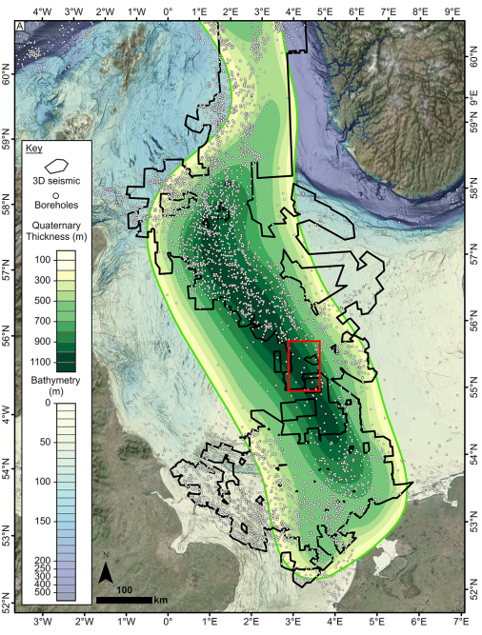
At the centre of the glacial action throughout the Plio-Pleistocene lay the 600 km long North Sea Basin, a depocenter which accumulated a 1.2 km thick sediment stack recording the history of the continent and its marginal ice sheets, glacial variability, and climate and ecosystem changes (see Figure below). Europe’s largest river systems fed into the basin, bringing with them of evidence of what was happening all across the European land mass. To date this extraordinary archive of glacial history has not been tapped, but in the Spring of 2027 the International Ocean Drilling Program’s Expedition 507 (IODP3 507) will for the first time recover full-depth sediments from the centre of the basin, allowing exploration of the full Plio-Pleistocene history of the continent at unprecedented temporal resolution.
This project will use molecular- and pollen- fossils from the cores recovered by Expedition 507 to elucidate the glacial history of the circum-North Sea Basin. Using hyphenated techniques such as GC-FID, GC-MS and HPLC-MS the project will develop high temporal-resolution records of the evolution of the basin. Molecular fossil proxies will be used to record the climatic evolution of land and sea, the waxing and waning of sea ice, and the migrating sources of rivers feeding into the basin. These will be coupled to pollen records from Expedition 507 and surrounding land masses to track evolution of the landscapes, climate and ecosystems on land and sea at extraordinary detail.
Figure 1: The North Sea Basin, showing thickness of the Quaternary sediments in and bathymetry of the basin. The proposed drilling site for Expedition 507 will be within the area of maximum thickness bounded by the red box. From Newton et al., (2026) CC-BY with imagery from Esri, EMODNet Bathymetry Consortium, Maxar, Earthstar Geographics and the GIS user community.
This project does not offer a CASE studentship
Each host has a slightly different application process.
Find out how to apply for this studentship.
All applications must include the CENTA application form.
Choose your application route
The student will generate multi-proxy high temporal resolution climate records from the Expedition 507 cores drilled by the International Ocean Drilling Programme (IODP3). Following a literature review in their first year, the PhD researcher will generate organic– and pollen-based proxy records including biomarker records from alkenones, alkanes, likely Highly Branched Isoprenoids such as IP25, and GDGTs. These will be integrated with palynology and other datasets from the Expedition 507 Cores and datasets from the wider circum-North Sea Basin. Analytical measurements will be performed by the student at The Open University, Milton Keynes and the University of Southampton’s Waterfront Campus at the National Oceanography Centre, Southampton.
DRs will be awarded CENTA Training Credits (CTCs) for participation in CENTA-provided and ‘free choice’ external training. One CTC can be earned per 3 hours training, and DRs must accrue 100 CTCs across the three and a half years of their PhD.
The student will be trained in advanced organic geochemistry and palynology techniques including organic clean lab extractions, column chromatography and solvent handing techniques. Training will be provided in analysis using hyphenated techniques (GC-FID, GC-MS, HPLC-MS) in the state-of-the-art laboratories at the OU. The student will acquire significant skills in organic biomarker analysis, identification and interpretation. Further training will include:
The project will form part of the research in the moratorium period for IODP3 Expedition 507 and so it is expected that the student will work with partners from across the Expedition 507 Science Team. This will likely involve attendance of Expedition 507 Science Team meetings and possibly visits to members of the Science Team in the UK and overseas.
Year 1: Literature review, training in laboratory techniques with supervisors and lab teams, integrate with the Expedition 507 Science Team. Initial lab processing of samples using Accelerated Solvent Extraction and small column chromatography. Pilot samples analysed by GC-FID. Attend UKIODP Meeting and British Organic Geochemical Society Annual Meeting (BOGS)
Year 2: Continuation of sample processing and cleanup. Analysis of samples by GC-FID, GC-MS, HPLC-MS. Palynology sampling and analysis. Integration of first datasets with wider Expedition 507 Science Team data products. Prepare first manuscript. Present preliminary data at UK-based conferences (BOGS and UKIODP meetings) with potential to attend the 16th International Conference on Paleoceanography in St Andrews.
Year 3: Finalisation of datasets, bio-informatics on larger datasets from Expedition 507. Data interpretation and write-up. Present data at major international conference (e.g. American Geophysical Union Fall Meeting or Goldschmidt Conference). Write up thesis and subsequent manuscripts for publication.
As Expedition 507 is scheduled to complete offshore operations in Spring/Summer 2027 and onshore operations in Late Summer 2027, the exact timeline will be confirmed once sample availability is confirmed.
Newton, A. M. W., Busschers, F. S., Ninnemann, U. S., and Stewart, M. A. (2026) IODP3 Expedition 507 “Late Cenozoic Glaciers, LAndscapes, Climates, and Ecosystems of the North Sea (GLACE-NS)” Scientific Prospectus, in: IODP³ Expedition 507: Late Cenozoic Glaciers, LAndscapes, Climates, and Ecosystems of the North Sea (GLACE-NS), Proc. Int. Ocean Drill. Prog., 507, 1, https://doi.org/10.5194/piodp-507-1-2026
Donders, T. H., van Helmond, N. A. G. M., Verreussel, R., Munsterman, D., ten Veen, J., Speijer, R. P., Weijers, J. W. H., Sangiorgi, F., Peterse, F., Reichart, G.-J., Sinninghe Damsté, J. S., Lourens, L., Kuhlmann, G., and Brinkhuis, H. (2018) Land–sea coupling of early Pleistocene glacial cycles in the southern North Sea exhibit dominant Northern Hemisphere forcing, Clim. Past, 14, 397–411, https://doi.org/10.5194/cp-14-397-2018
Students should have a background in Earth science, geography, environmental science, chemistry or similar, and an enthusiasm for learning/contributing to palaeoclimate scientific exploration. Experience of labwork and interests in (in)organic geochemistry would be helpful. The student will join a well-established team researching paleoenvironmental change at the Open University. If you would like further information, please contact [email protected].
To apply to this project:
You should make your application via The Open University’s applications portal. If you do not already have an account for this portal, you will need to register your interest and will be prompted to create an account. As part of your application, you will need to provide:
Applications must be submitted by 23:59 GMT on Wednesday 6th January 2027.