

Hypersaline environments are some of the most diverse on Earth with unique microbial populations, geochemical properties and environmental fluctuations (Paul and Mormile, 2017). Microbial communities collaborate in these environments to create conditions advantageous to their survival, driving adaptations to extracellular stress (Keneally et al., 2025). However, many terrestrial hypersaline environments are shrinking – often attributed to humans (agriculture, industry) and/or climate change (Clutter, 2023). The effects of these changes on microbial populations have not been well studied, but there is evidence that permanent aridification of hypersaline lakes leads to shifts towards unknown and rare taxa (Fairén et al., 2023), facilitating changes in metabolic strategies and alteration in biogeochemical cycling. Studying how microbiomes respond to environmental change is therefore crucial to understanding ecosystem behaviour, and biogeochemical cycling, in threatened hypersaline environments (Macey et al., 2026).
Microbial life survives and thrives in these conditions (that no human could tolerate) by utilising and producing small metabolic compounds (metabolites). Not only are these used for energy, but also as a tool for communication, co-operation, defence and survival. How microbes use and exploit these compounds and the metabolic pathways they interact within, is underexplored therefore their examination could provide a tool relevant to an array of applications; including climate change monitoring, antimicrobial resistance (AMR), and environmental biotechnology & informatics. Understanding production and utilisation of these compounds could help us understand survivability, with implications for the search for life on other planetary bodies (Batty et al., 2024). By creating microcosms comparing two separate lake sediment chemistries (sulfate rich vs chloride rich), this study will investigate how increased salinity and decreased water availability affect the taxonomy and metabolic functions of microbiomes from diverse hypersaline environments.
By integrating a multi ‘omics (holistic approach to analyse complex biological and chemical data using metagenomics, metabolomics and volatilomics) approach the microcosms can be characterised under controlled parameters thus be used to predict the microbial ecology of these systems. This research will significantly expand our understanding of the chemical diversity of metabolites across the extreme limits of life, potentially identifying key and novel features that could provide significant medical and industrial utility.
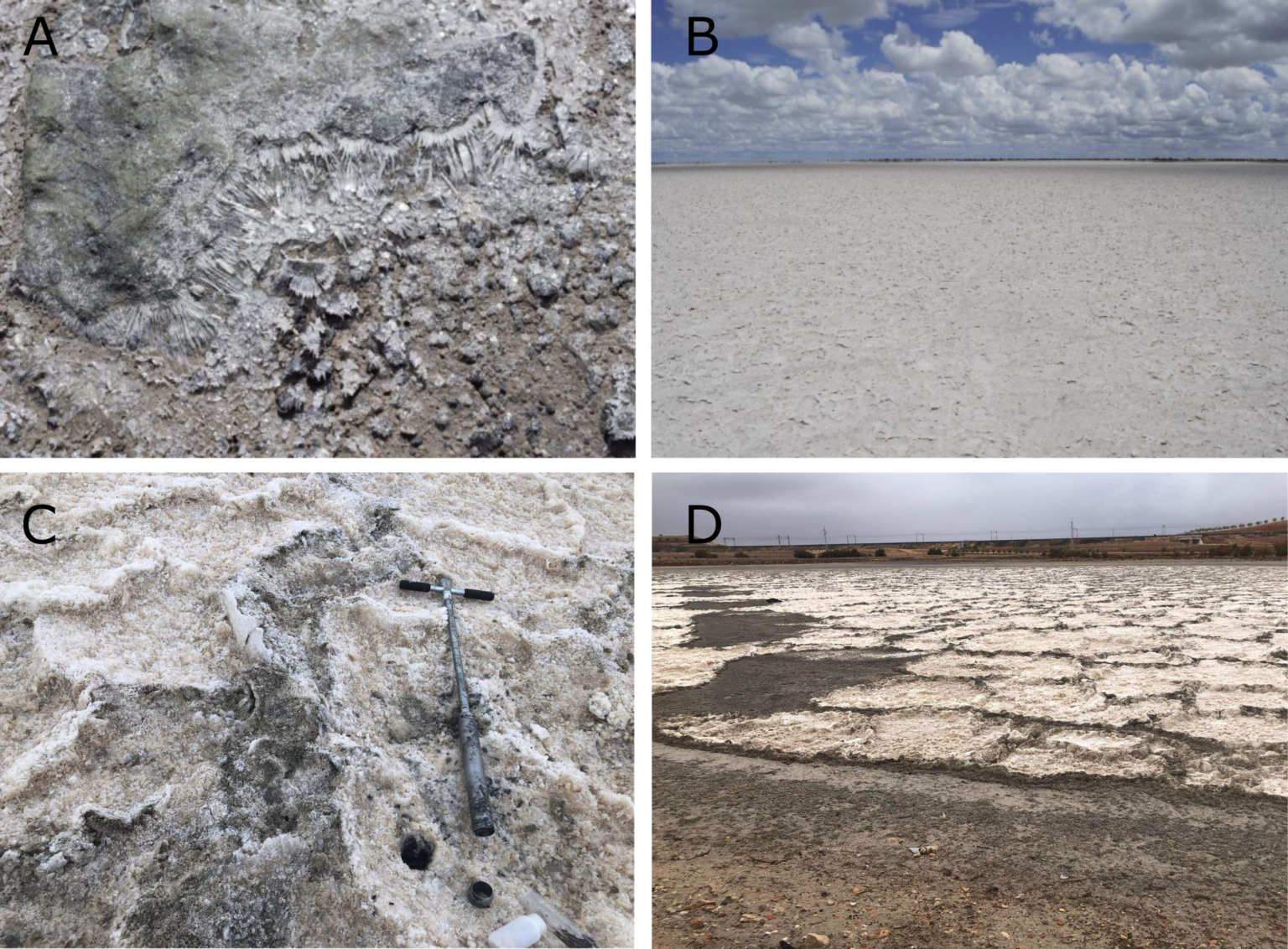
Figure 1: Examples of salt crystals (A) and Pans (B) of a chloride rich hypersaline environment in the Makgadikgadi Salt Pans, Botswana and surface salt crust (C, D) of a sulfate-rich desiccated lakebed in La Mancha, Spain.
This project does not offer a CASE studentship
Each host has a slightly different application process.
Find out how to apply for this studentship.
All applications must include the CENTA application form.
Choose your application route
Pre–collected samples from an extreme hypersaline environment will be utilised to create 4 x 30cm tall column microcosms, (plus controls) which will contain anoxic sediment and saline solution. The microcosms will contain two different lake sediments with distinct chemistries: a chloride-rich chemistry and a sulfate-rich chemistry. The columns themselves will be developed with the student, at the OU and be designed to collect liquid and gas samples at specified intervals; without disturbing the microcosm environment. Samples will be collected and analysed over a 2–year period with a multi’omics’ approach. This includes DNA extraction, and 16S sequencing for metagenomics, and GC-MS and SIFT-MS for metabolomics and volatilomics all of which can be carried out by the student between the OU and UKCEH. The data will be analysed with state-of-the-art bioinformatics tools and workflows.
DRs will be awarded CENTA Training Credits (CTCs) for participation in CENTA-provided and ‘free choice’ external training. One CTC can be earned per 3 hours training, and DRs must accrue 100 CTCs across the three and a half years of their PhD.
The student will be trained in techniques across microbiology, analytical chemistry and statistics. These will include microcosm design and engineering, DNA extraction, sequencing, mass-spectral techniques, and multivariate statistics. This combination of techniques will produce data that the student will analyse with advanced software, available at the Open University. The OU offers bespoke training including health & safety and laboratory skills. AstrobiologyOU offers training in CV-writing, managing budgets and fellowship writing and is committed to identifying teaching opportunities for any student that desires them. Early emphasis will be put on international conference participation, to gain visibility for the student.
Tim Goodall, based at CEH, will train the student to perform library preparation and 16S rRNA gene amplicon sequencing for taxonomic characterisation of the microcosm communities throughout the project. Even though these techniques are common in microbial ecology, many researchers do not have the laboratory skills or setup for gene amplicon sequencing. Thus, with the CEH collaboration, the student will be in a unique position to gain valuable technical skills.
Year 1: Initial literature review and objective writing; Design and building of bespoke microcosm environment; Training on instrumentation relevant to the PhD; Set-up and initial sampling from microcosms; training at UKCEH sequencing and library searching.
Year 2: Ongoing sampling from microcosms; Continued sample analysis; Statistical software training; Initial data analysis; Conference attendance.
Year 3: Completion of final microcosm sampling; complete data analysis; Interpretation of results, thesis writing.
Throughout the PhD the student will have the opportunity to be involved in public engagement, multidisciplinary seminars, and any other activities that would be relevant to their career progression and aspirations.
Batty, C.A., Pearson, V.K., Olsson-Francis, K., et al. (2024) Volatile organic compounds (VOCs) in terrestrial extreme environments: implications for life detection beyond Earth. Natural Product Reports. doi:10.1039/d4np00037d.
Fairén, A.G., Rodríguez, N., Sánchez-García, L., et al. (2023) Ecological successions throughout the desiccation of Tirez lagoon (Spain) as an astrobiological time-analog for wet-to-dry transitions on Mars. Scientific Reports 2023 13:1, 13 (1): 1423-. doi:10.1038/s41598-023-28327-3.
Clutter, C. (2023) From Sanguine to Hypersaline: Global Salt Lakes in Decline | ASM.org. Available at: https://asm.org/articles/2023/april/from-sanguine-to-hypersaline-global-salt-lakes-in (Accessed: 18 September 2026).
Keneally, C., Gaget, V., Chilton, D., et al. (2025) Microbial ecology in hypersaline coastal lagoons: A model for climate-induced coastal salinisation and eutrophication. Earth-Science Reviews. 266. doi:10.1016/j.earscirev.2025.105150.
Macey, M.C., Ilieva, V., Stephens, B.P., et al. (2026) Metagenomic insights into the taxonomic and metabolic diversity of the microbiome of Lake Karum in the Danakil Depression, Ethiopia. Environmental Microbiome. doi:10.1186/s40793-026-00938-z.
Paul, V.G. and Mormile, M.R. (2017) A case for the protection of saline and hypersaline environments: A microbiological perspective. FEMS Microbiology Ecology. 93 (8). doi:10.1093/femsec/fix091.
For any enquiries related to this project please contact Claire Batty, [email protected].
To apply to this project:
You should make your application via The Open University’s applications portal. If you do not already have an account for this portal, you will need to register your interest and will be prompted to create an account. As part of your application, you will need to provide:
Applications must be submitted by 23:59 GMT on Wednesday 6th January 2027.