

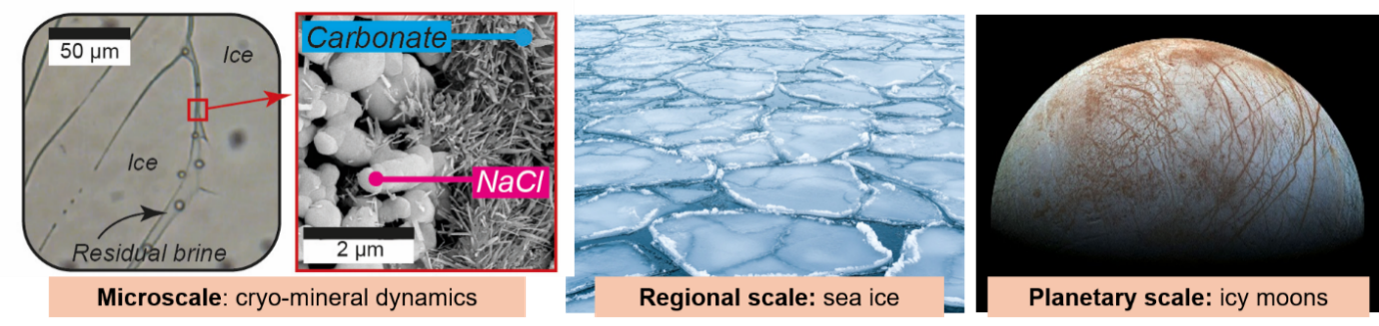
Saline ice is abundant on Earth and across the Solar System. As sea ice, it covers millions of square kilometres of Earth’s oceans, driving geochemical cycling and transport across marine, terrestrial and atmospheric interfaces in regions sensitive to climate change. In the outer Solar System, saline ice forms the thick shells of icy moons such as Europa and Enceladus, where salts transported from their interiors provide a window onto the chemistry and habitability of their hidden oceans. Although separated by millions of kilometres, the processes governing ice geochemistry across these worlds are the same.
Understanding material transport through saline ice on regional or planetary scales requires understanding chemical processes at the microscale within the ice matrix. Saline ice is structurally and compositionally heterogeneous. The formation of low-temperature solid phases, or cryo-minerals, within brine inclusions strongly influences its geochemical evolution, yet the mechanisms controlling their formation and interaction with residual brines remain poorly understood. A key unknown is how cryo-mineral formation and dissolution respond to different rates of temperature change. Recent work shows that different cooling rates produce different cryo-mineral assemblages (Hamp et al., 2026), suggesting an important role for kinetics. We also know little about how trace elements and organic compounds affect, or are incorporated during, cryo-mineral precipitation.
This project will investigate cryo-mineral dynamics using pioneering cryogenic experiments and cutting-edge low-temperature microanalysis. Experiments will be coupled with geochemical modelling of cryo-mineral kinetics to develop a mechanistic understanding of freezing and thawing in multiphase saline ice. The project aims to address questions: (i) How do cryo-mineral formation and dissolution vary as a function of cooling and warming rates? (ii) How does cryo-mineral formation affect the evolving composition of saline ice? And (iii) How do trace elements and organic compounds interact with cryo-minerals in chemically-complex ices?
The successful candidate will contribute to a fundamental understanding of ice geochemistry applicable to saline ices across the Solar System. Their results will improve predictions of geochemical responses to temperature change in Earth’s cryosphere and provide a framework for interpreting data from ESA’s JUICE and NASA’s Europa Clipper space missions, while informing instruments and sampling strategies for future icy-moon missions such as ESA’s L4.
Figure 1: The importance of cryo-minerals for ice geochemistry at a range of scales on Earth and beyond. Image credits: M. Fox-Powell, Tapio Haaja, NASA
This project does not offer a CASE studentship
Each host has a slightly different application process.
Find out how to apply for this studentship.
All applications must include the CENTA application form.
Choose your application route
The successful candidate will use cutting-edge cryogenic experimental, analytical and computational methods to identify and characterise cryo-minerals, investigate their growth and dissolution, and develop a predictive understanding of their formation. Methods will include:
The student may also work with natural saline ice samples from Earth’s cryosphere already available to the project team.
DRs will be awarded CENTA Training Credits (CTCs) for participation in CENTA-provided and ‘free choice’ external training. One CTC can be earned per 3 hours training, and DRs must accrue 100 CTCs across the three and a half years of their PhD.
The student will receive training in cryogenic experiments, including handling thermally unstable ice samples, and in spectroscopic and diffraction-based techniques for analysing the composition and crystal structures of low-temperature materials. An iterative cycle of analysis and model construction will provide training in formulating questions and testing hypotheses. Planning experimental campaigns will provide training in logistics and prioritisation. The student will gain experience managing collaborative work and training in scientific writing, grant proposal writing, time management, presentation skills, and networking. The student will join the interdisciplinary research group AstrobiologyOU, gaining experience communicating with researchers across science, governance and ethics disciplines.
This project will be conducted in collaboration with Dr Ines Collings (Natural History Museum). Dr Collings is an expert in applying diffraction techniques to probe crystal structure, including of cryo-minerals. The student will benefit from guidance from Dr Collings in planning and conducting X-ray diffraction measurements, and in analysing and interpreting diffraction data.
Year 1: Literature review and familiarisation with ice geochemistry, cryogenic mineral formation. Training and familiarisation with cryo-analytical techniques. Conducting initial experiments investigating cryo-mineral growth and dissolution across a range of temperature gradients. Report writing.
Year 2: Detailed experimental campaign investigating cryo-mineral formation and composition. Familiarisation with model codes and initial modelling of cryo-mineral kinetics. Present results at national conference and prepare manuscript for publication.
Year 3: Detailed modelling of cryo-mineral kinetics informed by experimental results. Correlative Raman-SEM mapping of cryo-mineral phases. Prepare second manuscript for publication. Present results at a major international conference. Write up and submit thesis.
Vancoppenolle, M., et al. (2013) Role of sea ice in global biogeochemical cycles: emerging views and challenges. Quaternary Science Reviews 79, 207-23. https://doi.org/10.1016/j.quascirev.2013.04.011
Butler and Kennedy (2015) An investigation of mineral dynamics in frozen seawater brines by direct measurement with synchrotron X-ray powder diffraction. Journal of Geophysical Research: Oceans 120, 5686–5697. https://doi.org/10.1002/2015JC011032
Fox‐Powell, M.G. and Cousins, C.R. (2021). Partitioning of crystalline and amorphous phases during freezing of simulated Enceladus ocean fluids. Journal of Geophysical Research: Planets, 126(1), p.e2020JE006628. https://doi.org/10.1029/2020JE006628
Hamp, R.E., Fox-Powell, M.G., et al. (2026) Sodium chloride hydrates provide an archive of ocean fluid freezing rates at icy worlds. Earth and Planetary Science Letters 690, 120196. https://doi.org/10.1016/j.epsl.2026.120196
Vance, S.D., et al. (2020) The salty secrets of icy ocean worlds. Journal of Geophysical Research: Planets 126, e2020JE006736. https://doi.org/10.1029/2020JE006736
Collings, I.E., et al. (2026) Polymorphism of Magnesium Chloride Decahydrate under High Pressures and Low Temperatures Found in Icy Moons. ACS Earth and Space Chemistry 10 (2): 434–440. https://doi.org/10.1021/acsearthspacechem.5c00273
The successful candidate will join AstrobiologyOU, a vibrant, multi-disciplinary group of researchers investigating the scientific, technical and ethical challenges associated with understanding the limits of life on Earth and beyond.
For any enquiries related to this project please contact Mark Fox-Powell, [email protected].
To apply to this project:
You should make your application via The Open University’s applications portal. If you do not already have an account for this portal, you will need to register your interest and will be prompted to create an account. As part of your application, you will need to provide:
Applications must be submitted by 23:59 GMT on Wednesday 6th January 2027.