

The terrestrial biosphere is a key component of the global carbon cycle due the large exchange of CO2 between the biosphere and atmosphere each year, but the response of vegetation to the ongoing increase in atmospheric CO2 remains one of the largest uncertainties in future predictions of climate-carbon interactions and feedbacks. CO2 drives photosynthesis, and the CO2 fertilisation effect of elevated CO2 (eCO2) is believed to be the main driver of global vegetation ‘greening’ that is observed in satellite records of vegetation indices such as the Normalised Difference Vegetation Index (NDVI). The evidence for this comes largely from process-based vegetation models whose CO2-fertilisation responses are themselves only weakly constrained by direct observation at ecosystem scale. Free Air CO2 Enrichment (FACE) experiments provide evidence of how ecosystems respond to eCO2 but are rare in mature forests. The BIFoR (Birmingham Institute of Forest Research) FACE site in Staffordshire is the only such experiment in a mature temperate northern hemisphere forest and provides a unique opportunity to investigate the response of leaf and canopy traits to eCO2 and to what extent these can be linked to hyperspectral reflectance and other remote sensing signals for eCO2 attribution at larger scales.
Hyperspectral reflectance is sensitive to leaf pigments, water content, nitrogen, and structural carbohydrates such as lignin and cellulose, as well as to canopy architecture, all of which may respond to eCO2. Activity-linked signals, such as solar induced fluorescence, can provide further ecophysiological insight. Establishing mechanistic links between eCO2-driven physiological and structural changes and reflectance spectra will provide observation-based support to model-based predictions of attribution that are relevant to upcoming spaceborne hyperspectral missions.
This PhD project will use measurements of leaf properties, leaf and canopy hyperspectral reflectance and Lidar measurements from an airborne platform and modelling to investigate what properties are responding to eCO2, to what extent are these detectable in canopy reflectance spectra, and can this information be extended to develop full forest carbon estimates from remotely sensed data.
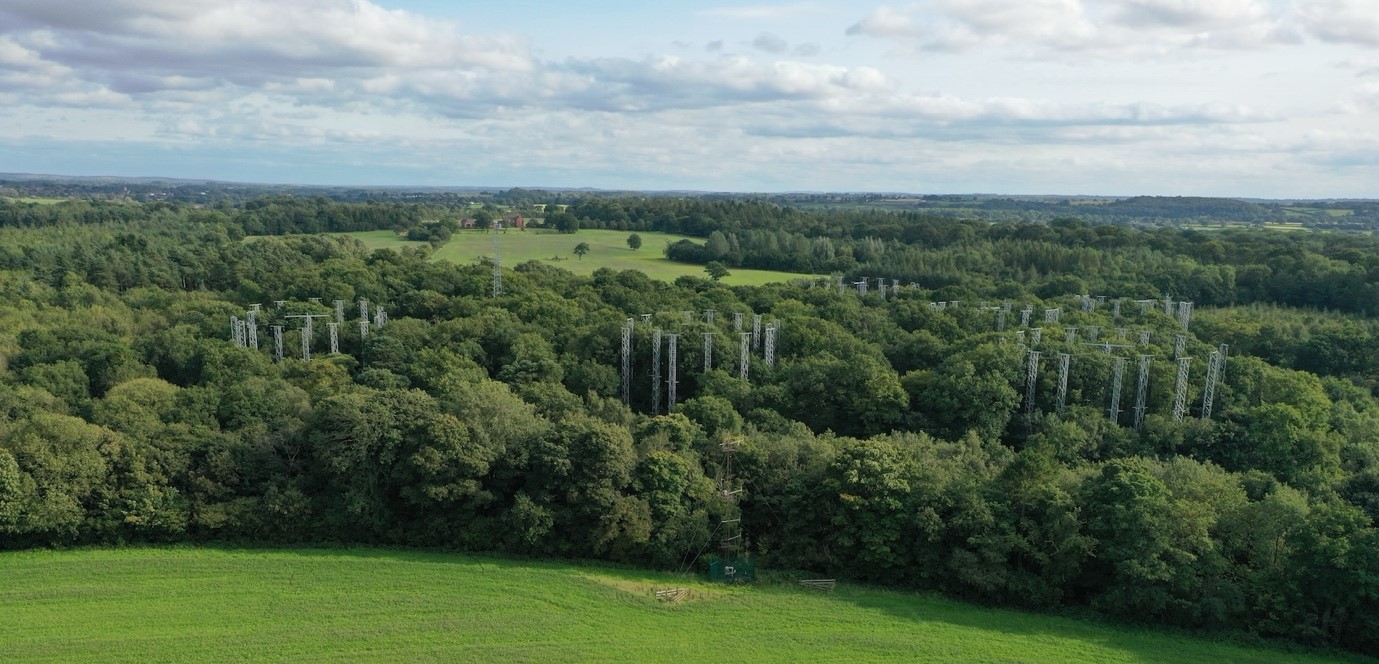
Figure 1: A view of the BIFoR FACE experimental site, showing the fumigation rings within a mature oak forest.
This project is a CENTA Flagship Project.
This project offers a CASE studentship
Each host has a slightly different application process.
Find out how to apply for this studentship.
All applications must include the CENTA application form.
Choose your application route
The project will be based at the BIFoR FACE site in Staffordshire, which has now had 10 years of elevated CO2 treatment at +150 ppm above ambient. Leaf-scale measurements of reflectance and absorption will be made with a field spectrometer on both canopy and understory species, with samples collected for further measurements of structural, functional and biochemical traits. Hyperspectral imagery of canopy reflectance from different time points across the decade of treatment from and airborne platform is available, with additional data likely collected during the PhD, together with airborne lidar. The reflectance, structural and associated physiological data (including existing data and new data collected where necessary) will be incorporated into a relevant radiative transfer model for simulating reflectance signatures, and allometric equations applied to this data to estimate full forest carbon estimates.
DRs will be awarded CENTA Training Credits (CTCs) for participation in CENTA-provided and ‘free choice’ external training. One CTC can be earned per 3 hours training, and DRs must accrue 100 CTCs across the three and a half years of their PhD.
You will receive training field spectroscopy, plant ecophysiology, and hyperspectral data analysis. You will also be supported in the development of your skills in experimental planning and project management. You will also be encouraged to participate in relevant networking and training programmes such as EU COST Actions. A rich and varied training programme is available to OU PG students which includes sessions on academic writing, research design and data management, career development communicating your research, as well as opportunities to get involved in public engagement, media and remote digital teaching.
This project is a collaboration between the Open University, the University of Birmingham and the remote sensing company 2Excel-geo, who are CASE partners on the project. This partnership will provide access to existing airborne hyperspectral imagery data from the site as well as new data, including airborne lidar data, collected during the PhD. You will have the opportunity to develop additional remote sensing data analysis skills through your CASE placement.
Year 1: Analysis of existing imagery data, collection of first season field data, submit project proposal and upgrade report.
Year 2: Second season of field data collection, model integration, and presentation of results at a national conference.
Year 3: Final data collection and analysis, writing up, and presentation at an international conference.
Foyer, C. H., A. Gardner, S. A. L. Hayward, et al. (2025). ‘Responses of an old deciduous forest ecosystem to elevated CO2.’ Global Change Biology 31, no. 7: e70355. doi: 10.1111/gcb.70355
Gardner, A., D. S. Ellsworth, K. Y. Crous, J. Pritchard, and A. R. MacKenzie (2022). ‘Is photosynthetic enhancement sustained through three years of elevated CO2 exposure in 175-Year-Old Quercus robur?’ Tree Physiology 42: 130–144. doi: 10.1093/treephys/tpab090
Piao, S., Wang, X., Park, T. et al. (2020) Characteristics, drivers and feedbacks of global greening. Nature Reviews Earth & Environment 1, 14–27. doi: 10.1038/s43017-019-0001-x
University of Birmingham (no date) BIFoR FACE. Available at https://www.birmingham.ac.uk/research/centres-institutes/birmingham-institute-of-forest-research/bifor-face (Accessed 18 September 2026)
For further details please contact Kadmiel Maseyk ([email protected]).
To apply to this project:
You should make your application via The Open University’s applications portal. If you do not already have an account for this portal, you will need to register your interest and will be prompted to create an account. As part of your application, you will need to provide:
Applications must be submitted by 23:59 GMT on Wednesday 6th January 2027.