

Hydrothermal systems are common seafloor features, particularly at plate margins. They continuously contribute chemically enriched fluids to the oceans, influencing ocean composition and supporting primary producers, e.g., microbial life, through the provision of essential elements and chemical energy.
Hydrothermal fluids are generated during water-rock interactions via mineral dissolution. However, when these fluids become saturated with aqueous species, secondary mineral precipitation will occur. If these secondary phases are insoluble, they can form coatings around minerals, inhibiting further water-rock interactions and altering the chemical fluxes delivered to the ocean. Constraining the sequence of secondary mineral precipitation (paragenesis) and the conditions that lead to their formation is essential to understanding their influence on the evolution of hydrothermal systems and their capacity to support microbial life.
This project aims to understand the effect secondary mineral formation may have on the evolution of fluids generated by deep-sea water-rock interactions within hydrothermal systems, and its impact on habitability. It will utilise novel core samples collected from deep-sea drilling of low-temperature hydrothermal systems, such as the Lost City Hydrothermal Vent Field, which provide natural laboratories to investigate mineral precipitation. It will also employ geochemical models to establish the chemical evolution of these core samples and the energy provided to the local environment, which may then be available for life.
This understanding will then be applied to the seafloor environment on Europa, one of Jupiter’s moons and a target for current exploration missions. Europa and Earth share similar physicochemical characteristics, namely a seafloor dominated by mafic (Fe- and Mg-rich) minerals and fluids rich in carbon. The identification of salts within Europa’s crust also suggests that hydrothermal activity is prevalent and may occur at temperatures akin to low-temperature terrestrial hydrothermal systems (<270 °C). Therefore, understanding the processes that govern hydrothermal systems on Earth will provide valuable insight into their role in the evolution of ocean worlds like Europa and their potential habitability.
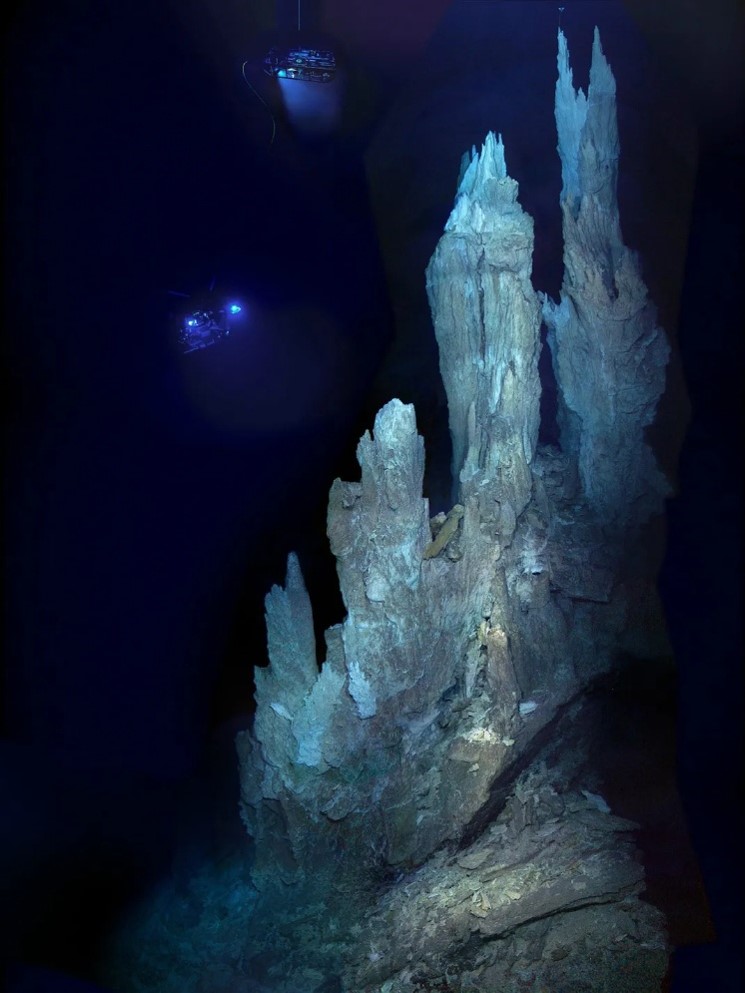
Figure 1: Carbonate chimney at the Lost City hydrothermal Vent Field, taken during a 2005 expedition. It was formed when enriched hydrothermal fluids were vented into the ocean from the seafloor. (Source: D. Kelley/ M. Elend/UW/URI-IAO/NOAA/The Lost City Science Team).
This project does not offer a CASE studentship
Each host has a slightly different application process.
Find out how to apply for this studentship.
All applications must include the CENTA application form.
Choose your application route
The project will begin by selecting samples from two low-temperature hydrothermal systems and obtaining them from International Ocean Discovery Program core repositories. Analysis of these samples will be conducted using SEM-EDS and Raman spectroscopy to assess sample textures, secondary mineralogy and paragenetic sequence. Mineral abundances will be determined by XRD analysis in collaboration with the Natural History Museum.
Analytical results and existing literature will be used to inform computer models that will reconstruct water-rock interactions and identify mineral reaction pathways of the two systems. Estimates of habitability will be determined by assessing energy availability using Gibbs energy calculations.
The insight gained from the reconstruction modelling will then be applied to computer models to assess the evolution of water-rock interactions on Europa. Energy availability will again be calculated for this system. These results will help to decipher how ocean composition can change with time, and how it will influence habitability.
DRs will be awarded CENTA Training Credits (CTCs) for participation in CENTA-provided and ‘free choice’ external training. One CTC can be earned per 3 hours training, and DRs must accrue 100 CTCs across the three and a half years of their PhD.
The student will develop as an interdisciplinary scientist. They will be taught to use geochemical modelling programs (CHIM-XPT and Geochemist Workbench), and learn about sample curation, storage, and preparation. Training will also be provided for geochemical analytical techniques (SEM, Raman and XRD), both at the Open University and at the Natural History Museum, London. As part of this project, the student will also foster skills in communication, time management, data handling, and management of large datasets.
Dr Jens Najorka is a mineralogist with 30 years of expertise in advanced XRD analysis. He currently leads the XRD facility at the Natural History Museum, London. Dr Najoka’s research focuses on the analysis of minerals and synthetic materials, and aims to understand their behaviour under high temperatures and high pressures.
Year 1 – Perform a literature review. Request appropriate samples from the IODP repositories. Begin analyses of the samples using SEM-EDS and Raman spectroscopy at the OU to determine secondary mineralogy and paragenesis. Undergo quantitative XRD training at the Natural History Museum and analyse samples. Present initial results at a national conference.
Year 2 – Complete analysis of samples; create a theoretical model of aqueous alteration for the cores. Learn to use the geochemical modelling code CHIM-XPT. Run reconstruction models to determine the physicochemical conditions for the observed secondary mineralogy and to determine mineral reaction pathways and resultant fluids. Run Gibbs energy calculations on fluids to assess the influence that the evolving fluids have on habitability. Present results at an international conference.
Year 3 – Using mineral reaction pathways identified from terrestrial settings, run geochemical models to simulate water-rock interactions under plausible europan conditions. Run Gibbs energy calculations to assess Europa’s potential habitability. Present results at a national/international conference. Write and submit thesis.
Denny, A. R., Kelley, D. S., & Früh-Green, G. L. (2016). Geologic evolution of the Lost City Hydrothermal Field, Geochemistry, Geophysics, Geosystems, 17, 375–394. https://doi.org/10.1002/2015GC005869
Lu, G. S., LaRowe, D. E., & Amend, J. P. (2021). Bioenergetic potentials in terrestrial, shallow-sea and deep-sea hydrothermal systems, Chemical Geology, 583, 120449. https://doi.org/10.1016/J.CHEMGEO.2021.120449
Ramkissoon, N. K., Fox-Powell, M. G., Sym, L., Suttle, M. D., Moral, A. Del, & Pearson, V. K. (2025). Accreted volatiles influence low-temperature rock equilibria on Europa, Icarus, 438, 116631. https://doi.org/10.1016/j.icarus.2025.116631
Seyfried, W. E., Pester, N. J., Tutolo, B. M., & Ding, K. (2015). The Lost City hydrothermal system: Constraints imposed by vent fluid chemistry and reaction path models on subseafloor heat and mass transfer processes, Geochimica et Cosmochimica Acta, 163, 59–79. https://doi.org/10.1016/j.gca.2015.04.040
Please contact Nisha Ramkissoon ([email protected]) for further information and an informal discussion about this project.
To apply to this project:
You should make your application via The Open University’s applications portal. If you do not already have an account for this portal, you will need to register your interest and will be prompted to create an account. As part of your application, you will need to provide:
Applications must be submitted by 23:59 GMT on Wednesday 6th January 2027.