

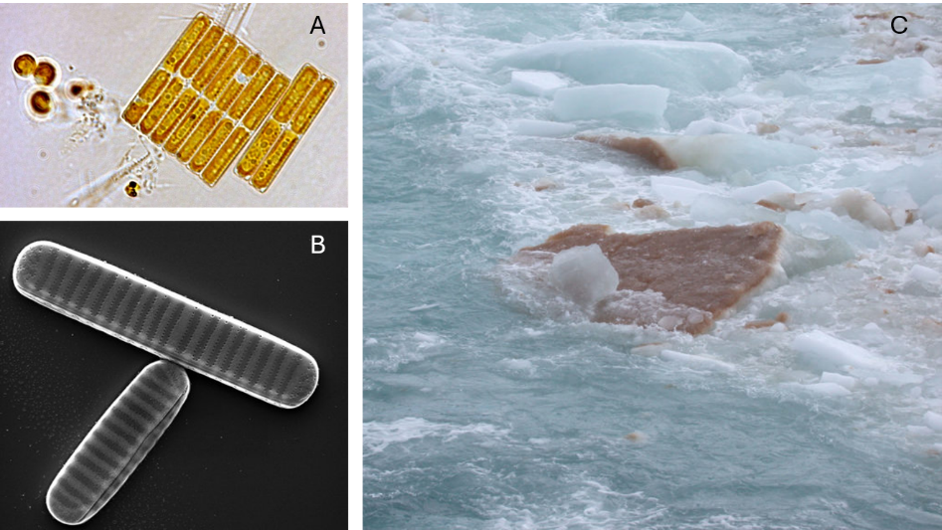
The polar diatom Fragilariopsis cylindrus (Fig 1) is a key primary producer in Polar Oceans and a model for studying microbial adaptation to extreme polar environments. Its genome features unusual architecture, including extensive transposable element (TE) content and nearly 25% highly divergent alleles that exhibit differential expression in response to environmental changes (Mock et al., 2017; Paajanen et al., 2017). These genomic traits likely contribute to its phenotypic plasticity, though chromatin-based regulatory mechanisms remain unclear.
Polycomb Repressive Complex 2 (PRC2) deposits the repressive histone mark H3K27me3 and silences TEs across diverse eukaryotes, suggesting an ancient, conserved genome defence function (Hisanaga et al., 2023; Velanis et al., 2020). PRC2 also regulates allele-specific gene expression in plants, including allele-biased repression of imprinted genes in Arabidopsis thaliana (Zhang et al., 2018), indicating its potential role in controlling divergent allele activity.
This project hypothesizes that PRC2 acts as an ancestral genome defence pathway in F. cylindrus by repressing TEs and regulating environmentally responsive divergent alleles, linking genome stability with adaptive transcriptional plasticity. The study will first map H3K27me3 distribution under climate-relevant stressors—ocean warming and acidification—to assess whether Polycomb targets TEs, divergent alleles, or conventional genes preferentially. Chromatin profiles will then be integrated with strand-specific RNA sequencing to examine whether allele-specific expression changes correlate with differential H3K27me3 marking.
Functional significance of PRC2 will be tested via chemical perturbation, evaluating effects on TE expression, allele-specific transcription, cellular fitness, and stress responses. An optional extension will investigate interactions between DNA methylation and Polycomb repression at selected loci.
By combining environmental biology, epigenomics, and functional genomics, this project aims to elucidate chromatin-based regulation’s role in genome stability, transcriptional plasticity, and environmental adaptation in a crucial polar phytoplankton species. The findings will enhance understanding of molecular mechanisms underpinning resilience to climate-driven changes in polar marine ecosystems.
Figure 1 Fragilariopsis cylindrus and its polar sea-ice habitat. (A) Light microscopy image showing characteristic cells of the pennate diatom Fragilariopsis cylindrus. (B) Scanning electron micrograph (SEM) revealing the distinctive elongated frustule morphology and valve ultrastructure of F. cylindrus. (C) Brown ice-associated algal communities growing on the underside and within sea ice in the Southern Ocean, where diatoms typically dominate the microbial assemblage and F. cylindrus is often a prominent component. Communities (Image credits: Gerhard Dieckmann and James Rymond).
This project does not offer a CASE studentship
Each host has a slightly different application process.
Find out how to apply for this studentship.
All applications must include the CENTA application form.
Choose your application route
Cultures of Fragilariopsis cylindrus will be exposed to climate-relevant stressors, including ocean warming and acidification. Core PRC2 components will be identified and characterised bioinformatically using available genome and transcriptome data. The genome-wide distribution of the repressive histone mark H3K27me3 will be mapped using low-input chromatin profiling methods, complemented by targeted ChIP-qPCR validation at selected transposable element (TE)-rich and highly divergent allelic loci.
Strand-specific RNA sequencing will quantify gene expression and allele-specific transcription under these environmental conditions. Integration of chromatin and transcriptomic datasets will assess whether differential H3K27me3 occupancy correlates with environmentally responsive allele-specific expression.
Functional roles of PRC2 will be evaluated through chemical inhibition, measuring effects on TE expression, allele-specific transcription, cellular growth and stress tolerance. Where appropriate, targeted DNA methylation analyses will investigate interactions between DNA methylation and Polycomb-mediated repression at candidate loci.
DRs will be awarded CENTA Training Credits (CTCs) for participation in CENTA-provided and ‘free choice’ external training. One CTC can be earned per 3 hours training, and DRs must accrue 100 CTCs across the three and a half years of their PhD.
This project will provide training in environmental microbiology, algal culturing and physiology, wet lab molecular biology and epigenetics, epigenomics, transcriptomics, bioinformatics and data analysis. The student will gain hands-on experience in phytoplankton culturing, climate-stress experimentation, chromatin profiling, RNA sequencing and genome-scale data integration. Training will also be provided in statistical analysis, reproducible computational workflows, scientific writing, presentation skills, research ethics and open science practices. Together with CENTA training events, conferences and professional development opportunities, these activities will equip the student with a broad range of technical and transferable skills relevant to careers in academia, environmental research and the biotechnology sector.
This project will benefit from collaboration between the lead PI’s group, which has expertise in molecular epigenetics and Polycomb Repressive Complex 2 (PRC2) biology, Dr Woodhouse’s group, with expertise in species adaptative responses (physical and biological) to climate, and the Mock Lab (UoEA), a world-leading research group investigating the evolution, genomics and environmental adaptation of marine phytoplankton, including Fragilariopsis cylindrus. The partnership provides access to internationally recognised expertise in diatom biology, genome complexity, allele-specific expression and climate-change responses, as well as established genomic resources and experimental systems for polar diatoms, thereby strengthening project feasibility and ensuring successful delivery.
In Year 1, Fragilariopsis cylindrus cultures will be exposed to climate-relevant stressors, including ocean warming and acidification. Bioinformatic analyses will identify and characterise core PRC2 components using available genome and transcriptome resources. Initial low-replicate genome-wide chromatin profiling (e.g. CUT&Tag) will map H3K27me3 distribution under selected environmental conditions. These findings will be validated through targeted ChIP-qPCR at transposable element (TE)-rich and highly divergent allelic loci. Data analysis will identify the principal genomic targets of PRC2 and determine whether Polycomb repression is primarily associated with genome defence.
In Year 2, strand-specific RNA sequencing will be performed on samples from environmental treatments identified as most informative in Year 1. Allele-specific expression will be quantified using available haplotype-specific genome and transcriptome resources. Integration of chromatin and transcriptomic datasets will identify environmentally responsive alleles whose expression correlates with differential H3K27me3 enrichment.
In Year 3, PRC2 function will be investigated through chemical perturbation using EZH inhibitors. Validation of H3K27me3 depletion at selected marker loci will precede assessments of transposable element expression, allele-specific transcription, cellular growth and physiological stress responses. Subject to project progression and available resources, limited RNA sequencing may be undertaken to capture broader transcriptional responses to PRC2 perturbation. Targeted DNA methylation analyses at selected loci will explore potential interactions between DNA methylation and Polycomb-mediated repression.
Major outputs will include identification of PRC2 genomic targets and repression patterns (Year 1), characterisation of relationships between H3K27me3 and allele-specific expression under environmental stress (Year 2), and functional evidence for the role of PRC2 in genome stability, adaptive gene regulation and stress resilience, together with data integration, manuscript preparation and thesis completion (Year 3).
Hisanaga, T., Romani, F., Wu, S. et al. (2023) ‘The Polycomb repressive complex 2 deposits H3K27me3 and represses transposable elements in a broad range of eukaryotes’, Current Biology, 33(20), pp. 4367–4380.e9. Available at: https://doi.org/10.1016/j.cub.2023.08.073.
Hodgkinson, K.A., Wright, J., Accinelli, G.G., Heavens, D., Hopes, A., Mock, T., van Oosterhout, C. and Clavijo, B.J. (2022) ‘Disentangling the genomic complexity of the Fragilariopsis cylindrus (CCMP1102) genome’, bioRxiv. Available at: https://doi.org/10.1101/2022.07.14.500034.
Mock, T., Otillar, R.P., Strauss, J., McMullan, M., Paajanen, P., Schmutz, J., Salamov, A., Sanges, R., Toseland, A., Ward, B.J., Allen, A.E., Dupont, C.L., Frickenhaus, S., Maumus, F., Veluchamy, A., Wu, T., Barry, K.W., Falciatore, A., Ferrante, M.I., Fortunato, A.E., Glöckner, G., Gruber, A., Hipkin, R., Janech, M.G., Kroth, P.G., Leese, F., Lindquist, E.A., Lyon, B.R., Martin, J., Mayer, C., Parker, M., Quesneville, H., Raymond, J.A., Uhlig, C., Valas, R.E., Valentin, K., Worden, A.Z., Armbrust, E.V., Clark, M.D., Bowler, C., Green, B.R., Moulton, V., van Oosterhout, C. and Grigoriev, I.V. (2017) ‘Evolutionary genomics of the cold-adapted diatom Fragilariopsis cylindrus’, Nature, 541(7638), pp. 536–540.
Paajanen, P., Strauss, J., van Oosterhout, C., McMullan, M., Clark, M.D. and Mock, T. (2017) ‘Building a locally diploid genome and transcriptome of the diatom Fragilariopsis cylindrus’, Scientific Data, 4, Article 170149.
Velanis, C.N., Perera, P., Thomson, B., de Leau, E., Liang, S.C., Hartwig, B., Förderer, A., Thornton, H., Arede, P., Chen, J., Webb, K.M., Gümüş, S., De Jaeger, G., Page, C.A., Hancock, C.N., Spanos, C., Rappsilber, J., Voigt, P., Turck, F., Wellmer, F. and Goodrich, J. (2020) ‘The domesticated transposase ALP2 mediates formation of a novel Polycomb protein complex by direct interaction with MSI1, a core subunit of Polycomb Repressive Complex 2 (PRC2)’, PLOS Genetics, 16(5), e1008681. Available at: https://doi.org/10.1371/journal.pgen.1008681.
Zhang, M., Hill, R.J., Yadegari, R. et al. (2018) ‘FIS-PRC2 regulates type I MADS-box genes through both allelic repression and parent-of-origin-specific silencing during Arabidopsis endosperm development’, PLOS Genetics, 14, e1007837.
This interdisciplinary project combines expertise in molecular epigenetics, chromatin biology and marine phytoplankton genomics, and would suit candidates with backgrounds in biology, molecular biology, genetics, genomics, bioinformatics, marine science or environmental science. Through a collaboration between the DEEp lab (Open University) and the Mock Research Lab (University of East Anglia), the student will benefit from training in both epigenetic mechanisms of genome regulation and the genomics, ecology and climate adaptation of marine phytoplankton. If you are interested in finding out more about this project, please contact Christos Velanis ([email protected]) or Thomas Mock ([email protected]).
To apply to this project:
You should make your application via The Open University’s applications portal. If you do not already have an account for this portal, you will need to register your interest and will be prompted to create an account. As part of your application, you will need to provide:
Applications must be submitted by 23:59 GMT on Wednesday 6th January 2027.