

Trees in towns and cities provide a wide variety of benefits to people, including by reducing pollution, flooding and air temperatures and providing links to our culture and history. However, they are increasingly threatened by a changing climate and the emergence of novel pests and diseases. This project will investigate the potential climate-linked impact of an emerging threat to our most common urban tree.
Sooty bark disease (SBD), caused by the fungus Cryptostroma corticale which originated in North America, mainly affects maple trees (genus Acer). It is now widespread in mainland Europe and has been present in Britain since the 1940s. The fungus primarily affects sycamore (Acer pseudoplatanus), initially colonising the wood as an endophyte. However, prolonged hot and dry weather facilitates the switch to a pathogenic mode and Cryptostroma grows outwards and kills the bark before producing huge numbers of black spores that give the disease its name, rapidly resulting in the death of the tree. Exposure to the spores themselves can cause human respiratory problems (respiratory pneumonitis).
Recent periods of hot, dry weather in Britain have led to a substantial increase in reports of the disease.
Sycamore is probably the most abundant and widespread urban tree species in Britain, and SBD therefore presents a threat not just to individual trees and sycamores in general, but to the integrity of urban forests. In addition, dealing with infected trees has significant public health, safety and cost implications.
As the occurrence of SBD has increased in Europe, interest in understanding its biology has also increased. However in Britain we do not know which urban areas have most sycamores, how widespread SBD is here, and how future climate change may affect its occurrence and spread.
This project will aim, through fieldwork, laboratory analysis and ecological modelling to understand the risk that sooty bark disease presents to urban forests in Britain. Working with a team of leading urban tree and plant health specialists from the Open University and Forest Research, the project will provide vital information to support the protection and management of Britain’s urban forests as our climate changes.
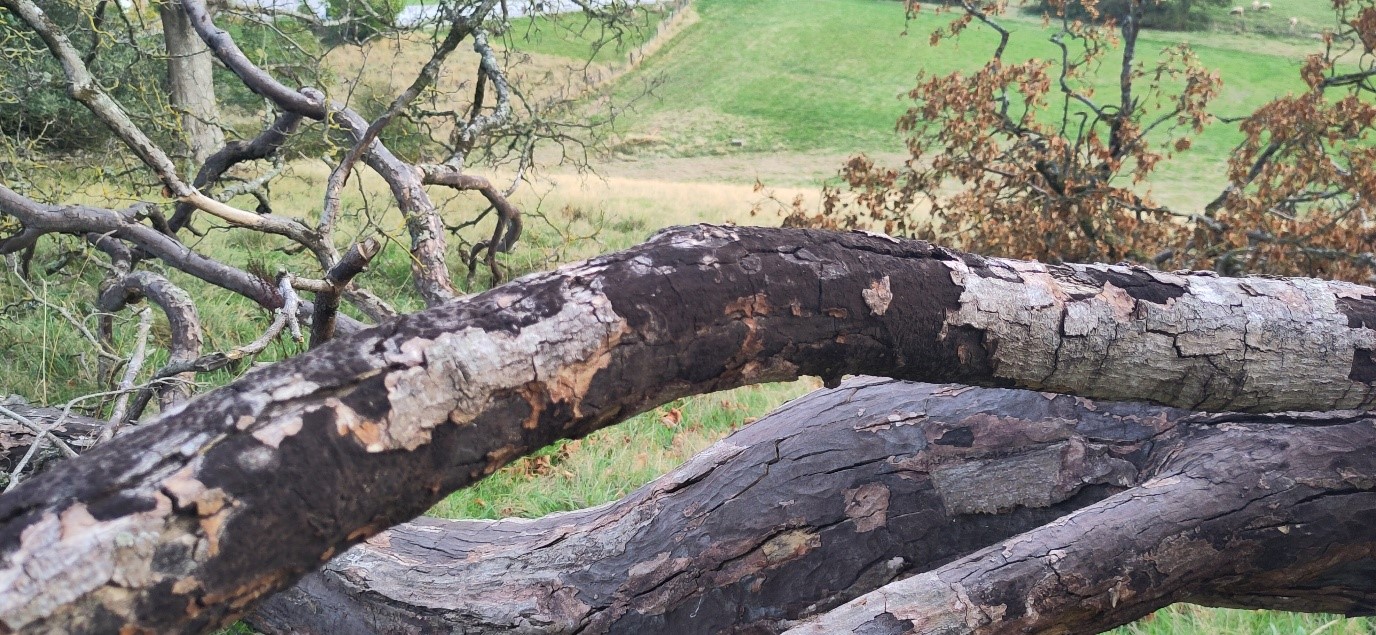
Figure 1: Sooty bark disease on the fallen branches of a mature sycamore.
This project does not offer a CASE studentship
Each host has a slightly different application process.
Find out how to apply for this studentship.
All applications must include the CENTA application form.
Choose your application route
The project will employ a variety of approaches to assess the risk that sooty bark disease poses. These include desk, field and laboratory methods which will be developed in the early stages of the project but are likely to include the following:
DRs will be awarded CENTA Training Credits (CTCs) for participation in CENTA-provided and ‘free choice’ external training. One CTC can be earned per 3 hours training, and DRs must accrue 100 CTCs across the three and a half years of their PhD.
The project provides an excellent opportunity for the successful candidate to develop key skills for a career in plant health, or wider ecological research, and experience working with leading specialists in urban trees and tree health. We expect applicants to have some background in field ecology and ecological data analysis, commensurate with their level of prior study, but training will be provided in the use of geographic information systems (GIS), ecological modelling (in R), field surveys of trees, and microscopic analysis of fungi.
Forest Research (FR) is the research agency of the Forestry Commission and Great Britain’s principal organisation for forestry and tree-related research. FR is internationally renowned for the provision of science, research, evidence, data and services in support of sustainable forestry. The Tree Health Diagnostic and Advisory Service at FR offers specialist support for identifying and managing pests and diseases affecting trees. It provides diagnostics, guidance, and research to protect tree health across the UK. FR’s Urban Forests Group focuses on understanding the benefits of trees in urban environments. It supports policymakers, planners, and communities in expanding and managing urban forests.
Year 1: Literature review on tree health, urban trees and sooty bark disease
Training in GIS, ecological modelling and laboratory techniques
Refining research questions
Identifying focal cities and sourcing tree inventory data
Year 2: Field data collection, laboratory analysis of spore samples.
Year 3: Ecological modelling, paper publication and thesis write-up.
There will be scope to adapt the project timeline based on the first year of research.
Feau, N. et al. (2026). ‘Emerging Tree Diseases Driven by Climate Change: A Critical Perspective on Current Challenges and Future Directions’. Annual Review of Phytopathology 64: 73–99. https://doi.org/10.1146/annurev-phyto-011325-023326.
Muller, E. et al. (2023) ‘Conditions of Emergence of the Sooty Bark Disease and Aerobiology of Cryptostroma Corticale in Europe’. NeoBiota 84 (May 2023): 319–47. https://doi.org/10.3897/neobiota.84.90549.
Forest Research, n.d. ‘Sooty Bark Disease (Cryptostroma Corticale)’. Accessed 16 September 2026. Available at: https://www.forestresearch.gov.uk/tools-and-resources/fthr/pest-and-disease-resources/sooty-bark-disease-cryptostroma-corticale/.
If you are interested in this project, please contact the project lead supervisor Dr Philip Wheeler by email: [email protected].
To apply to this project:
You should make your application via The Open University’s applications portal. If you do not already have an account for this portal, you will need to register your interest and will be prompted to create an account. As part of your application, you will need to provide:
Applications must be submitted by 23:59 GMT on Wednesday 6th January 2027.