

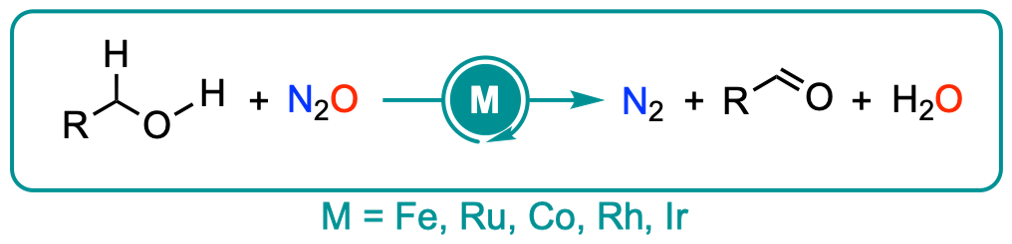
Nitrous oxide (N2O, laughing gas) is an abundant gas that accumulates in the Earth’s atmosphere, leading to depletion of ozone in the stratosphere and contributing to global warming as a potent greenhouse gas. Increasing anthropogenic emissions of N2O from intensive agricultural fertilisation, industrial processes and wastewater treatment are a cause for concern due and make it imperative that methods are developed to remediate concentrated fluxes of this environmental pollutant. Within the nitrogen cycle, N2O is consumed by denitrifying microorganisms through 2e−/2H+ reduction to N2 and H2O, catalysed by the copper-containing enzyme nitrous oxide reductase. Hydrogenation is an alternative way of achieving this outcome but to be practically useful potentially explosive mixtures of N2O/H2 must be avoided. In this context, transfer hydrogenation methods that exploit sacrificial organic molecules as the reductant are an attractive N2O remediation manifold and will be rigorously explored during this project, with a focus on homogenous transition metal catalysts that operate in water using sustainable H-donors such as ethanol and glycerol.
Figure 1: Remediation of nitrous oxide by transfer hydrogenation.
This project does not offer a CASE studentship
Each host has a slightly different application process.
Find out how to apply for this studentship.
All applications must include the CENTA application form.
Choose your application route
Established transition metal-based transfer hydrogenation catalysts will be assessed in the reduction of N2O, with a focus on systems that operate effectively in aqueous solution. High N2O concentration regimes and synthetically convenient reducing agents will be employed initially to help identify the most promising leads and facilitate supporting mechanistic investigations. The most active catalysts will thereafter be optimised to maximise catalyst productivity under low N2O concentration regimes using sustainable H-donors in air to enable the technological feasibility of this remediation method to be critically assessed.
This project will provide exceptional scientific training, encompassing the advanced use of methods for the synthesis and evaluation of late transition metal complexes in catalysis, quantitative analysis of catalytic reactions involving gaseous substrates, supporting mechanistic studies and translational work. The supervisors and senior members of their research teams will provide close guidance and support thought the project.
DRs will be awarded CENTA Training Credits (CTCs) for participation in CENTA-provided and ‘free choice’ external training. One CTC can be earned per 3 hours training, and DRs must accrue 100 CTCs across the three and a half years of their PhD.
Results from the project will be used to engage with relevant industries, e.g. water companies, working with the University of Warwick’s technology transfer office (Warwick Innovations) to review and protect any emerging Intellectual Property.
Year 1 and 2: Synthesis and evaluation of late transition metal complexes in the transfer hydrogenation of N2O, using routinely employed sacrificial H-donors such as formic acid and isopropanol. Supporting mechanistic investigations.
Year 3 and 4: Optimisation of catalyst system and evaluation under application-relevant conditions. Assessment of biomass derived alcohols, such as ethanol and glycerol, as sacrificial H-donors; use of variably diluted N2O/air gas mixtures; impurity and catalyst stress-testing relevant to potential environmental applications.
S. H. Dewick, T. M. Hood, Y. Han, S. Huband, A. B. Chaplin, “Rhodium-catalysed hydrogenation of nitrous oxide” Catal. Sci. Technol. 2025, 15, 4126–4129. https://doi.org/10.1039/d5cy00490j
T. M. Hood, R. S. C. Charman, D. J. Liptrot, A. B. Chaplin, “Copper(I) Catalysed Diboron(4) Reduction of Nitrous Oxide” Angew. Chem. Int. Ed. 2024, e202411692. https://doi.org/10.1002/anie.202411692
X. Wu, J. Du, Y. Gao, H. Wang, C. Zhang, R. Zhang, H. He, G. (Max) Lu, Z. Wu, “Progress and challenges in nitrous oxide decomposition and valorization” Chem. Soc. Rev. 2024, 53, 8379–8423. https://doi.org/10.1039/d3cs00919j
H. G. Nedden, A. Zanotti-Gerosa, M. Wills, “The Development of Phosphine-Free ‘Tethered’ Ruthenium(II) Catalysts for the Asymmetric Reduction of Ketones and Imines” Chem. Rec. 2016, 16, 2623–2643. https://doi.org/10.1002/tcr.201600084
D. Wang, D. Astruc, “The Golden Age of Transfer Hydrogenation” Chem. Rev. 2015, 115, 6621–6686. https://doi.org/10.1021/acs.chemrev.5b00203
K. Severin, “Synthetic chemistry with nitrous oxide” Chem. Soc. Rev. 2015, 44, 6375–6386. https://doi.org/10.1039/c5cs00339c
Before starting the project, applications must hold an honours degree (at least II.1 or equivalent) in Chemistry, or other relevant discipline.
Enquires are welcomed and applications should be directed to Professor Adrian Chaplin ([email protected]); please include a current CV that details any past research work.
To apply to this project:
Applications must be submitted by 23:59 GMT on Wednesday 6th January 2027.