

Fine airborne particles (soot, dust, smoke) are the component of air pollution most strongly linked to premature death, and a leading uncertainty in climate projections, because they scatter sunlight and seed cloud droplets. How much sits over any given place depends above all on how fast rain washes them out.
Rain does this well for coarse particles, flung onto the drops by their own inertia, and for the very finest, carried there by Brownian motion. Between roughly 0.1 and 1 µm (about a hundredth the width of a human hair) neither mechanism works. This is the “Greenfield gap”: the size range rain clears worst, which is why these particles travel furthest and linger longest.
And we cannot predict even the rate we observe. Every physically based scheme in use is one to two orders of magnitude too slow, and the usual suspects still leave a factor of ten unexplained. In the Met Office’s Unified Model, theory gives accumulation-mode mineral dust an atmospheric lifetime of 43.8 days; a scheme fitted to observations gives 5.4.
This project attacks a piece of physics every existing scheme fudges. Air is not a continuous fluid on the scale of these particles: they are comparable in size to the distance an air molecule travels between collisions, so the gas around them is rarefied along their whole path. The models handle this with a single empirical number derived a century ago for oil droplets in still air. It cannot describe non-spherical particles (real dust and soot are not spheres) nor what happens as a particle nears a drop, where the surface reshapes its drag and its random motion.
You will build a model of a single particle approaching a falling raindrop that treats the rarefied gas dynamics properly, from kinetic theory, for particles of realistic shape, turning the capture probabilities into a scavenging coefficient the Met Office can test in its own models. You do not need a background in atmospheric science: the project suits a physicist, engineer or mathematician who wants their fluid dynamics to land on a real environmental problem.
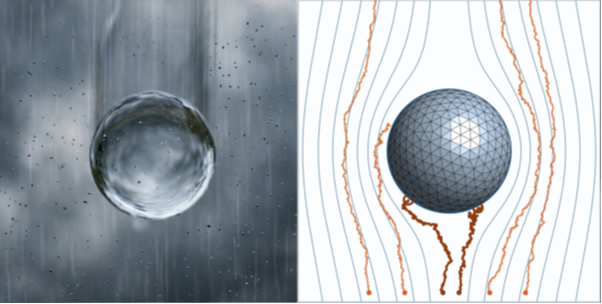
Figure 1: A raindrop falling through polluted air (left, illustrative) and the same encounter modelled (right): streamlines of air passing the drop, with the Brownian paths of fine particles. Most are swept around the drop; a few are captured. How often that happens is what this project sets out to predict.
This project does not offer a CASE studentship
Each host has a slightly different application process.
Find out how to apply for this studentship.
All applications must include the CENTA application form.
Choose your application route
The particles are 0.1–1 µm across, hundreds to thousands of times smaller than the drop, so the coupling is one-way: we solve Brownian (Langevin) dynamics for a single particle in a prescribed drop flow field. On the scale of the particle, the air is rarefied, so Stokes flow is not assumed. Instead, its resistance is obtained by a correction-tensor valid across the whole rarefaction range, making non-spherical shapes tractable. Closer in, the drop surface is locally planar, and mobility becomes a function of surface distance and, for non-spherical particles, orientation – and this same description carries all the way to contact. Capture probability then follows as a first-passage problem with rare-event sampling, integrated over a raindrop size distribution to give an operational scavenging coefficient and fitted to a form the Met Office can implement in its own aerosol scheme.
DRs will be awarded CENTA Training Credits (CTCs) for participation in CENTA-provided and ‘free choice’ external training. One CTC can be earned per 3 hours training, and DRs must accrue 100 CTCs across the three and a half years of their PhD.
Beyond CENTA provision, the DR will be trained at Warwick in rarefied gas dynamics and kinetic theory, stochastic (Langevin/Fokker-Planck) simulation, rare-event sampling, and high-performance and research software engineering. Through the Met Office collaborators, the DR will learn about atmospheric aerosol microphysics, wet deposition, and how parameterisations are developed, evaluated and implemented in operational models – with potential for visits to Exeter and the opportunity to work alongside the aerosol modelling group. The combination of first-principles fluid dynamics and operational environmental modelling is deliberately unusual and highly employable in both sectors.
The Met Office is a CENTA3 external partner and has co-developed this project. The scientific case follows directly from the Met Office’s own review of below-cloud scavenging in the Unified Model (Jones et al., 2022), which identified the discrepancy this project addresses. The DR will visit Exeter regularly, and the resulting scavenging parameterisation will be delivered in a form designed for evaluation in the relevant software. Note, a CASE project with the same partners will be submitted next year.
Year 1. Training in kinetic theory, Langevin dynamics and HPC. Reproduce standard continuum collection efficiencies as a baseline, and benchmark against the schemes in Jones et al. (2022). Assemble tabulated drop flow fields across the relevant Reynolds number range. First visit to the Met Office; agree target model and validation case.
Year 2. Mobility across the Knudsen range: surface-distance-dependent resistance near the interface, carried to contact and verified there against a direct kinetic solution. Quantify, for spheres first, how much collection efficiency in the Greenfield gap moves when this replaces a free-space slip correction.
Year 3. Non-spherical and aggregate morphologies; phoresis evaluated consistently in the transition regime. Rare-event sampling to reach the small capture probabilities that matter. Integration over drop-size distributions to give the scavenging coefficient.
Year 3.5. Deliver the parameterisation and its uncertainty bounds in implementable form, with a demonstration case run in collaboration with the Met Office.
Journal:
Greenfield, S. M. (1957) ‘Rain scavenging of radioactive particulate matter from the atmosphere’, Journal of Meteorology, 14 (2), pp. 115–125.
Jones, A. C., Hill, A., Hemmings, J., Lemaitre, P., Quérel, A., Ryder, C. L. and Woodward, S. (2022) ‘Below-cloud scavenging of aerosol by rain: a review of numerical modelling approaches and sensitivity simulations with mineral dust in the Met Office’s Unified Model’, Atmospheric Chemistry and Physics, 22, pp. 11381–doi: 10.5194/acp-22-11381-2022.
Wang, X., Zhang, L. and Moran, M. D. (2010) ‘Uncertainty assessment of current size-resolved parameterizations for below-cloud particle scavenging by rain’, Atmospheric Chemistry and Physics, 10, pp. 5685–5705. doi: 10.5194/acp-10-5685-2010.
Laakso, L., Grönholm, T., Rannik, Ü., Kosmale, M., Fiedler, V., Vehkamäki, H. and Kulmala, M. (2003) ‘Ultrafine particle scavenging coefficients calculated from 6 years field measurements’, Atmospheric Environment, 37, pp. 3605–3613.
Lemaitre, P., Quérel, A., Dépée, A., Guerra Devigne, A., Monier, M., Hiron, T., Soto Minguez, C., Hardy, D., and Flossmann, A.: Microphysical modelling of aerosol scavenging by different types of clouds: description and validation of the approach, Atmos. Chem. Phys., 24, 9713–9732, https://doi.org/10.5194/acp-24-9713-2024, 2024.
For any enquiries related to this project please contact Prof. Duncan Lockerby ([email protected]).
To apply to this project:
Applications must be submitted by 23:59 GMT on Wednesday 6th January 2027.