

Conservation areas are increasingly fragmented. Areas set aside for wildlife are shrinking, split into sub-areas, or increasingly surrounded by mixed-purpose development. Even within large conservation areas, anthropogenic structures such as roads influence animal space use and health. Understanding how wildlife navigate such landscapes – from mixed use areas to established protected areas – is a central question in conservation biology.
Animal movement is influenced by external features of the landscape and internal physiology. The converse also occurs: an animals’ physiological state responds dynamically to changes driven by movement. For example, an animal may exhibit different movement behaviours based on their physiological state. Many desert ungulates, including desert bighorn sheep, move towards and stay in cooler, north-facing sites during the hottest summer days to reduce heat and required water intake. These behaviours are likely traded-off against other needs, such a feeding, predator avoidance, and reproduction, all of which may vary in different environmental contexts. Measuring how the physiological state of an animal changes across these contexts and behaviours provides quantitate information to characterise trade-offs. Understanding the shape of these trade-offs is required to target conservation resources for animal health.
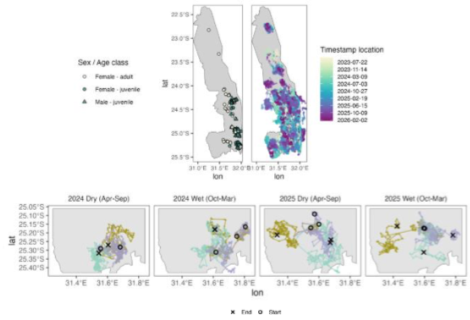
Research on both animal movement and physiology is increasingly data rich, following exciting advances in GPS and bio-logging technology. As an example, our work in African buffalo monitors the movement of 130 animals over the 20,000 km2 extent of Kruger National Park, South Africa (Figure 1). Similarly, our work on desert bighorn sheep in the USA monitored 120 animals across 8 populations in the American southwest. This proposed project has the potential to take advantage of either the African buffalo or the desert bighorn sheep system; both ongoing longitudinal studies measure movement, temperature, immunology, nutrition and disease. Taken together, these systems present a novel opportunity to understand intersections between an animal’s physiology and movement. Furthermore, both are embedded in complex conservation landscapes, such that the influence of management can be evaluated, particularly movement corridors or supplement water provision.
Figure 1: Maps showing African buffalo capture locations and movement in Kruger National Park. (top left) The map shows the first registered coordinate for all collared buffalo. Colour and shape denotes sex and age class. (top right) The map shows coordinates available for all buffalo during the studied period. Colour shade represents the timepoint of the location. (bottom) Example of movement of 3 buffalo across the dry and wet season in two years.
This project does not offer a CASE studentship
Each host has a slightly different application process.
Find out how to apply for this studentship.
All applications must include the CENTA application form.
Choose your application route
Example questions that could be addressed in this project include:
Working with our team, the best combination of datasets can be selected for each question (or additional data collection can be proposed).
The project will apply custom animal movement models to address the selected questions. Animal movement models are a broad and diverse set of analyses for analysing data from GPS collars. They can define how animals move, identify animal behaviours, or quantify how they interact with their environment. Additional bio-logging and capture data are available to quantify temperature, immunology, nutrition, and disease.
DRs will be awarded CENTA Training Credits (CTCs) for participation in CENTA-provided and ‘free choice’ external training. One CTC can be earned per 3 hours training, and DRs must accrue 100 CTCs across the three and a half years of their PhD.
Training is available in GIS software, geospatial analyses, use of publicly available geospatial data. Additional training from our team will be provided for learning R for statistical and mathematical modelling.
Data collection for these projects is underway, funded by two NSF/BBSRC-EEID grants to our research team. As a result, the data are being collected by collaborators at Oregon State University, California Department of Fish and Wildlife Services, and South African National Park. There is a large community of PhD students supported by these grants. Interested candidates will need to work with physiology-focused PhD students as well as wildlife-focused PhD students.
While there is sufficient data already collected for the project, interested candidates will additionally have access to the infrastructure provided by those grants to propose additional data collection.
Year 1: Conduct preliminary analysis to understand movement in selected host species / conservation context. Identify three target questions, with the aim of addressing one question per year.
Year 2: If desired and feasible, additional physiological data collection is possible. Unpack changes in physiology after movement?
Year 3: Explore physiological triggers of movement.
Cain, J.W., Krausman, P.R., Rosenstock, S.S., Turner, J.C. (2006) ‘Mechanisms of Thermoregulation and Water Balance in Desert Ungulates’, Wildlife Society Bulletin, 34, 570-581. https://doi.org/10.2193/0091-7648(2006)34[570:MOTAWB]2.0.CO;2
Goossens, S., Wybouw, N., Van Leeuwen, T., Bone, D. (2020). ‘The physiology of movement’, 8, 5. doi: 10.1186/s40462-020-0192-2.
Hetem, R. S., Haylock, K.A., Boyers M., Parrini, F., Owen-Smith, N., Beytell, P., and Strauss, M. (2025) ‘Integrating physiology into movement ecology of large terrestrial mammals’, The Journal of Experimental Biology, 228, jeb248112. doi: 10.1242/jeb.248112.
Meza, D. K., Pedersen, A. B., Hawkes, S. F., Carpenter, S. A., Aiello, C. M., Epps, C. W., Ianniello, R., Prentice, P. R., Beechler, B. R., Jolles, A. E., & Gorsich, E. E. (2026). ‘High and dry: Environmental conditions drive opportunities for disease transmission in desert bighorn sheep’, Journal of Applied Ecology, 63, e70480. Doi: 10.1111/1365-2664.70480
For any enquiries related to this project please contact Erin Gorisch, [email protected]
https://warwick.ac.uk/fac/sci/lifesci/people/egorsich/
To apply to this project:
Applications must be submitted by 23:59 GMT on Wednesday 6th January 2027.