

Microplastics (MPs) are an emerging contaminant of increasing concern that are ubiquitous within freshwater and marine ecosystems. Rivers are recognised as a fundamental transport pathway for MPs; connecting terrestrial plastic sources to marine ecosystems, as well as an area where high levels of biological activity and modification can occur. However, there is little consideration as to the sources and fate of plastics within these freshwater ecosystems. Rivers are subject to plastic pollution from both point (i.e. sewage systems) and diffuse (i.e. agricultural and urban runoff) sources. It is expected that riverbed sediments act as a sink for microplastic debris (1). However, the extent to which riverbeds interact with MPs and their entrapment rates will be governed by many physical, biological and chemical factors. Colonisation studies of plastic debris by microbial biofilms have shown to cause buoyant polymers to sink (2,3). Equally, microbial biofilms over riverbed sediment will influence MP infiltration and settling rates. Nevertheless, the relative importance of these processes remains largely unclear with empirical data urgently needed to parametrise models. In this project you will investigate the interactions and feedbacks between riverbed dynamics and MPs. The main aim will be to determine the key variables which contribute to the entrapment and resuspension of MPs within this freshwater ecotone. Different types of plastic particles with different densities will be considered and analysed using novel state-of the-art technology and innovative methods. The release rate and sources of MPs is vital for a more complete understanding and assessment of the hazards posed by these contaminants. As such, the new insights offered by the project have the potential to contribute directly towards new policies relating to water management and environmental conservation.
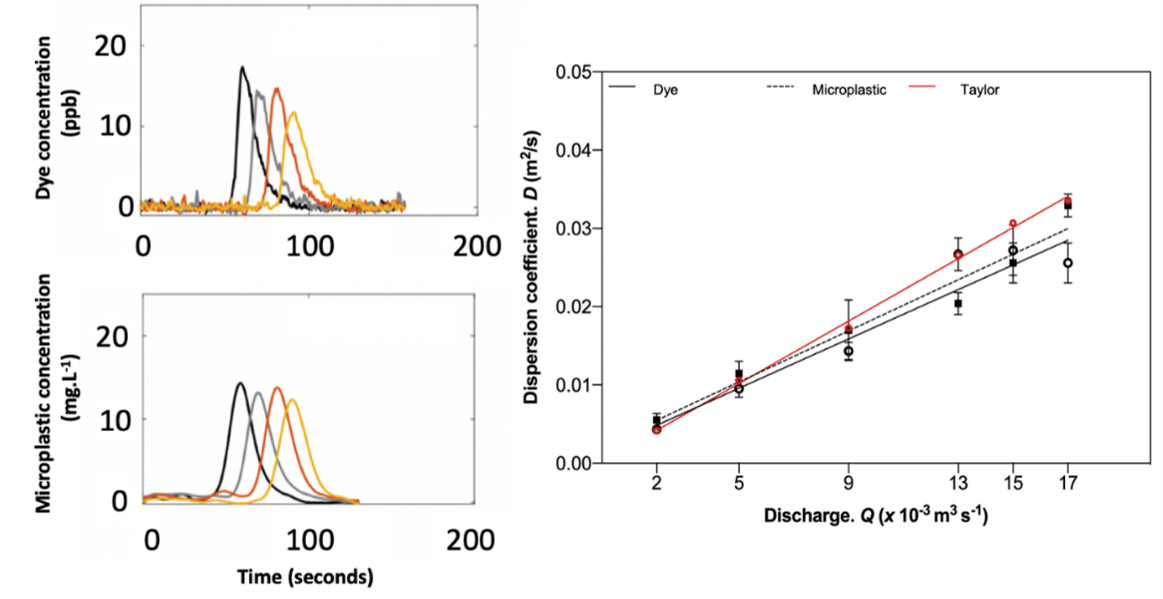
Figure 1: Longitudinal Dispersion in uniform open channel flow of a solute tracer and microplastics compared to Taylors (1953, 1954) classical theory (adapted from Cook et al. (2020)).
This project does not offer a CASE studentship
Each host has a slightly different application process.
Find out how to apply for this studentship.
All applications must include the CENTA application form.
Choose your application route
We will use our novel flume systems to investigate and isolate the different mechanistic processes governing the interaction between the riverbed and MPs. We will test different plastic polymers, with a range of densities and sizes, across a range of riverbed systems with unique characteristics (i.e. pore size, biofilm coated, bedform shape). Methods will include metagenomics to analyse biofilm community structure and optical spectral imaging to visualise where the biofilm colonises the different plastic polymers. In addition, we will adopt our newly developed method to track the movement of MPs within our laboratory-based system (4) using fluorescence-based technology, and baseline the MPs results against traditional regulatory approved fluorometric solute tracing techniques. It is important to apply our understanding to the real-world environment. As such, we will also use local rivers and sites across London as a ‘living laboratory’ to collect sediment cores from the river bed & perform regulatory approved tracing tests.
DRs will be awarded CENTA Training Credits (CTCs) for participation in CENTA-provided and ‘free choice’ external training. One CTC can be earned per 3 hours training, and DRs must accrue 100 CTCs across the three and a half years of their PhD.
Training will be provided by the supervisory team in a broad range of environmental and water engineering approaches, including river process experimentation in Warwick’s physical laboratory facilities, molecular techniques (16S amplicon sequencing), bioinformatics, molecular spectroscopy, and multivariate data analysis. The student will also receive training in research design, scientific writing, publication, presentation, stakeholder engagement, project management, and research ethics through regular supervision, seminars, and conference participation. This will equip them with both the technical expertise and transferable skills required for a successful research and professional career.
Year 1: Mesocosm studies to develop process level understanding of the environmental pathways and interactions of microplastics
Year 2: Targeted analysis of microplastics from riverbed systems to investigate their environmental fate and temporal / spatial distribution
Year 3: Integration and ecological interpretation
For any enquiries related to this project please contact Jonathan Pearson, School of Engineering, University of Warwick; [email protected].
To apply to this project:
Applications must be submitted by 23:59 GMT on Wednesday 6th January 2027.