

Ammonia oxidising microorganisms carry out a key step in the global nitrogen cycle, which is of major importance for climate change and food webs. Ammonia oxidisers, comprising specific groups of archaea and bacteria, are among the most numerous living organisms and account for up to 40% of prokaryotic cells in the ocean. Yet, there are knowledge gaps on how they adapt to nutrient scarcity and their role in underpinning marine food chains. The aim of this project is to determine how lipids of ammonia oxidising microorganisms change in response to nutrient limitation and how their lipids are used by other microorganisms in marine environment.
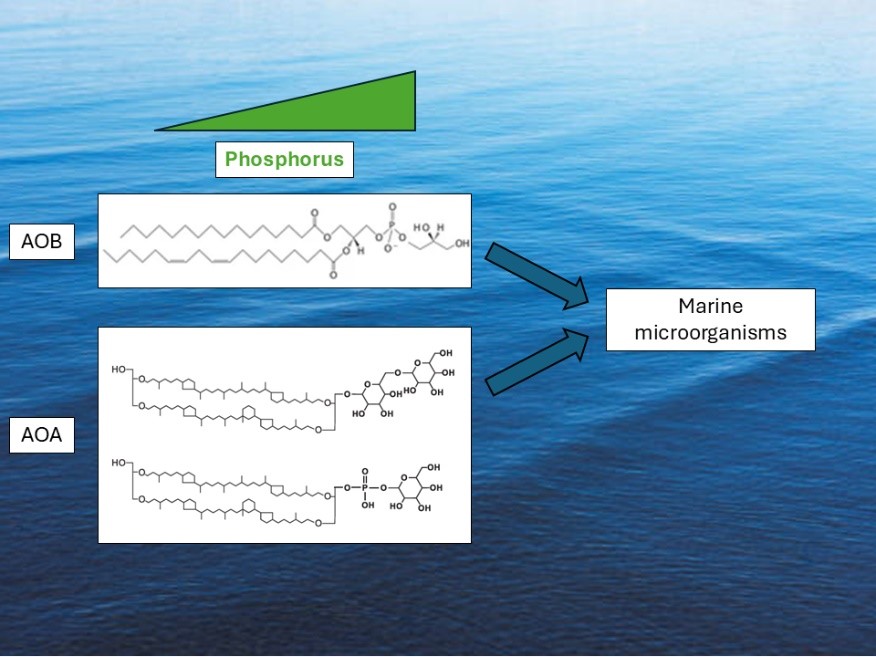
Ammonia oxidising archaea (AOA) contain unusual monolayer-forming lipids while ammonia oxidising bacteria (AOB) harbour a more typical membrane bilayer. Little is understood about how AOA and AOB respond to phosphorus limitation. In other non-ammonia oxidising microorganisms, phosphorus limitation causes membrane remodelling, and in this project, you will test how phosphorus scarcity affects the membranes of cultivated AOB and AOA. Furthermore, lipids represent a potential source of both carbon and phosphorus which are used by other microorganisms. While some of the bacterial lipid degradation and uptake mechanisms are known, very little is known about how archaeal lipids are recycled in the ocean. In this project, you will study how lipids of AOB and AOA are broken down and which microorganisms utilise the lipid-derived carbon and phosphorus.
The project will take advantage of the ammonia oxidising archaea and bacteria routinely cultivated in the lead supervisor’s lab, including a recently published novel marine AOA Nitrosarchaeum marinum. Combining the cultivation-based approaches to seawater microcosm experiments will bring together the ecology and physiology of the key microorganisms and characterise the identity and ecological role of lipids. This project uses a combination of state-of-the-art techniques to link marine nitrogen, carbon and phosphorus cycling processes. There is an option to visit and obtain training in the collaborator’s lab in Germany. The results will provide insights into the response of microorganisms to nutrient limitation, and inform efforts for predicting and managing biogeochemical cycling.
Figure 1: This PhD project investigates the lipids of ammonia oxidising microorganisms and how they can be used by other microorganisms.
This project does not offer a CASE studentship
Each host has a slightly different application process.
Find out how to apply for this studentship.
All applications must include the CENTA application form.
Choose your application route
The PhD student will determine the lipid profiles, growth and nitrification rates in pure cultures of ammonia oxidising microorganisms in phosphorus-replete and phosphorus-deplete conditions. The lipids will be quantified using LC-MS, and nitrification rates by inorganic nitrogen assays. The PhD student will gain expertise in growing microorganisms, fluorescence microscopy and analytical chemistry. Microbial communities and their roles in lipid degradation will be studied in seawater microcosms through process rates and molecular tools, including high-throughput sequencing. Microbial cells will be quantified using flow cytometry, LC-MS will be used to study lipid degradation process rates, and dissolved phosphorus, carbon and nitrogen measured. Metagenome-assembled genomes (MAGs) will be generated from sequencing of the microcosms and used for predicting putative enzymes involved in lipid degradation. These putative genes will be searched against existing metagenome and metatranscriptome databases and can be used for future experimental validation of functions.
DRs will be awarded CENTA Training Credits (CTCs) for participation in CENTA-provided and ‘free choice’ external training. One CTC can be earned per 3 hours training, and DRs must accrue 100 CTCs across the three and a half years of their PhD.
The PhD student will receive advanced research skills training in microbial cultivation, molecular techniques, and analytical chemistry. The student will present their research findings in lab meetings, seminars and (inter)national conferences. The student will also be encouraged to take part in transferable skills training and public engagement. Supervisory team has extensive expertise and a complementary skill set in the subject area, and there is also an option to train in the collaborator’s lab. This studentship provides a strong scope for developing critical thinking and data interpretation skills, and will equip the successful applicant with a well-rounded skillset.
This PhD project will be carried out in collaboration with Dr Felix Elling (Heidelberg University). Elling has extensive experience with the analysis of archaeal lipids, including lipids of AOA. There is an option for the PhD student to gain skills and experience working on archaeal lipids in the collaborator’s lab.
Year 1: Culture-based experiments, growing AOA and AOB in phosphorus-replete and phosphorus-limited medium. Gaining skills in cultivation, microscopy, lipid extraction and LC-MS.
Year 2: Finish analysing the culture-based experiments. Initiate seawater microcosm experiments.
Year 3: Complete the analysis of seawater microcosms using flow cytometry, LC-MS, dissolved nitrogen, phosphorus and carbon analyses, metagenomic analyses.
Lüke, C, Haaijer SCM, Bespiatykh D, Speth DR, Mesman R, Jetten MSM, Op den Camp HJM, Lücker S, Lehtovirta-Morley LE. (2026) ‘A novel North Sea ammonia-oxidizing archaeon Nitrosarchaeum marinum leverages a high abundance of transport systems to grow over a wide salinity range.’ FEMS Microbiol Ecol 102(3):fiag013.
Lehtovirta-Morley LE, Sayavedra-Soto LA, Gallois N, Schouten S, Stein LY, Prosser JI, Nicol GW (2016) ‘Identifying potential mechanisms enabling acidophily in the ammonia-oxidizing archaeon ‘Candidatus Nitrosotalea devanaterra’.’ Applied Environ Microbiol 82: 2608-2619.
Wang N, Westermann LM, Li M, Li CY, Murphy ARJ, Gu Z, Silvano E, Blindauer CA, Lidbury IDEA, Zhang YZ, Scanlan DJ, Chen Y (2025) ‘Structural basis and evolutionary pathways of glycerol-1-phosphate transport in marine bacteria.’ Proc Natl Acad Sci U S A 122(50): e2524546122.
Elling FJ, Könneke M, Nicol GW, Stieglmeier M, Bayer B, Spieck E, de la Torre JR, Becker KW, Thomm M, Prosser JI, Herndl GJ, Schleper C, Hinrichs K-U (2017) ‘Chemotaxonomic characterisation of the thaumarchaeal lipidome.’ Environ Microbiol 19: 2681-2700. doi: 10.1111/1462-2920.13759
Elling FJ, Evans TW, Hemingway JD, Kharbush JJ, Spieck E, Summons RE, Pearson A (2022) ‘Marine and terrestrial nitrifying bacteria are sources of diverse bacteriohopanepolyols.’ Geobiology 20: 399-420. doi: 10.1111/GBI.12484
Yao M, Elling FJ, Jones C, Sulung N, Long CP, Crowe SA, Antoniewicz MR, Hinrichs K-U, Maresca JA (2016) ‘Heterotrophic bacteria from an extremely phosphate-poor lake have conditionally reduced phosphorus demand and utilize diverse sources of phosphorus.’ Environ Microbiol 18: 656-667. doi: 10.1111/1462-2920.13063
Interested candidates are strongly encouraged to contact Prof Laura Lehtovirta-Morley ([email protected]) to discuss their application.
To apply to this project:
Applications must be submitted by 23:59 GMT on Wednesday 6th January 2027.