

The plant microbiome, particularly within the phyllosphere (above-ground surfaces) and rhizosphere (root-associated zone), plays a fundamental role in plant health, nutrient cycling, pathogen suppression and ecosystem function [1]. While bacteria and fungi within these communities have been extensively studied, much less is known about the ecological role of bacteriophages: viruses that infect bacteria and are abundant components of plant-associated microbial communities [2,3].
Phages can selectively reduce bacterial populations and alter competition between microbial taxa, potentially restructuring entire communities. However, we do not yet understand the extent to which phages act as ecological drivers within plant environments, whether phage-induced changes persist or communities recover following disturbance, or what these changes mean for microbial function and plant health.
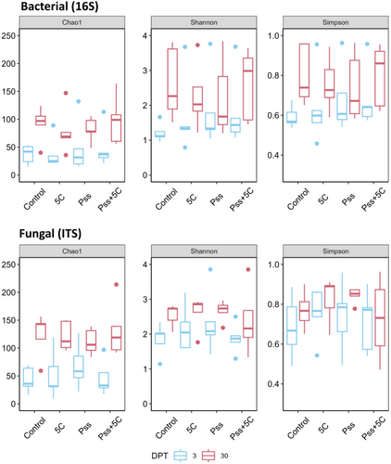
Our recent work showed that application of a phage cocktail targeting Pseudomonas syringae did not significantly alter overall microbial diversity on cherry leaves and shoots (Fig.1) [4]. However, measures of overall diversity alone cannot reveal changes in individual microbial taxa, community structure, ecological interactions or function. This raises an important question: what are the wider ecological consequences when phages exert pressure on plant-associated microbial communities?
This project will determine how phage pressure influences the composition, diversity, structure and resilience of microbial communities within the phyllosphere and rhizosphere. Using controlled plant and microcosm experiments combined with microbiome and virome sequencing, we will track how bacterial, fungal and viral communities respond to phage disturbance over time.
We will then determine whether phage-driven community changes alter important ecological functions, including pathogen suppression and interactions between microbial community members. Finally, metabolomics and transcriptomics will establish whether changes within the microbiome are associated with altered plant biochemical and molecular responses.
By linking phage pressure, microbiome structure, ecological function, plant response, this project will establish the wider ecological role of bacteriophages in plant environments and provide fundamental knowledge needed to understand the consequences of natural and applied phages for sustainable plant and ecosystem management.
Figure 1. Alpha diversity indices of bacterial and fungal communities from cherry leaves sampled 3 and 30 days after treatment (DPT). The treatments were Pseudomonas syringae pv. syringae 9097, phage cocktail 5C, Pss combined with phage cocktail 5C, and a control. Diversity was evaluated using three indices: Chao1, estimating the total number of species per sample; Shannon’s index, reflecting community diversity (higher values indicate greater diversity); and Simpson’s index, reflecting community evenness (higher values indicate a more even community) [4].
This project is a CENTA Flagship Project.
This project offers a CASE studentship
Each host has a slightly different application process.
Find out how to apply for this studentship.
All applications must include the CENTA application form.
Choose your application route
DRs will be awarded CENTA Training Credits (CTCs) for participation in CENTA-provided and ‘free choice’ external training. One CTC can be earned per 3 hours training, and DRs must accrue 100 CTCs across the three and a half years of their PhD.
The doctoral researcher will receive multidisciplinary training in microbial ecology, bacteriophage biology, plant-microbe interactions, field and controlled-environment experimentation, microbiome and virome sequencing, metabolomics, transcriptomics, bioinformatics, statistics and integration of complex multi-omics datasets.
Training at Warwick will provide expertise in experimental design, microbial and phage isolation, community profiling, functional microbiology and analysis and interpretation of large sequencing and multi-omics datasets. The CASE partnership with Carus Animal Health Ltd will complement this academic training through experience of industrial research, translation of phage science, product development and assessment of the wider environmental implications of applied biological products.
Carus Animal Health Ltd will act as the industrial CASE partner and contribute to project development, co-supervision and doctoral training. The student will undertake a placement with Carus, gaining experience in translating fundamental phage ecology into industrial research and product-development considerations. Training will include the development and application of phage-based biological products and consideration of how microbiome and ecological-impact data inform product development, environmental assessment and responsible deployment. Carus will provide industrial expertise, access to relevant facilities and resources, and financial support for the CASE placement and associated research activities.
Ethical, genetic and biological risk
We are not carrying out experiments on organisms that necessitate ethical or other types of approvals or licenses, other than necessary APHA compliance. There is no genetic or biological risk, as all bacteria are sourced directly from the UK natural environment. There are no plans to release genetically modified organisms during this project. This work is approved by the UoW under existing genetic manipulation and biological safety committee project.
For any enquiries related to this project please contact Mojgan Rabiey ([email protected]).
To apply to this project:
Applications must be submitted by 23:59 GMT on Wednesday 6th January 2027.