

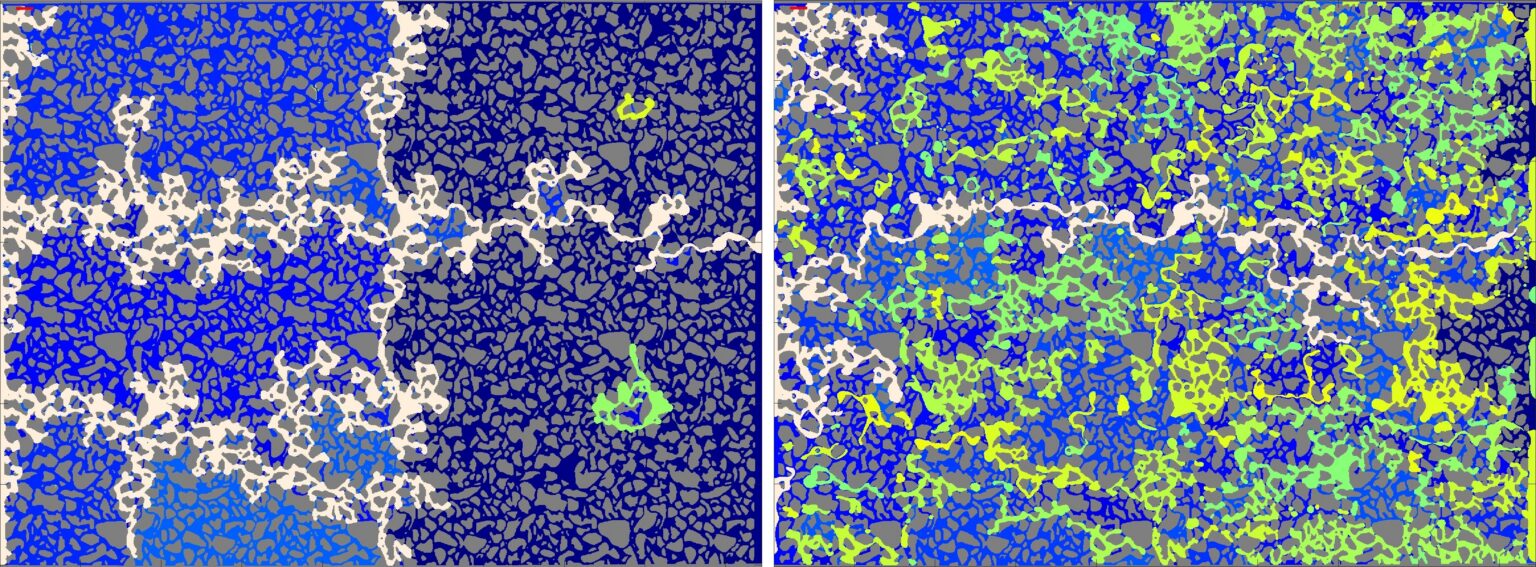
Hidden Pathways, Far-Reaching Risks: The transport of dissolved substances through geological porous media underpins major environmental and industrial challenges, from pollutant migration in groundwater and the soil vadose zone to the secure geological storage of carbon dioxide and other hazardous materials. These subsurface systems are commonly only partially saturated: water and air coexist within complex networks of pores, throats and fractures. Their spatial arrangement controls where contaminants can travel, become trapped, accumulate or re-enter flowing water, making multiphase transport fundamentally more complex than conventional single-phase predictions suggest (Figure 1).
Environmental Extremes Reshape Subsurface Transport: Contaminant migration under multiphase conditions is governed by the interaction between two mechanisms: the evolving distribution and connectivity of water and air, and the relative influence of advection, diffusion and dispersion within the water phase. These processes depend strongly on pore structure, wettability, saturation history, flow rate and boundary conditions. Flooding, intense rainfall, drought and repeated wetting–drying cycles can rapidly reorganise fluid pathways and water–air interfaces, mobilising contaminants previously retained in low-flow regions or isolating them within disconnected water clusters. As climate change increases the frequency and severity of hydrological extremes, models based on static or steady-state conditions may substantially misrepresent contaminant travel times, persistence and leakage risk.
Resolving Transport from the Pore Scale Upwards: This PhD will identify and quantify the mechanisms controlling solute transport under dynamic multiphase conditions. Controlled pore-scale experiments will resolve fluid configurations and contaminant pathways across porous materials with contrasting structural heterogeneity. Complementary numerical simulations will quantify advection, diffusion, dispersion, interfacial exchange and transient trapping as boundary conditions vary. By systematically linking pore geometry, phase connectivity and flow history to observed breakthrough and retention behaviour, the research will establish predictive relationships that cannot be obtained from bulk measurements alone.
A New Basis for Subsurface Risk Prediction: The resulting experimentally validated modelling framework will determine when environmental disturbances accelerate contaminant release, enhance retention or create persistent transport pathways. This mechanistic understanding will improve predictions of pollutant migration and hazardous-substance leakage, support more effective groundwater remediation and monitoring strategies, and strengthen the resilience of subsurface storage and environmental-protection systems under an increasingly extreme climate.
Figure 1: Effect of cyclic drainage-imbibition on phase distribution in porous media. (Left) First drainage of fully saturated domain; (Right) Sixth drainage of fully saturated domain. Light-grey element corresponds to the invading gas streamer, green-yellow elements show other gas-filled segments, blue tones show correspond to liquid phase, and dark grey indicates solid matrix.
This project does not offer a CASE studentship
Each host has a slightly different application process.
Find out how to apply for this studentship.
All applications must include the CENTA application form.
Choose your application route
This project will integrate microfluidic experiments with pore-scale direct numerical simulations. Representative porous networks spanning different degrees and types of structural heterogeneity will be fabricated using soft lithography and high-resolution 3D printing in Warwick’s clean-room facilities. Extreme hydrological disturbances will be reproduced through repeated drainage–imbibition cycles, systematically varying the magnitude, duration and rate of water and air injection. Fluorescently dyed phases, high-resolution imaging and automated segmentation will quantify saturation, phase connectivity, interfacial area and the evolution of preferential pathways.
Experimentally resolved fluid configurations will be converted directly into computational domains, avoiding the cost of explicitly simulating every multiphase displacement. Using Warwick’s high-performance computing facilities, the incompressible Navier–Stokes equations will be coupled with the advection–diffusion equation to resolve flow and solute migration through the measured water pathways. Simulations will quantify breakthrough, dispersion, mixing and trapping, enabling systematic assessment of how fluid history, boundary-condition variability and pore-scale heterogeneity jointly control contaminant transport.
DRs will be awarded CENTA Training Credits (CTCs) for participation in CENTA-provided and ‘free choice’ external training. One CTC can be earned per 3 hours training, and DRs must accrue 100 CTCs across the three and a half years of their PhD.
This PhD provides interdisciplinary training in subsurface environmental science, multiphase flow, contaminant transport and pore-scale modelling. The researcher will gain hands-on experience in microfluidic device fabrication using soft lithography and 3D printing, experimental flow control, fluorescence imaging and automated image analysis. Computational training will cover mesh generation, high-performance computing, numerical solution of the Navier–Stokes and advection–diffusion equations, and development of efficient CFD workflows for complex porous geometries. The candidate will also learn experimental design, uncertainty and sensitivity analysis, validation of simulations against laboratory observations, and management of large imaging and simulation datasets. These skills will support reproducible, robust environmental modelling.
This project will benefit from collaboration with the University of Manchester and Swedish Environmental Research Institute.
Year 1: Foundations, Microfluidic Fabrication & Computational Development
Foundational training will cover multiphase flow, contaminant transport, porous-media physics, experimental design and research data management. Following a critical literature review, the candidate will develop representative heterogeneous pore networks and gain hands-on experience in CAD, soft lithography, high-resolution 3D printing, flow control and fluorescence imaging. In parallel, pore-scale computational methodologies will be established using OpenFOAM and Warwick’s high-performance computing facilities. Initial simulations will couple the Navier–Stokes and advection–diffusion equations, providing validated baseline models for flow and solute transport under controlled conditions.
Year 2: Environmental Disturbance Experiments & Model Validation
Comprehensive microfluidic experiments will quantify water–air distributions under repeated drainage–imbibition cycles representing flooding, drought and rapid infiltration. The magnitude, duration and rate of imposed disturbances will be varied systematically across porous structures with contrasting heterogeneity. Automated image analysis will quantify saturation, phase connectivity, interfacial area and preferential pathways. Experimentally resolved fluid configurations will then be converted into computational domains for pore-scale solute-transport simulations. Numerical models will be calibrated and validated against laboratory observations, enabling rigorous assessment of breakthrough, dispersion, mixing, retention and remobilisation.
Year 3: Mechanistic Synthesis, Predictive Relationships & Thesis Completion
Integrated analysis of experimental and numerical datasets will determine how structural heterogeneity, fluid history and changing boundary conditions jointly control contaminant migration. Sensitivity and uncertainty analyses will establish model robustness and identify dominant transport mechanisms. The resulting evidence will be synthesised into predictive relationships relevant to groundwater pollution, vadose-zone transport and geological containment. The final year will include publication of peer-reviewed papers, dissemination at scientific conferences, release of reproducible datasets and modelling workflows, and completion of the doctoral thesis.
References
1) Saeibehrouzi, Ali, et al. “Solute spreading enhancement by drainage-imbibition cycles in unsaturated porous media.” Water Research (2025): 123741.
2) Saeibehrouzi, Ali, et al. “Solute transport in unsaturated porous media with spatially correlated disorder.” Advances in Water Resources 191 (2024): 104773.
3) Hasan, Sharul, et al. “Direct characterization of solute transport in unsaturated porous media using fast X-ray synchrotron microtomography.” Proceedings of the National Academy of Sciences 117.38 (2020): 23443-23449.
4) Jiménez‐Martínez, Joaquín, et al. “Pore‐scale mechanisms for the enhancement of mixing in unsaturated porous media and implications for chemical reactions.” Geophysical Research Letters 42.13 (2015): 5316-5324.
For more information about the project, you can contact Professor Soroush Abolfathi at: https://warwick.ac.uk/fac/sci/eng/people/soroush_abolfathi/
To apply to this project:
Applications must be submitted by 23:59 GMT on Wednesday 6th January 2027.