

The general aim of this project is to determine the genetic diversity loss between and within populations of the crop wild relative of maize (Zea mays ssp. mexicana or teosinte) in its natural distribution in Mexico using herbarium specimens held at Kew Gardens.
Crop wild are species closely related to domesticated crops, these relatives hold genetic diversity that might be essential for strengthening agricultural resilience in the face of climate change. One of such species is Zea mays ssp. mexicana (or teosinte), a relative that introgressed maize with traits that allowed the resistance of high altitudes (Yang et al. 2023). And though this contributed to the adaptability and global success of maize. Nowadays maize is one of the most important crops for human diet worldwide, along with its use for livestock feeding (Erenstein et al. 2022), but most of the commercial varieties of maize that are used come from inbred lines to maintain desired characteristics, but in the long term this inbred lines are not sustainable and some form of new genetic diversity has to be added, normally from maize traditional races or teosinte.
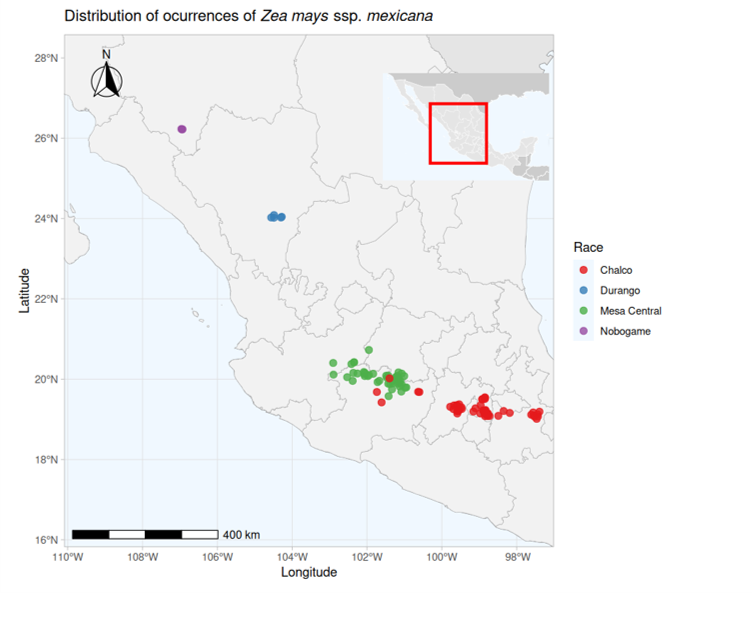
Zea mays ssp. mexicana is an endemic species to the central part of Mexico (Figure 1). Even though it is very important for breeding programs of maize, it is reported that populations have been very severely declining since last century because of land use change in Mexico. It is even reported that entire local populations have been lost due to deweeding campings and the use of herbicides (Wilkes 1997).
Even though teosinte populations are shrinking and the fragmentation between populations is increasing, the subspecies is not part of any risk category of the IUCN Red List nor the Mexican classification of endangered species. For the conservation of teosinte information about the loss of genetic diversity is essential, to assess the degree of the endangerment of the populations and correctly determine the state of modern populations in comparison. For this, herbarium specimens give very valuable information, as they harbour the “original” genetic diversity conditions of teosinte prior to modern perturbations. This would let us evaluate how much of the genetic diversity and local adaptations might have been lost without us even realising.
Figure 1: Distribution of occurrences of Zea mays ssp. mexicana through all his distribution according to the National Commission of Biodiversity (CONABIO by its Spanish acronym)
This project does not offer a CASE studentship
Each host has a slightly different application process.
Find out how to apply for this studentship.
All applications must include the CENTA application form.
Choose your application route
A strategy of sequencing the whole genome of herbarium specimens of teosinte that are prior to 1960s will be used (prior to the Green Revolution), this material can be supplied by the herbarium of Royal Botanic Gardens, Kew, as well as other herbariums if needed.
A reference panel will be made from published Z. mays ssp. mexicana genomes and, if there is lack of representation of a population, that population will be sequenced using material from germplasm collection.
Genetic structure will be compared between historical samples and reference panel (modern samples) to determine if the historical samples correspond to the current populations or they represent populations that are now extinct.
Selection analysis of historical samples will search for putative selection traits that were lost in the last century. Finally, deleterious mutations (genetic load) will be surveyed in historical samples and in the current samples to determine if the modern samples are going through processes of inbreeding due to population reduction.
DRs will be awarded CENTA Training Credits (CTCs) for participation in CENTA-provided and ‘free choice’ external training. One CTC can be earned per 3 hours training, and DRs must accrue 100 CTCs across the three and a half years of their PhD.
Candidates will be trained in ancient DNA techniques, including sampling handling and DNA extraction in Warwick’s ancient DNA facility. Candidates will also be trained in Next Generation Sequencing and analysis, as well as the specific analyses associated with archaeogenomics that deals with the DNA base changes that occur in specimens over time. The project will involve handling genome datasets and associated software to study population structure, selection and genomic deterioration. Training will also include coding to form bespoke computational analyses.
Royal Botanic Gardens, Kew is a longstanding external partner within CENTA, co-supervising 11 current and recent CENTA PhD students. Doctoral students aligned with Kew have research access to the organisation’s extensive collections and facilities, including the herbarium, fungarium and living collections. They also join Kew’s community of more than 140 PhD researchers, with opportunities to engage with the wider public programmes, advocacy and education work at Kew. Kew runs an annual PhD symposium, as well as offering regular opportunities to participate in student competitions, talks and other research activities.
Year 1: Ancient DNA extraction of herbarium specimen and generation of genome datasets (number of genomes dependent on DNA recovery levels and consequent sequence effort required). Construction of reference genome panel. Associated training.
Year 2: Comparative genomics phase, structure analysis, GERP based analyses and selection signature analyses. Resequencing as necessary dependent on results.
Year 3: Final analyses, preparation of publications, presentation at conference, thesis write up.
Erenstein O, Jaleta M, Sonder K, et al (2022) Global maize production, consumption and trade: trends and R&D implications. Food Secur 14:1295–1319. https://doi.org/10.1007/s12571-022-01288-7
Wilkes HG (1997) Teosinte in Mexico: Personal Restrospective and Assesment. In: Gene Flow Among Maize Landraces, Improved Maize, and teosinte: Implications for transgenic maize, 1st edn. Centro Internacional de Mejoramiento de Maíz y Trigo, México, pp 10–17
Yang N, Wang Y, Liu X, et al (2023) Two teosintes made modern maize. Science 382:eadg8940. https://doi.org/10.1126/science.adg8940
For any enquiries related to this project please contact Professor Robin Allaby ([email protected]).
To apply to this project:
Applications must be submitted by 23:59 GMT on Wednesday 6th January 2027.