

Confronting the UK Freshwater-Quality Crisis
The UK’s rivers, lakes, wetlands, and ponds face mounting pressure from sewage discharges, agricultural runoff, urbanisation, industrial contaminants, habitat degradation, and ageing infrastructure. In England, only 14.3% of surface waters achieved good ecological status in the latest Environment Agency classification, while all assessed surface waters failed chemical-status requirements, largely because of persistent pollutants [1]. These pressures threaten biodiversity, water security, recreation, and local economies. Yet conventional monitoring is spatially and temporally incomplete, particularly for small streams and less-studied water bodies, meaning deterioration is often detected only after ecological damage has occurred.
Climate change will intensify both chronic and episodic water-quality risks. UK projections indicate substantial reductions in low flows and possible increases in high flows across much of Great Britain [2]. Hotter summers, heatwaves, and droughts will warm waters, reduce dissolved oxygen, favour harmful algal blooms, and concentrate pollutants as dilution declines. Conversely, heavier rainfall and flooding can mobilise nutrients, sediments, pathogens, plastics, and other contaminants from agricultural and urban landscapes. Across 965 published case studies, water quality deteriorated in 68% of drought and heatwave cases and 51% of rainstorm and flood cases [3]. Management based on historical averages is therefore increasingly inadequate.
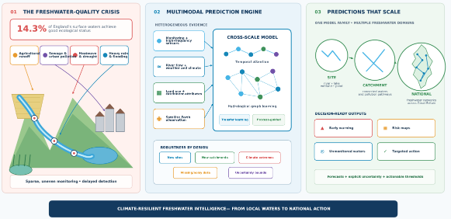
This project will develop robust, transferable machine-learning models that scale from small rivers and individual water bodies to catchments and national freshwater networks. It will integrate routine monitoring, high-frequency sensors, hydrometeorological records, land use, catchment attributes, and Earth observation. Spatiotemporal, graph-based, and multimodal architectures will represent connections among monitoring sites, river reaches, catchments, lakes, wetlands, and ponds. Transfer learning and domain generalisation will enable data-rich locations to improve predictions in sparsely monitored and ungauged systems. Process-guided learning will embed hydrological and ecological knowledge, while ensemble, Bayesian, and conformal methods will quantify uncertainty. Deep learning is especially promising for integrating heterogeneous data, filling spatial and temporal gaps, and identifying influential water-quality drivers [4].
A Step-Change in Freshwater Management: Rigorous leave-location-out, leave-catchment-out, regional, and cross-domain validation will test reliability under extreme events, missing observations, sensor errors, and environmental non-stationarity. The resulting forecasts will support early warning, monitoring-network design, pollution-risk assessment, and targeted intervention, transforming fragmented observations into timely, uncertainty-aware intelligence for UK freshwater protection.
Figure 1: From Stream to Nation: integrating fragmented environmental observations with robust and transferable machine learning to predict water quality across freshwater domains and spatial scales, from individual water bodies to catchments and national networks.
This project does not offer a CASE studentship
Each host has a slightly different application process.
Find out how to apply for this studentship.
All applications must include the CENTA application form.
Choose your application route
This interdisciplinary project will create a harmonised, multiscale freshwater dataset by integrating Environment Agency water-quality observations and high-frequency sensor records with National River Flow Archive hydrology, Met Office weather and climate data, UKCEH catchment and land-cover attributes, and Sentinel/Landsat Earth observation. Target variables will include dissolved oxygen, temperature, turbidity, nutrients, chlorophyll-a and ecological status, spanning individual sites, connected river networks, catchments and national systems.
We will benchmark methods, including gradient-boosted trees and Gaussian processes, before developing state-of-the-art multimodal architectures. Temporal transformers will capture long-range dynamics; graph neural networks will represent hydrological connectivity; and cross-attention models will fuse monitoring, meteorological, spatial and satellite information. Transfer learning, self-supervised pre-training and domain generalisation will extend predictions to poorly monitored and ungauged waters, while process-guided constraints will preserve hydrological and biogeochemical realism. Rigorous spatial, temporal, leave-catchment-out and extreme-event testing, combined with Bayesian ensembles and conformal prediction, will deliver robust forecasts and decision-ready uncertainty estimates.
DRs will be awarded CENTA Training Credits (CTCs) for participation in CENTA-provided and ‘free choice’ external training. One CTC can be earned per 3 hours training, and DRs must accrue 100 CTCs across the three and a half years of their PhD.
This PhD provides specialist training in freshwater water-quality processes and predictive environmental modelling. The researcher will learn how hydrology, nutrient cycling, oxygen dynamics, algal growth, sediment transport, land use, and climate extremes control water quality across rivers, lakes, wetlands, and ponds. Technical training will cover data harmonisation, feature engineering, time-series forecasting, spatial validation, and development of temporal transformers, graph neural networks, multimodal architectures, transfer-learning models, and process-guided machine learning. The candidate will also master benchmark selection, hyperparameter optimisation, explainability, uncertainty quantification, and robustness testing. Engagement with environmental stakeholders will build practical understanding of monitoring, regulation, catchment management, and decision-ready forecasting.
This PhD project benefits from international collaboration between leading research group at the School of Engineering, University of Warwick and industry, with co-supervision from the Rivers Trust, AECOM, and the Swedish Environment Institute. The project will receive further financial support from an existing Leverhulme Trust-funded project led by Professor Abolfathi. The student will have the opportunity of working closely with the research end-user and long-term industrial collaborators from the water and utility sector. We envisage that the project will attract interest from industrial players with opportunities for short internships in water quality modelling, communication and public understanding of science, and plastic pollution risk management.
Year 1 Freshwater Systems, Data Integration & Predictive Foundations: Foundational training in freshwater hydrology, water-quality processes, environmental data science, and advanced machine learning. The candidate will critically review existing predictive approaches and harmonise national monitoring, sensor, river-flow, meteorological, Earth-observation, land-use, and catchment datasets. Exploratory analysis will identify spatial and temporal dependencies, monitoring gaps, extreme events, and cross-domain differences. Robust benchmark models will be developed to predict key water-quality indicators at local and catchment scales, establishing reproducible validation protocols and baseline performance.
Year 2 Multiscale Machine Learning & Cross-Domain Generalisation: Development of state-of-the-art temporal transformers, graph neural networks, and multimodal architectures to represent long-term dynamics, hydrological connectivity, and interactions among monitoring, climate, catchment, and satellite data. Transfer learning, self-supervised pre-training, and domain-generalisation methods will extend predictions from data-rich locations to poorly monitored rivers, lakes, wetlands, and ponds. Process-guided constraints will embed hydrological and biogeochemical knowledge. Models will be rigorously evaluated through spatial, temporal, leave-catchment-out, and cross-domain testing.
Year 3 Robust National Prediction, Decision Support & Synthesis: Models will be scaled to regional and national freshwater networks and stress-tested under climate extremes, environmental non-stationarity, missing observations, and sensor errors. Ensemble, Bayesian, and conformal methods will quantify uncertainty, while explainability analysis will identify the dominant drivers of water-quality change. Collaboration with environmental stakeholders will guide the development of early-warning outputs, risk maps, and monitoring recommendations. The project will culminate in integrated model evaluation, peer-reviewed publications, open and reproducible research outputs, stakeholder dissemination, and completion of the doctoral thesis.
References
[1] Environment Agency (2026). New data to drive action to improve England’s rivers and lakes.
[2] Lane, R. A. and Kay, A. L. (2021). “Climate Change Impact on the Magnitude and Timing of Hydrological Extremes Across Great Britain.” Frontiers in Water, 3, 684982. https://doi.org/10.3389/frwa.2021.684982
[3] van Vliet, M. T. H. et al. (2023). “Global river water quality under climate change and hydroclimatic extremes.” Nature Reviews Earth & Environment, 4, 687–702. https://doi.org/10.1038/s43017-023-00472-3
[4] Zhi, W. et al. (2024). “Deep learning for water quality.” Nature Water, 2, 228–241. https://doi.org/10.1038/s44221-024-00202-z
For more information about the project you can contact Professor Soroush Abolfathi at: https://warwick.ac.uk/fac/sci/eng/people/soroush_abolfathi/
To apply to this project:
Applications must be submitted by 23:59 GMT on Wednesday 6th January 2027.