

Pioneering Nanoplastic Fate and Transport in Aquatic Ecosystems.
Nanoplastics are the defining invisible pollutant of our era: with global plastic production now exceeding 400 million tonnes annually, the sub-micron fragments that evade all current regulatory monitoring frameworks are accumulating undetected in freshwater systems upon which human health, biodiversity, and ecosystem function critically depend. Despite being recognised by the WHO and the EU as an urgent emerging contaminant, no validated mechanistic framework yet exists to predict their transport, fate, or long-term ecological impact in freshwater environments, a critical scientific and regulatory blind spot that this project is uniquely positioned to close. This project targets the critical 20 nm – 5 µm diameter range. The reason is twofold: microplastics fragment, and many products (polymer liquid formulations) contain polymer latex particles (such as paints, adhesives, and water-based inks). Evading standard brightfield microscopy, these ubiquitous nanoparticles silently infiltrate aquatic ecosystems and cellular food chains.
Precision Fabrication of Model Colloids. To study these polymer nanoparticles rigorously, we are synthesising a bespoke library of model polymer colloids. Leveraging advanced techniques such as (mini-)emulsion polymerisation and catastrophic phase-inversion emulsification, we engineer artificial latexes with unprecedented control over: 1) Particle size, morphology, and molecular weight; 2) Chemical composition and colloidal stability; 3) Environmental persistence, deliberately contrasting highly recalcitrant particles with innovative, hydrolytically degradable alternatives. The latter, for example, could yield benefits in paper recycling (avoiding the “stickies” problem in recycled paper pulp).
Unravelling Complex Physical Mechanisms. Beyond precision synthesis, we will decode the fundamental physics that governs these nanoparticles in the wild. We are mapping intricate motility behaviours—including hydrodynamic flow and diffusion—alongside accumulation phenomena such as adhesion, colloidal crowding, coagulation, and film formation. By simulating dynamic environments ranging from stagnant wetlands to turbulent river flows, we capture the full physicochemical life cycle of these particles. We are also interested in brackish, non-equilibrium conditions and how mixing salt and fresh water affects particle fate.
A Step-Change in Environmental Protection. Current environmental policy for plastic pollution is built almost entirely on microplastic data, particles visible to standard instrumentation, regulated by frameworks that were never designed to capture the nanoscale. This project changes that by bridging the crucial gap between fundamental physical chemistry and macroscopic environmental modelling. By precisely quantifying where nanoplastics reside and how they are transported, we will deliver a transformative leap in integrated catchment management and global ecological protection.
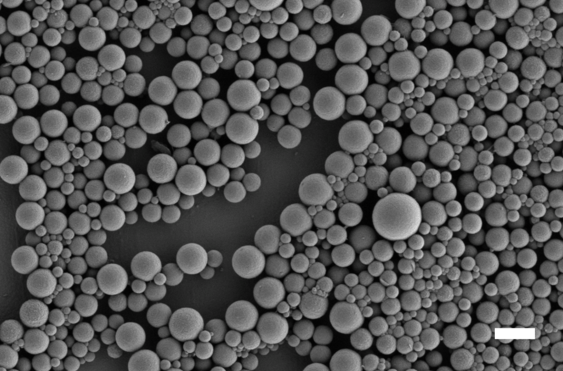
Figure 1: SEM Image of a typical synthetic polymer latex with a broad particle size distribution. Scale bar is 250 nm
This project does not offer a CASE studentship
Each host has a slightly different application process.
Find out how to apply for this studentship.
All applications must include the CENTA application form.
Choose your application route
This interdisciplinary initiative pioneers environmental methodologies at the intersection of colloid science and environmental fluid dynamics.
We will engineer bespoke nanoplastic models by combining (mini-)emulsion and polycondensation methods, achieving unprecedented synthetic control over molar mass, complex architectures, and long-term colloidal stability.
To capture these elusive particles across aqueous and terrestrial matrices, we will deploy a rigorous analytical suite, dynamically coupling high-resolution optical tracking (darkfield, fluorescence, Raman) with trace elemental profiling (XRF, ICP-MS).
Crucially, this empirical data will drive next-generation predictive modelling. Leveraging OpenFOAM, we will develop custom computational fluid dynamics (CFD) algorithms and integrate them into multiphase flow frameworks to simulate pollutant transport across diverse hydrological conditions. Laboratory-derived transport parameters feed directly into a hybrid CFD/Physics-Informed Neural Network (PINN) architecture. By embedding governing physical laws into the neural network training process, the model extracts robust predictions from sparse observational data without sacrificing physical consistency. Bayesian uncertainty quantification then delivers catchment-scale probabilistic risk maps, constituting the first AI-augmented predictive framework for nanoplastic fate in freshwater systems, directly actionable by environmental regulators.
Finally, particle degradation kinetics will be rigorously mapped using advanced ODEs and Monte Carlo frameworks, delivering a transformative leap in understanding nanoscale environmental fate.
DRs will be awarded CENTA Training Credits (CTCs) for participation in CENTA-provided and ‘free choice’ external training. One CTC can be earned per 3 hours training, and DRs must accrue 100 CTCs across the three and a half years of their PhD.
This exceptional opportunity provides rigorous, hands-on training in bespoke polymer nanoparticle synthesis, advanced characterization, and complex colloidal hydrodynamics. The researcher will master cutting-edge metrology, specifically Particle-Image-Velocimetry (PIV) and Laser-Induced-Fluorescence (LIF), alongside sophisticated numerical frameworks for fluid dynamics analysis and development of predictive models.
Beyond the laboratory, our industrial partners will immerse the candidate in real-world applications, offering applied training in catchment planning, pollution risk management, and impactful scientific communication. By collaborating directly with our specialized wetland design team, the successful candidate will seamlessly bridge fundamental physical chemistry with applied environmental engineering to drive tangible ecological impact.
Severn Trent will support the project through participation in project meetings, provision of feedback on project outputs, and sharing of relevant knowledge and experience where appropriate. Severn Trent will help ensure that project findings are communicated in a way that is understandable, practical and relevant to organisations involved in freshwater environmental management and regulation. Based on this anticipated involvement, our in-kind contribution to this project is estimated at £5,000.
CRODA to be finalized.
This PhD project benefits from supervision by two internationally leading research groups at the University of Warwick: BonLab at the Department of Chemistry, and the Centre for Predictive Modelling at the School of Engineering (S Abolfathi). They are recognised for their research into polymer colloids, the plastic waste impacts on the environment and environmental chemistry. The project is supported Severn Trent, the Leverhulme Trust, and current industrial collaborators from the two teams. The student will have the opportunity to work closely with the research end-user and long-term industrial collaborators such as Covestro and Domino Printing Sciences, as well as our industrial consortia, the Sustainable Engineering Plastics Hub (UKRI) and the Polymer Club (Warwick). We envisage that the project will attract interest from industrial players, with opportunities for short internships in plastic recycling technologies and challenges, communication and public understanding of science and plastic pollution risk management.
Year 1: Methodological Innovation & Synthesis Foundational training in advanced colloidal characterization and heterogeneous polymerization frameworks. The candidate will conduct a critical literature synthesis to establish, optimize, and validate robust methodologies for the precise fabrication of bespoke model polymer dispersions.
Year 2: Hydrodynamic Metrology & Spatiotemporal Tracking Execution of comprehensive, high-resolution hydrodynamic and fluorometric empirical studies to quantify solute and micro/nanoplastic transport. This phase systematically isolates the mechanistic impacts of particle density, morphology, and size on environmental fate across diverse simulated aquatic domains, including complex fluvial and lentic systems (rivers, ponds, wetlands).
Year 3: Predictive Modeling & Computational Integration Advanced processing of empirical datasets utilizing rigorous statistical methodologies for precise parameter estimation. The candidate will develop and validate robust predictive models for pollutant transport under varied environmental flow regimes, seamlessly embedding these algorithms into existing numerical codes. The program culminates in the synthesis and final write-up of the doctoral thesis.
Journal:
Rillig, M.C. (2012) ‘Microplastic in terrestrial ecosystems and the soil?’, Environmental Science and Technology 46, 6453-6454.
Ballent, A., Pando, S., Purser, A., Juliano, M.F. and Thomsen, L. (2013) ‘Modelled transport of benthic marine microplastic pollution in the Nazaré Canyon’, Biogeosciences 10(12), 7957-7970.
Besseling, E., Quik, J.T.K., Sun, M. and Koelmans, A.A. (2017) ‘Fate of nano- and microplastic in freshwater systems: A modeling study’, Environmental Pollution 220, 540-548.
Guo, M., Bon, S. A., & Abolfathi, S. (2025). Transport dynamics of microplastics within aquatic vegetation featuring realistic plant morphology. Water research, 282, 123534.
Web page:
https://www.waterboards.ca.gov/drinking_water/certlic/drinkingwater/docs/2022/mp-hndbk.pdf
(accessed 15 Sep 2026)
For any enquiries related to this project please contact Prof. dr. ir. Stefan A. F. Bon: https://bonlab.info
To apply to this project:
Applications must be submitted by 23:59 GMT on Wednesday 6th January 2027.