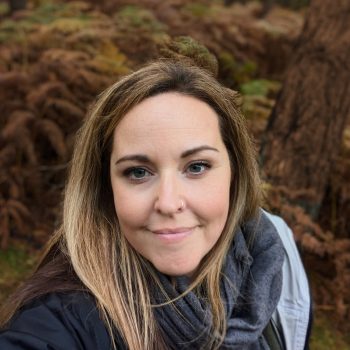
A photo of the head and shoulders of a woman in an outdoor environment.

Anni Lloyd-Langford

My PhD research investigates water-rock interactions in impact craters and their potential to support life. Using the well-preserved, ~215-million-year-old Manicouagan impact structure in Canada, I will study post-impact hydrothermal circulation, mineral alteration and the development of potentially habitable environments. These findings will help refine models of hydrothermal habitability and explore whether impact craters on early Earth (>4Ga) and other planetary bodies could have provided environments conducive to the emergence and persistence of microbial life.

Prior to starting my PhD, I completed my MSci in Geology at Cardiff University, where my Master’s thesis focussed on the melt sheet geochemistry and meteoritic signatures and clasts of the Morokweng impact structure in South Africa. This research sparked my interest in impact craters and planetary processes, ultimately motivating me to pursue further research into planetary geology and its implications for habitability.

I find it incredibly exciting to contribute to research at the forefront of scientific discovery, exploring new ideas and following my curiosity. I particularly enjoy the autonomy that research offers, allowing me to explore different avenues and develop my project in directions that reflect my interests. I enjoy the concept of no two days being the same and embrace the challenges opportunities for learning that scientific discovery brings.

While PhD’s are inherently academically oriented, CENTA provide opportunities, training and experiences to develop my wider skillset and provide a bigger lens into career paths beyond my doctorate. I am particularly excited by the opportunity to network my wider CENTA cohort across different universities bringing together different disciplines, experiences and perspectives from universities across the UK.

Through CENTA, I hope to develop a diverse skillset, both academically through my research and professionally through its wider training opportunities. I believe that an interdisciplinary approach and a broad range of transferable skills are increasingly valuable in modern research, and CENTA offers an excellent opportunity to develop these throughout my doctorate. Looking ahead, I hope to pursue a career in planetary science research, contributing to our understanding of planetary evolution and the potential habitability of past environments.


Other Student Profiles

Skip to content