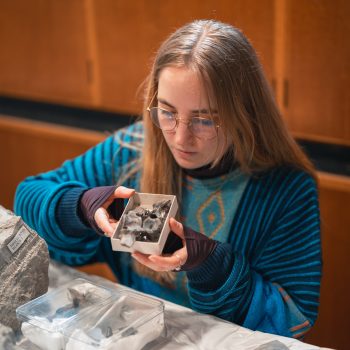
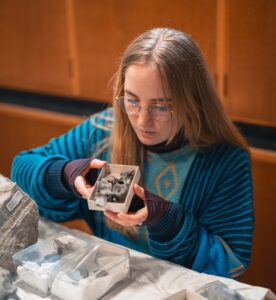
Photo of a seated woman examining a fossil specimen in a box.

Emily Driscoll

Pterosaurs, the flying reptiles of the Mesozoic, are particularly interesting because they were the first of only three vertebrate groups to achieve powered flight. This lineage includes some of the largest ever volant vertebrates, with the largest species outweighing the largest extant flying birds 34 times over, and challenges our fundamental understanding of the limits and constraints of flight. Since we are restricted to the limited evidence remaining in the fossil record, understanding the locomotion of these creatures requires innovative approaches across biology, geology, chemistry, engineering, and physics.  

Studies of pterosaur flight traditionally focus on the forelimb, comprising the main supportive strut of the flight surface with the elongated fourth manual digit. However, exceptionally preserved fossils discovered over recent decades have revealed without doubt the integration of the hindlimbs in the flight surface. Despite this, the hindlimbs of pterosaurs have received comparatively little attention. My project aims to fill this gap by determining how pterosaurs used their hindlimbs in flight. I will focus on using new digital techniques such as morphometric analysis, range of motion studies, and/or biomechanical modelling to reconstruct how these ancient reptiles once ruled the skies. 

I began my academic journey as an undergraduate student at the University of Exeter (Falmouth campus) studying zoology. This degree nurtured my curiosity about the natural world, and gave me foundational training in anatomy, ecology, conservation, as well as statistical, laboratory and field experience. My time in Falmouth culminated in an undergraduate dissertation examining meteorological driver of butterfly migration and the influence of topography on orientation. 

Following my undergraduate degree, I sought to follow my passion for extinct life by bridging the gap between biology and geology through studies of palaeobiology. The MSc Palaeobiology course at the University of Bristol provided the ideal opportunity for this. During this time, I learnt cutting-edge techniques for investigating extinct biodiversity, and completed a 9-month research project that sought to determine which hypothesised functions may have led to the evolution of iguanodontian thumb spikes. 

Alongside these degrees, I contributed to several additional projects including studies on the effect of microplastic on plankton, polychaete worm taphonomy, and using BRUVs to document marine wildlife around Monserrat. 
I have always been passionate about the natural world, and my previous studies at university further deepened that curiosity. Particularly, undertaking longer-term research projects such as my undergraduate thesis on butterfly migration, postgraduate thesis on iguanodontian thumbs, and numerous side projects, sparked a lasting enthusiasm for independent research. I aim to advance the field of palaeobiology by applying the novel interdisciplinary and digital techniques, which have recently become accessible to the field, to other unresolved mysteries such as my current project on pterosaur hindlimbs.  

The CENTA studentship appealed to me because it fosters a cohort of scientists and offers numerous opportunities to further my skills outside of my own niche and institution. I particularly value the opportunity to learn new skills such as Python coding or GIS which support the interdisciplinary nature of my research and enhance transferrable skills. What makes CENTA unique is its commitment to shape well-rounded students who graduate from their PhD not just with a thesis, but also with skills and experiences developed along the way.  

Presently, I am eager to continue my research in functional morphology throughout my future career. My doctoral degree with CENTA would be instrumental in achieving this goal, equipping me with the skills, knowledge, and experience needed to advance the field palaeobiology and contribute to its future development 

Other Student Profiles

Skip to content