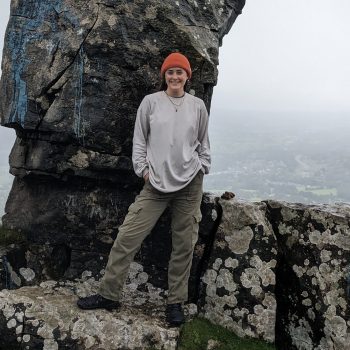
Photograph of the head and shoulders of a woman standing in front of a snowy and forested mountainous background.

Enolà Le Basle

Global biodiversity is declining at an alarming rate, with insects being particularly affected. The Kentish Glory moth, Endromis versicolora, is a striking example of this crisisOnce widespread in England and Wales, the species became locally extinct in the 1970s and now persists only in fragmented populations in the Scottish Highlands, continental Europe and western Asia.  

Using a whole-genome approach, I will analyse DNA from contemporary samples and museum specimens to compare genetic variation across time and space, population structure and explore relationships with extinct English, Welsh and Continental European populations.  

The outcomes will guide ongoing conservation efforts, including potential reintroduction to England, and contribute to a broader understanding of insect conservation genomics.  

Before my PhD, I completed a two-year Master’s in biology at the University of Geneva in Switzerland, specialising in Biodiversity and Systematics. As part of the national “DecliNe” project, I investigated the temporal dynamics of three butterfly species (Polyommatus icarus, Pieris napi, Vanessa atalanta) in Switzerland since the early 20th century.  

Using HyRAD and ddRAD methods on both museum specimens (663 historical samples) and contemporary individuals (360 fresh samples), I compared population genetic parameters across multiple space and time points, establishing population dynamics using estimates such as genetic diversity, effective population size and inbreeding along the last century and throughout Switzerland. This project provided a retrospective view on human impacts on butterfly populations over decades, offering valuable insights for future environmental management strategies.  

After my Master’s, it became clear to me that I wanted to continue working in research, particularly in population genomics and insect conservation, where significant knowledge gaps remain. Pursuing a PhD was the natural next step, allowing me to deepen my scientific skills and research abilities. This project was particularly ideal for me, combining approaches I was not familiar with, collaborations across remarkable environmental institutions and allowing me to work on a topic I’m passionate about. 

I was initially drawn to this specific PhD project, and through it, I discovered CENTA. The interdisciplinary research environment and networking opportunities offered by CENTA motivated me, as I believe they would help me grow both as a researcher and as a person. I was also particularly interest in the training opportunities, which I believe provide an excellent framework to support my growth and my project, while maximizing the impact of my work.   

After my PhD, I plan to remain in research and focus on population genomics and the conservation of insect species. I believe this PhD will not only allow me to work on a passionate subject and move closer to one of my life goals (contributing to the reintroduction of a specie), but also strengthen my scientific skills and ability to produce meaningful research.  

Contact information

LinkedIn: https://www.linkedin.com/in/enolà-le-basle-299a7a303/

Other Student Profiles

Skip to content