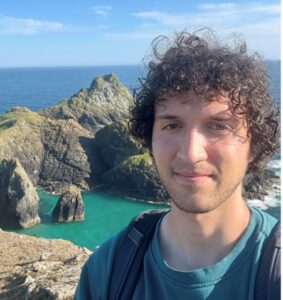
Photo of the head and shoulders of a man standing in front of a rocky coast.

Martin Zilli

Island syndromes comprise a suite of recurrent evolutionary adaptations that have evolved in insular populations in response to the distinctive ecological conditions of islands. Although past research on island syndromes has focused predominantly on vertebrates, arthropods often possess shorter generation times and higher reproductive rates, allowing pronounced evolutionary responses. This project aims to synthesise current knowledge of arthropod adaptations to island environments and identify key gaps where further research is needed. Subsequently, the aim is to produce rigorous scientific studies investigating potential island syndromes in insect species that have not previously been examined from this perspective. 

I have completed a bachelor’s degree in Zoology at Royal Holloway, University of London, and subsequently a Master of Science by Research at the same institution that focused in comparing insect compositions in urban burial grounds with differing practices. I have extensive experience in rearing Coleoptera and Phasmatodea, mounting entomological specimens, and possess good taxonomical knowledge of ground beetles (Carabidae). In the year prior to joining the CENTA program at Birmingham University I have volunteered in the London NHM beetle collections, where I gained a deep understanding of rigorous museal conservation practices. I have always enjoyed producing invertebrate anatomical diagrams – natural history illustration has been a lifelong passion. I also enjoy fossil and mineral collecting, and malacology has always fascinated me.  

My passion for entomology culminated during my MSc by Research, where independently designing research projects (and sampling methodologies) and conducting extensive fieldwork fostered a profound sense of motivation and fulfilment in pursuing a deeper understanding of the natural world and its ongoing changes.  

A PhD represents the natural progression of this journey, offering the opportunity to undertake long term research with greater scientific independence while providing the essential training and experience to develop a career in academia. 

Over the years I have developed a wide range of interests revolving around the natural world, independently from what was taught during my university studies (for example entomology, which was superficially touched in my undergraduate path). The interdisciplinary nature of the CENTA programmprovides an incredible opportunity to formalise and interlink those interests, carry research in the areas I am most passionate about, regardless of how niche they may be. Beyond allocating the funding necessary to undertake impactful research, the opportunity to select, in consultation with supervisors, the courses, workshops, and connect with experts whose field is most relevant to the research projectprovide an invaluable framework for academic and personal growth. 
I am incredibly passionate about field work revolving around entomologyand museum curation including taxonomy, and although I am still not certain about what I would like to do once this programme is over, it will certainly gift me with a far better understanding of some roles relevant with my interest. CENTA’s training for academic practice and integrity is essential in pursuing scientific positions, and open doors for jobs in academia. 

Other Student Profiles

Skip to content