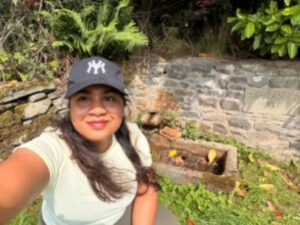
Photo of a crouching woman with a wall and plants in the background.

Wewerly Fernandes

My PhD investigates the microbial ecology of chemically unique British springs and wells. The project explores how water chemistry and geochemistry shape microbial diversity and community structure in historically significant and mineral-rich aquatic environments. I will combine field sampling, physicochemical measurements, culture-dependent microbiology, DNA extraction, 16S rRNA gene sequencing and bioinformatic analysis to characterise microbial communities across different sites. The project also considers the presence of environmental antimicrobial resistance (AMR)-associated genes and the potential biotechnological significance of microorganisms adapted to iron-rich, sulphurous, acidic, alkaline or mineral-rich waters. 
Before starting my PhD, I worked as a Research Technician in Microbiology and Planetary Protection at The Open University, supporting projects in astrobiology, cleanroom microbiology, microbial survival and environmental microbiology. I also worked as a Senior Science Technician in a secondary school, where I managed laboratory preparation, supported practical science teaching and supervised technical staff. My academic background includes a BSc in Biotechnology and an MSc in Forensic Science from the University of Strathclyde. 

I decided to undertake doctoral research because I wanted to develop my own scientific questions and contribute new knowledge in environmental microbiology. My work as a research technician strengthened my interest in microbial life in unusual environments, particularly how microorganisms survive, adapt and interact with their surroundings. This PhD allows me to combine fieldwork, microbiology, water chemistry and sequencing to investigate hidden microbial ecosystems in British springs and wells. 

I was interested in a CENTA studentship because of its interdisciplinary focus and strong training environment. My project sits at the intersection of microbiology, geochemistry, hydrogeology and environmental science, and CENTA provides an excellent framework for developing these skills. The opportunity to be part of a wider doctoral training partnership, collaborate across disciplines and receive specialist training was a major motivation for applying. 

Studying here will help me build expertise in environmental microbiology, molecular ecology, field sampling, data analysis and scientific communication. I hope to develop as an independent researcher with strong technical and analytical skills. In the future, I would like to continue working in environmental microbiology, microbial ecology or astrobiology-related research, with a focus on understanding microbial life in unusual or understudied environments. I am also interested in science communication and sharing research with wider audiences. 

Other Student Profiles

Skip to content