Mateus Macul
- University of Leicester
- Private Landholding Size–Frequency Distribution and Forest Dynamics Across the Brazilian Amazon
- Professor Kevin Tansey, Professor Heiko Balzter
Tackling deforestation and degradation in rainforest ecosystems is essential to mitigate carbon emissions from land cover changes in developing countries. This is also important to demean impact on global warming, contribute to conserve biodiversity and avoid extreme events to occur. For that purpose, my current PhD project funded by CENTA at the University of Leicester is utilises modelling and satellite data to investigate how the spatial distribution of private landholdings influences land-use change, forest carbon dynamics, and wildfire occurrence across the Brazilian Amazon. By linking land ownership structure to forest cover changes across space and time, carbon dynamics, and fire risk, the research provides a novel framework for understanding how the spatial organisation of private lands contributes to environmental change in the Amazon and how that information can be incorporated into future assessments of deforestation, climate adaptation, and forest conservation.
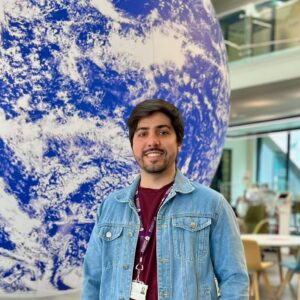
Before starting my PhD, I was working as an associate researcher in the Brazil Data Cube project at the Brazilian National Institute for Space Research (INPE). It was also at INPE that I previously worked at the Wildfire Monitoring Team (Queimadas Program) and did my master’s degree in Remote Sensing. In the Queimadas Program, I worked on a project in collaboration with the University of Leicester analysing the sizes and frequencies of forest fires in Amazonia. In my master’s dissertation, I used statistical modelling to study the land market and deforestation in an agricultural frontier in the Amazon. The beginning of my scientific trajectory was at the University of São Paulo, where I graduated in Forest Engineering. During this period, I worked with spatial and quantitative analysis at the Brazilian Agricultural Research Corporation (EMBRAPA) and won a scholarship from the Science Without Borders Programme for a year of international exchange studying Environmental Science at Bangor University (United Kingdom), which was my first time in the UK.
I am passionate about research, specifically remote sensing, and I want to pursue this career. I became sure of this during my master’s degree and for having worked for nearly 4 years applying scientific research at INPE. I am deeply concerned about the environmental issues we are facing and will face in the future, so I believe that science is the best way to find solutions and impact society regarding the environmental sustainability. Looking forward, undertaking a PhD is a fundamental step towards my professional goals.
I see CENTA as a singular initiative that brings together high-quality faculty from high-standard UK institutions to work with PhD students and provide them trainings on multiple environmental topics. Furthermore, the University of Leicester was crucial for me to become interested in the CENTA studentship, as the university offers a solid structure for researchers to carry out their work, such as Space Park Leicester, a new centre for research institutions and companies related to space activities. Moreover, CENTA actively connects participants, which is great for networking and having a PhD period surrounded by colleagues.
My plans involve continuing to work with Earth observation science in a manner that I could use it to help mitigate the impact of human development on tropical ecosystems. I chose research because I have the ambition to contribute finding evidence that can subsidise appropriate public policies and strategies to reduce forest disturbance and carbon emission. So, I believe that CENTA will not only prepare me to conduct high-quality research due to the trainings, but also CENTA’s placement support will help me gain more experience and prepare me for a high-impact position.